


India EV Market 2026: Sales, Charging and Jobs in Numbers
The India EV market 2026 has moved from early adoption into real scale. Registrations are close to doubling year on year, electric two-wheelers carry most of the volume, and new models are arriving almost every month. At the same time, charging infrastructure is struggling to keep pace, and that gap shapes both the risks and the career opportunities in the sector.
This guide brings together the latest numbers on the India EV market 2026 as of October 1, 2026. It covers sales, vehicle segments, charging and jobs, and explains what the data means for engineers, technicians, students and entrepreneurs planning their next move.
India EV Market 2026
India EV Market 2026: The Big Picture
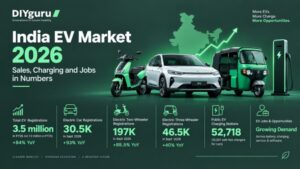
The headline figure for the India EV market 2026 is hard to ignore. According to SIAM data reported by Business Today, total EV registrations in India reached 3.5 million units in FY26, compared with 1.9 million in FY25. That is an increase of roughly 84% in a single year.
The momentum has carried into 2026. EVreporter’s analysis shows India registered 18,95,803 EVs in the first seven months of calendar 2026. The peak so far came in June, when, according to Business Standard, retail sales hit a record 3,06,220 units, up 63% on the same month last year. That pushed overall EV penetration above 12% for the first time.
In other words, the India EV market 2026 is no longer a niche. In some months, more than one in ten new vehicles sold in India is electric. For a country that sells millions of two-wheelers every month, that is a significant shift.
India EV Market 2026: Electric Car Registrations in September
Passenger cars are the most visible part of the India EV market 2026, and September was a strong month. Vahan-based data shows electric-car registrations rose from 18,537 units in September 2025 to 35,866 in September 2026, growth of 93%. That is about 8.5% of the car registrations covered by the data.
| Metric | Figure |
|---|---|
| EV car registrations, Sept 2025 | 18,537 |
| EV car registrations, Sept 2026 | 35,866 (up 93%) |
| EV share of car registrations | about 8.5% |
| Tata Motors EV registrations, Sept 2026 | 14,729 |
Tata remains the clear leader, and its September volume was exactly double what it sold a year earlier. But the India EV market 2026 is now broader than one brand. In August, Tata led with more than 13,000 registrations, while the Mahindra XEV 9S led retail registrations with 3,743 units. Over the first half of the year, the MG Windsor EV led the January–June period with 19,080 units.
International brands are also gaining ground from a small base. Tesla registrations surged 304% in September. More launches are coming this month, including the Volvo EX90 and ES90 electric variants on October 12, and the compact VinFast VF3, expected in October, according to this launch calendar.
Note: September figures are preliminary Vahan data and are usually revised. Another tracker updated on the same day showed about 32,000 electric cars for the month. Treat the exact count as provisional.
India EV Market 2026: Two-Wheelers and Three-Wheelers Lead the Volume
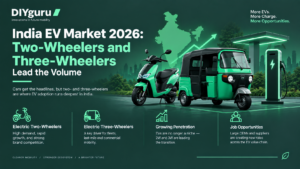
Cars get the headlines, but in the India EV market 2026, two- and three-wheelers are where adoption runs deepest. A Vahan-based tracker puts September electric two-wheeler registrations at about 207K, up 88.5% year on year, and electric three-wheelers at about 86K, up 40%. The e-2W leaders are TVS (53K), Bajaj (48K) and Ather (30K).
Over a longer window, India recorded 11.78 lakh e-2W sales between January and July 2026, a penetration of 8.9% in the segment. Business Standard also reports that the electric two-wheeler market crossed 1 million registrations in a record seven months.
Growth is not even across brands. An early-September two-wheeler tracker showed TVS and Bajaj more than doubling their registrations, while Ola was tracking about 34% lower year on year. Established two-wheeler makers are taking share quickly, with their service networks, financing options and brand trust. For job seekers, this matters: large OEMs and their suppliers are becoming major EV employers.
Three-wheelers deserve attention too. Electric autos and cargo carriers have a strong business case for fleet owners, because daily running costs are low and routes are predictable. Bajaj and Mahindra lead this segment in the tracker data.
Electric Buses and Fleets
Public transport and fleets are scaling as well. EV Update Media reports that electric bus registrations grew 40% in the first half of 2026 to 2,944 units, with Switch Mobility leading the market. On the delivery side, Yulu raised $93 million in a Series C round and is targeting a fleet of 200,000 EVs.
Fleets matter beyond the sales numbers in the India EV market 2026. A fleet operator cares about uptime, so it needs trained service technicians, battery diagnostics and reliable charging. That creates steady demand for skills that are different from those in a passenger-car showroom.
Why the India EV Market 2026 Is Accelerating
Several forces are pushing the India EV market 2026 in the same direction:
- Fuel and energy security. Business Standard reports that the West Asia war is accelerating demand for new electric vehicles. JSW MG Motor India expects new energy vehicles to make up as much as 80% of its sales this year.
- State policy. Delhi logged over 10,000 EV registrations, its highest in 2026, after its new EV policy. Read our explainer on the Delhi EV Policy 2026 and the 2028 two-wheeler mandate.
- More choice at more price points. From low-cost hatchbacks to three-row electric SUVs, buyers have far more options than two years ago.
- Better financing and ownership models. Hyundai Motor India introduced a Battery-as-a-Service option for the CRETA Electric starting at ₹10.99 lakh, which lowers the upfront cost.
How to Read India EV Market 2026 Data Correctly
Before you quote any figure on the India EV market 2026, know what it measures. EV numbers in the news come from different sources, and they are not interchangeable.
- Registrations (Vahan) count vehicles actually registered with transport authorities. They reflect retail demand, not factory dispatches.
- Dispatches or wholesale count vehicles shipped from factories to dealers, and can run ahead of or behind registrations.
- Preliminary vs final. Month-end numbers are often revised as late registrations come in.
- Definitions differ. Some reports count only passenger cars, others include all vehicle types, and some count charging stations while others count charging points.
This is why you will see slightly different September figures from different trackers. When you cite numbers in a report or a college project, always name the source and the date.
EV Charging Stations in India: The Gap to Watch
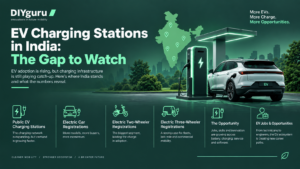
Charging is the most important constraint on the next stage of the India EV market 2026. The government told Parliament that 52,718 public EV charging stations are operational, including 16,561 fast chargers for cars. Other industry sources, such as this state-wise network guide, cite lower counts: 27,737 registered stations, of which about 22,753 were operational as of March 2026. The difference likely comes from how stations and points are counted.
The bigger concern is deployment under the flagship scheme. electrive reports that PM E-DRIVE has a ₹10,900 crore budget for April 2024 to March 2028, and that 6,562 public charging points have been approved, but none had been installed as of 22 July 2026. Of the total budget, ₹2,000 crore is earmarked for public charging, as outlined in the Ministry of Heavy Industries release on PIB. For comparison, its predecessor FAME-II delivered 9,583 public charging stations and supported more than 1.67 million EVs.
Looking ahead, the scale of the need is large. ORF estimates, as summarised here, that India needs about 1.32 million public charging stations to support 30% EV penetration by 2030. Carmakers are filling part of the gap themselves. Hyundai, for example, has crossed access to more than 30,000 charging points through its myHyundai app.
AC vs DC fast charging in brief
AC chargers are slower and suit homes, offices and overnight charging. DC fast chargers deliver power directly to the battery, so they suit highways and quick top-ups, but they need heavier grid connections and more engineering. The 16,561 fast chargers reported by the government are the ones that make long-distance EV travel practical.
If you want to understand the approval side of the problem, try our free EV Charger DISCOM Approval Tool.
Key Challenges Ahead
Strong growth does not remove the risks facing the India EV market 2026. Four issues stand out:
- Charging deployment is lagging approvals, as the PM E-DRIVE figures show.
- Data quality varies, with different sources reporting different charging and registration numbers.
- Competition is intensifying, and some early leaders are losing share to established OEMs.
- Skills are scarce. Companies need engineers and technicians who can work on real hardware from day one, not just theory.
What the India EV Market 2026 Means for EV Jobs
Every new vehicle and every new charger needs people to design, build, install, test and service it. A report cited by Business Standard says India’s EV industry could generate up to 40 million jobs by 2030. That is a high-end projection, and forecasts vary, but the direction is clear.
The areas likely to see the strongest hiring as the India EV market 2026 grows:
- Charging infrastructure. Installation, OCPP software integration and grid approvals.
- Battery and BMS. Pack design, testing, diagnostics and second-life applications.
- Service and repair. Technicians for two- and three-wheelers, where volumes are highest.
- Embedded, ADAS and software. As vehicles become software-defined, controls and AUTOSAR skills command a premium.
- Manufacturing and quality. Production, testing and homologation roles as OEMs scale up.
To see how these roles are paid, use our EV Salary Estimator and download the EV Job Report 2025-26.
Which Path Fits You?
The right entry point into the India EV market 2026 depends on where you start.
ITI and diploma holders. Service and repair is the fastest route, because two- and three-wheeler volumes are the largest. Hands-on training on real vehicles and high-voltage safety are the key skills.
B.Tech students and fresh graduates. Choose a specialisation early: battery and BMS, embedded systems, motor control, or ADAS and software. Employers hire for depth, so project work on real hardware makes a big difference.
Working professionals. If you come from ICE automotive, electronics or IT, you can pivot without starting over. Add EV-specific skills such as power electronics, BMS or charging protocols to what you already know.
Entrepreneurs. Charging, fleet services, battery swapping and service workshops all have room to grow, especially given the gap between approved and installed chargers.
Not sure which fits? The EV Career Path Advisor can help you narrow it down.
Outlook: What to Watch Next
Three things will shape the India EV market 2026 over the next 12 months:
- Monthly Vahan releases will show whether September’s near-doubling is a lasting trend or a festive-season spike.
- PM E-DRIVE charger installations will show whether the charging gap starts to close.
- New launches from Volvo, VinFast, Hyundai, Tesla and others will test how deep demand goes above the mass market.
For readers tracking the sector, our EV Market section covers these developments as they happen.
Key Takeaways
- The India EV market 2026 is growing at record pace, led by two-wheelers and passenger cars.
- EV registrations reached 3.5 million in FY26, up from 1.9 million in FY25.
- Electric car registrations rose 93% year on year in September 2026, to about 8.5% of the car registrations covered.
- Two-wheelers drive volume, with e-2W registrations up about 88%.
- Charging infrastructure is the main bottleneck, and PM E-DRIVE deployment is behind approvals.
- Skills in batteries, charging, service and embedded systems are in strong demand.
Frequently Asked Questions
How big is the India EV market 2026?
About 3.5 million EVs were registered in FY26, and registrations are still rising quickly through 2026.
How many EVs were registered in India in FY26?
About 3.5 million, compared with 1.9 million in FY25, according to SIAM.
Which company sells the most electric cars in India?
Tata Motors leads, with 14,729 registrations in September 2026.
What share of new cars sold in India are electric?
About 8.5% in September 2026, based on preliminary Vahan data.
Which EV segment is growing fastest?
Electric two-wheelers, with registrations up about 88% year on year in September.
How many public EV charging stations does India have?
The government has reported 52,718 operational public stations. Other sources report lower counts, depending on methodology.
What is PM E-DRIVE?
It is a central scheme with a ₹10,900 crore budget for April 2024 to March 2028, including ₹2,000 crore for public charging infrastructure.
Are EV jobs in India growing?
Yes. Charging, battery, service and software roles are all seeing demand growth. Use our Career Path Advisor to find the right track.
Conclusion
The India EV market 2026 offers real opportunity, but growth alone will not decide who benefits. Charging infrastructure, data you can trust and job-ready skills will. Whether you are a student, a technician or an engineer, now is the time to build skills that match where the market is heading.
Build Your EV Career with DIYguru
The EV market is growing faster than the workforce. If you want hands-on skills that employers look for, start with the free Course Advisor Tool. You can also explore the Professional Certification in Charging Technologies or browse all DIYguru programs.