


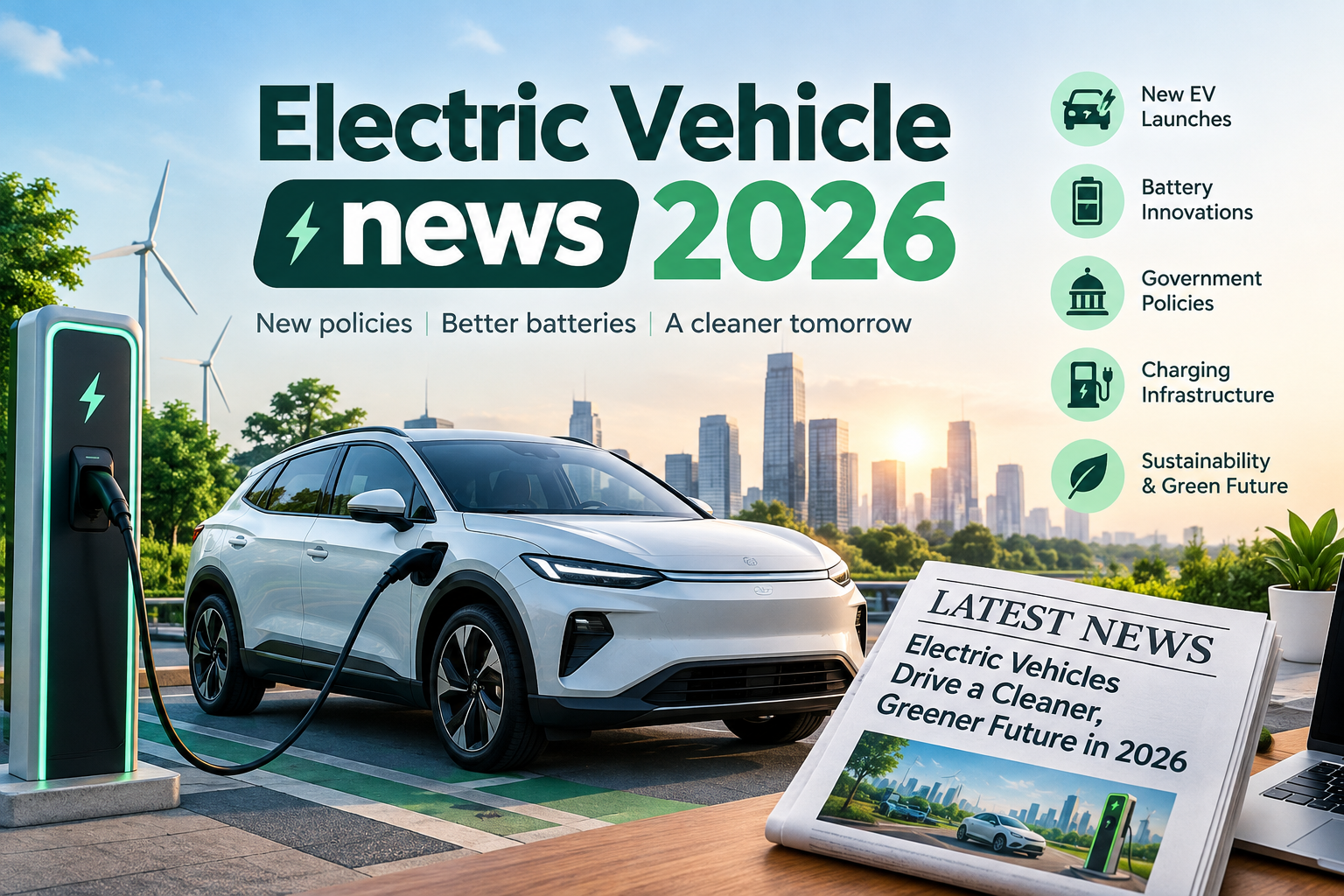
Electric Vehicle News 2026: Key Trends Shaping the EV Industry in India
Electric vehicle news 2026: latest EV trends in India — battery tech, price parity, charging infrastructure, policy shifts & career opportunities. The Electric Vehicle (EV) industry has moved well past the early-adopter phase and is now firmly in a period of mass-market transition. Battery technology, charging infrastructure, government policy, and manufacturer competition are all shifting simultaneously, making 2026 one of the most consequential years yet for anyone tracking the space — whether you’re a prospective buyer, a working professional, or someone exploring a career in India’s fast-growing EV sector. Here’s a breakdown of the biggest trends shaping the industry right now and what they mean for the road ahead.
1. Electric Vehicle News 2026: Battery Technology Breakthroughs
Battery chemistry remains the single biggest lever for improving EVs, and 2026 has continued the steady march toward faster charging, longer range, and lower costs. Solid-state batteries — long promised as the “next big leap” — have been moving from lab prototypes toward limited commercial production at several major manufacturers. These batteries promise higher energy density, reduced fire risk, and significantly faster charge times compared to today’s liquid-electrolyte lithium-ion cells.
At the same time, lithium-iron-phosphate (LFP) batteries have continued gaining market share, particularly in more affordable EV models, thanks to their lower cost and longer cycle life. Fast-charging improvements have also been a major storyline, with several new vehicle platforms supporting charge times that bring a car from roughly 10% to 80% battery in under 15–20 minutes under ideal conditions.
For engineers and technicians, this shift is creating strong demand for battery and BMS (Battery Management System) specialists — a skill area worth tracking if you’re building a career in this space.
2. Electric Vehicle News 2026: Record Sales and Price Parity in India
For years, the biggest barrier to EV adoption in India has been sticker price. That gap has been narrowing steadily as battery costs drop, manufacturing scales, and competition puts downward pressure on prices. Several analysts have pointed to 2026 as a milestone year where unsubsidized price parity between EVs and comparable petrol vehicles becomes achievable in more segments — with several compact and mid-range EVs now priced under ₹15–20 lakh, and entry-level electric two-wheelers available well under ₹1 lakh.
This shift matters enormously for adoption: price consistently ranks as the top concern for would-be EV buyers in consumer surveys, ahead of range anxiety and charging availability. Expect adoption to accelerate fastest in the budget and mid-range segments rather than at the luxury end, where EVs already compete well.
3. Electric Vehicle News 2026: Charging Infrastructure and Government Support
Charging infrastructure has historically lagged behind vehicle sales growth, but 2026 has seen continued aggressive expansion of public and highway fast-charging networks across India. Standardization of connector types and DISCOM (electricity distribution company) approval processes has also been a major focus area, reducing one of the most cited frustrations among EV owners: inconsistent charging access across states and providers.
For readers who want a neutral, government-backed reference on EV policy, subsidies, and charging information in India, the e-AMRIT portal run by NITI Aayog is a useful resource — it’s a one-stop destination covering EV purchase incentives, financing options, and charging infrastructure data.
4. Electric Vehicle News 2026: Policy and Incentive Shifts
Government policy remains one of the most volatile and impactful factors in the EV market. A notable example: Delhi’s EV Policy 2026 has made electric mandatory for all new two-wheelers from April 2028, a move that will significantly reshape the two-wheeler market and the workforce needed to service it. Similar state-level mandates, tax credit structures, and import tariff decisions continue to shift competitive dynamics across the country.
For anyone writing about or investing in the EV space, policy tracking has become as important as tracking the vehicles themselves.
5.Electric Vehicle News 2026: New Model Launches and Market Segmentation
The EV lineup available to Indian consumers has broadened substantially — from electric two-wheelers and compact hatchbacks to SUVs and commercial fleet vehicles. Legacy automakers have continued rolling out dedicated EV platforms rather than adapting petrol-vehicle architectures, while EV-native brands compete aggressively on software, over-the-air updates, and in-car technology as key differentiators beyond just range and price.
6.Electric Vehicle News 2026: What This Means for Your Career
Beyond the hardware story, EVs have increasingly become defined by their software experience — over-the-air updates, advanced driver-assistance systems, and in-cabin AI features are now major purchase considerations. This trend blurs the line between automaker and tech company, and it’s opening up entirely new career tracks in embedded systems and software-defined vehicles.
What This Means for Your Career
The 2026 EV landscape isn’t just a story about vehicles — it’s a story about the workforce being built to design, manufacture, service, and sell them. Battery specialists, BMS engineers, charging infrastructure technicians, and embedded systems professionals are all in growing demand as this industry scales.
Not sure where you’d fit into this shift? Take our free EV Career Path Advisor — a 5-minute AI-powered assessment that maps your background and interests to a personalized roadmap, real salary benchmarks, and the right certification path for India’s EV industry.