



India's EV job market in 2026
EVs are creating jobs across the whole chain, from cell factories and component plants to software teams, charging networks and service workshops.
| Indicator | What the data says |
|---|---|
| Jobs by 2030 | 30–40 million EV-linked jobs, of which 10–15% direct and 85–90% indirect (Adecco India, August 2026) |
| Hiring growth | 15–20% a year; manufacturing accounts for about half of demand |
| Where the jobs are | Tamil Nadu (about 15% of demand), Maharashtra (13%), Gujarat (13%), Karnataka (6%), NCR (6%), Telangana (5%); new corridors at Hosur, Sanand and Dholera |
| How people start | 40–50% of hiring begins as contract or flexi-staffing roles before conversion to permanent jobs |
| Fastest-growing niches | Battery cells, recycling, power electronics, motors, controllers, semiconductors and charging infrastructure |
Career demand varies by employer, location and investment cycle. Use current vacancy descriptions to identify the skills being hired; long-term employment projections are not a count of vacancies available today.
EV careers in India: compare four tracks
| Track | Example roles | Typical entry route | Starting pay (approx.) |
|---|---|---|---|
| Hands-on: service, assembly, charging | EV service technician, battery pack technician, charging station technician | 12th, ITI, diploma or mechanic + EV technician certification | ₹1.8–3.6 LPA (₹15,000–30,000 a month) |
| Hardware engineering | BMS, pack design, power electronics, motor, vehicle design, thermal, testing | B.E./B.Tech (mechanical, electrical, electronics) + EV specialisation | ₹3.5–7.5 LPA |
| Software & data | Embedded software, AUTOSAR/ADAS, battery data analytics | B.E./B.Tech (electronics, computer science, electrical) + embedded or AUTOSAR skills | ₹4.8–9 LPA |
| Business, infrastructure & operations | Charging infrastructure engineer, manufacturing and quality, field service, sales and service advisor | Diploma or degree; sales roles open to any graduate | ₹2.4–5.8 LPA |
Most people move between tracks over a career: a technician becomes a workshop manager or opens a service centre; a test engineer moves into BMS design; an embedded engineer moves into AUTOSAR architecture.
Salary tables and city multipliers below are illustrative planning estimates, not a verified market survey. Career-match percentages are rule-based scores, not hiring probabilities. Compare current vacancies and written CTC breakdowns; annual CTC divided by 12 is not take-home pay.
EV salaries in India by role (2026)
Annual cost to company (CTC) in ₹ lakh. These are indicative ranges: actual offers depend on the employer, your skills, your projects and the interview.
| Role | Entry (0–2 yrs) | Mid (3–6 yrs) | Senior (7+ yrs) | Demand |
|---|---|---|---|---|
| Embedded Software Engineer (EV ECUs) | 4.8–8 | 12–20 | 22–38 | Very high |
| AUTOSAR / ADAS Software Engineer | 5–8.5 | 12–21 | 22–40 | High |
| Battery / BMS Engineer | 4.5–7.5 | 10–18 | 20–35 | Very high |
| Battery Data & Analytics Engineer | 5–9 | 12–20 | 20–35 | Growing |
| Power Electronics / Motor Controller Engineer | 4.2–7 | 10–17 | 19–32 | Very high |
| Electric Motor & Drivetrain Engineer | 4–6.5 | 9.5–16 | 18–30 | High |
| Thermal Management Engineer | 3.8–6.5 | 9.5–16 | 17–30 | Growing |
| Testing & Validation (HIL) Engineer | 3.8–6.2 | 9–15 | 16–28 | High |
| Battery Pack Design Engineer | 3.6–6 | 8.5–15 | 16–28 | High |
| Vehicle Design & CAE Engineer | 3.5–6 | 8–14 | 15–26 | High |
| EV Charging Infrastructure Engineer | 3.5–5.8 | 8–13.5 | 15–25 | High |
| Manufacturing & Quality Engineer | 3.2–5.2 | 7–12.5 | 13–22 | Very high |
| Field Service / Diagnostic Engineer | 3–5 | 5–9 | 9–15 | High |
| EV Sales / Service Advisor | 2.4–4.5 | 4.5–8 | 8–15 | High |
| EV Service Technician | 1.8–3.6 | 3.6–6 | 6–9 | Very high |
| Charging Station Technician (O&M) | 2–3.6 | 3.6–6 | 6–9 | High |
| Battery Pack Assembly Technician | 1.8–3.2 | 3.2–5 | 5–8 | Very high |
Illustrative planning ranges retained from the supplied guide, not a verified salary survey. Compare current employer offers and published salary datasets before negotiating. Senior figures cover lead and specialist roles; managers and architects can earn more.
What moves you up the rangeHands-on projects you can show, tools employers name in job posts (MATLAB/Simulink, CAN tools, CAD, AUTOSAR), a recognised EV certification, internships, and for technicians, high-voltage safety training and diagnostic experience on real vehicles.
EV salaries by city
Bangalore pays the most for engineers, but rents are highest too. Pune, Chennai and Hyderabad often leave you with more money at the end of the month.
| City / hub | Pay vs Pune | Mid-level EV engineer (approx.) | Known for |
|---|---|---|---|
| Bangalore | About 10% higher | ₹11–20 LPA | Two-wheeler OEMs, BMS and embedded teams, start-ups, R&D centres |
| Pune | Baseline | ₹10–18 LPA | OEMs, Tier-1 suppliers, engineering services, testing labs |
| Hyderabad | Similar | ₹10–18 LPA | Software, battery and bus makers, engineering services |
| Chennai and Hosur | About 3% lower | ₹9.7–17.5 LPA | Large EV and component plants, two-wheeler OEMs |
| Delhi NCR | About 3% lower | ₹9.7–17.5 LPA | OEMs, component makers, charging and service networks |
| Gujarat (Ahmedabad, Sanand, Dholera) | About 10% lower | ₹9–16 LPA | Car plants, cell and battery gigafactories |
| Other cities | About 15% lower | ₹8.5–15 LPA | Plants, dealerships, service and charging roles |
Mid-level range shown for a typical EV hardware engineer (for example a BMS engineer). The Career Path Finder applies these city differences to every role.
EV Career Path Finder
Tell us your education, experience and what you enjoy. You'll see your three best-matched EV roles with salaries for your city, how long it takes to become job-ready and the program that fits. Unlock your full roadmap for a skills checklist, portfolio projects, interview questions and a 90-day plan for each role.
1. About you
2. What you enjoy
Salaries are indicative 2026 ranges for your city. Matches weigh your interests, background, preferred way of working and experience.
3. Your best EV career match
Demand for your top role: –
🔒 Get your full EV Career Roadmap (free)
For each of your top three roles: what you'd do day to day, the salary ladder in your city, a skills checklist, tools to learn, portfolio projects that impress employers and interview questions to prepare. Plus a week-by-week 90-day plan and where to find jobs. Print it or save it as a PDF.
Guidance only, not a job or salary guarantee. Salary ranges are indicative 2026 figures compiled from public salary portals, industry reports and hiring-partner offers.
How to become an EV engineer in India
You don't need a degree called "EV engineering". You need a core engineering branch, EV-specific skills for one area, and proof that you can apply them.
- Pick your area based on your branchMechanical: vehicle design, battery pack design, thermal, manufacturing. Electrical: BMS, motors, power electronics, charging. Electronics: BMS, power electronics, embedded. Computer science: embedded, AUTOSAR, battery data.
- Learn how a whole EV worksBattery, BMS, motor, controller, charger, vehicle controller and how they talk over CAN. Every EV interview starts here.
- Learn the tools your area usesMATLAB/Simulink for modelling, CAD and CAE for mechanical roles, Embedded C and CAN tools for electronics and software, LTspice or PLECS for power electronics.
- Build two or three projectsA state-of-charge estimator, a CAN network on microcontrollers, a scooter frame FEA, a charger site design. Put them on GitHub or in a portfolio with photos and results.
- Get hands-on timeLab work on real batteries, motors and controllers, an internship, or a hands-on program with industry projects.
- Apply where EV employers lookEV job platforms, hiring drives, OEM and supplier career pages, and LinkedIn. Talk about your projects in every interview.
What each branch should add
| Your branch | Best-fit EV roles | Add these skills |
|---|---|---|
| Mechanical / Automobile | Vehicle design & CAE, battery pack design, thermal, manufacturing & quality | CATIA/SolidWorks, ANSYS, vehicle dynamics, battery thermal basics, MATLAB |
| Electrical / EEE | BMS, motors & drivetrain, power electronics, charging infrastructure | Battery modelling, motor control, MATLAB/Simulink, power electronics simulation, charging standards |
| Electronics / ECE | Embedded software, BMS, power electronics, testing & HIL | Embedded C, STM32, CAN, PCB basics, AUTOSAR fundamentals |
| Computer Science / IT | Embedded software, AUTOSAR/ADAS, battery data & analytics | C/C++, embedded basics, CAN, Python data analysis, battery fundamentals |
EV jobs after ITI, diploma or 12th
Some of the biggest hiring is for hands-on roles, and they don't need an engineering degree.
EV service technician
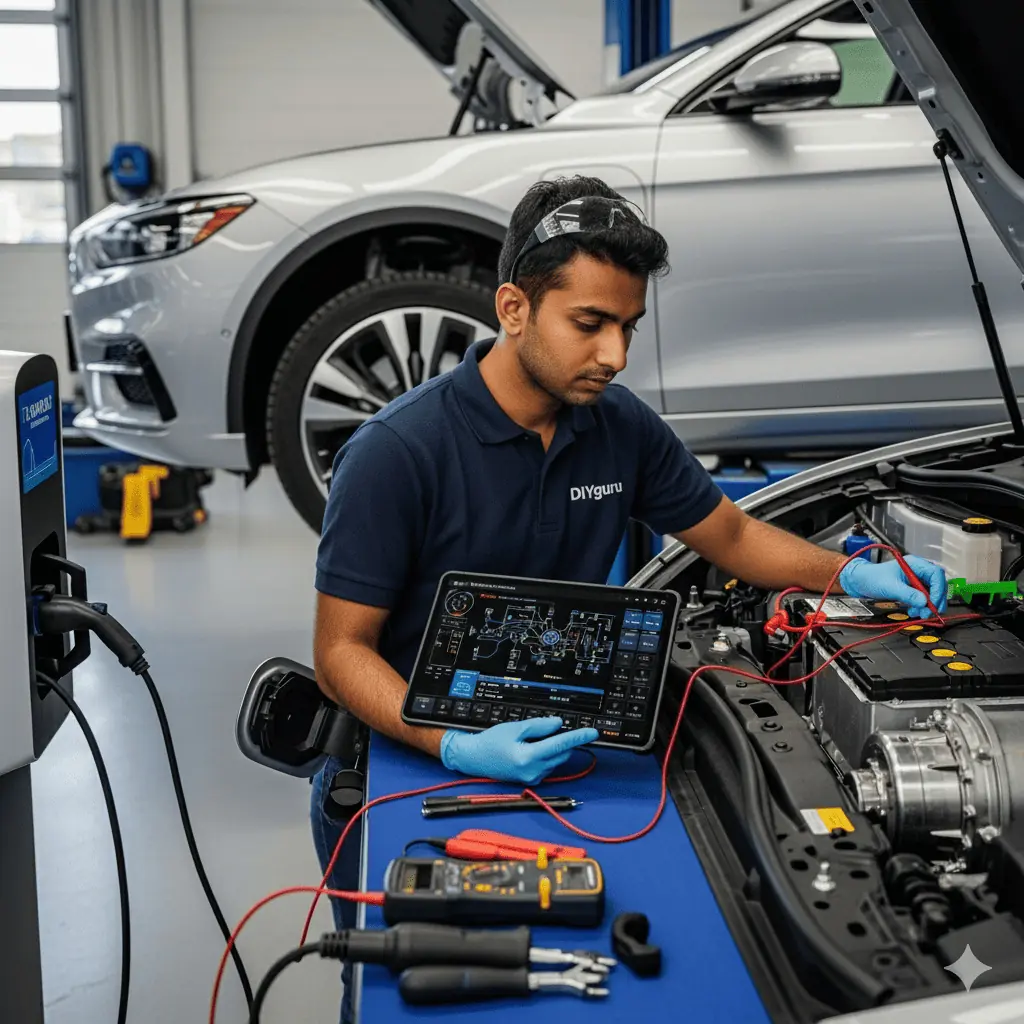
Diagnose and repair e-scooters, e-autos and electric cars at dealerships, fleets and service networks. Start: about ₹15,000–30,000 a month.
Battery pack assembly technician
Build and test battery packs in factories and gigafactories. Start: about ₹15,000–27,000 a month.
Charging station technician
Install and maintain chargers for charge point operators and contractors. Start: about ₹17,000–30,000 a month.
Field service engineer (diploma)
Solve difficult faults for OEMs and fleets, and train technicians. Start: about ₹3–5 LPA.
How to get in: learn high-voltage safety first, then battery, motor, controller and charger diagnostics on real EV parts. A 3-month EV technician certification with practicals is the most direct route. Experienced petrol-vehicle mechanics usually pick EV work up fastest because they already understand vehicles and customers.
Grow into your own businessMany technicians go on to run their own EV service workshop. DIYguru's ev.care network offers a franchise model for 2W and 3W EV service centres.
Switching into EVs from petrol-diesel automotive or IT
From petrol / diesel automotive
- Your vehicle, manufacturing, testing and quality experience carries over
- Add: batteries and BMS, motors and controllers, high-voltage safety, CAN
- Natural moves: validation, manufacturing, vehicle integration, service management
- Mechanics: an EV technician course gets you working on EVs in about 3 months
From IT / software
- Your coding, testing and data skills carry over
- Add: embedded C, microcontrollers, CAN, AUTOSAR, battery basics
- Natural moves: embedded software, AUTOSAR, test automation, battery data analytics
- Expect a project-heavy learning curve for hardware-facing roles
If your experience is outside the role you want, expect to enter a level below your years of experience, then move up quickly once you have EV projects and a year in the field. The Career Path Finder takes this into account.
Skills and tools EV employers ask for
| Area | Skills | Tools named in job posts |
|---|---|---|
| Everyone | How an EV works end to end, high-voltage safety, reading datasheets, documentation | Multimeter, Excel, basic Python |
| Battery & BMS | Cell chemistry, SoC/SoH estimation, balancing, protection, AIS-156 | MATLAB/Simulink, battery cyclers, CAN tools |
| Motors & power electronics | Motor sizing, field-oriented control, inverter design, thermal design | LTspice, PLECS, Maxwell/Motor-CAD, oscilloscope |
| Embedded & software | Embedded C, microcontrollers, CAN, RTOS, AUTOSAR, MISRA C, ISO 26262 basics | STM32CubeIDE, Keil, CANoe/PCAN, Vector DaVinci, Git |
| Vehicle design | Packaging, chassis, FEA/CFD, vehicle dynamics, range simulation | CATIA, SolidWorks, ANSYS, MATLAB |
| Testing & quality | Test planning, HIL, data analysis, PFMEA, SPC | CANoe, dSPACE/NI, Python, Minitab |
| Service & charging | Diagnostics, insulation testing, charger maintenance, customer handling | Insulation tester, diagnostic scanners, OCPP platforms |
How to get hired in the EV industry
- Show, don't tell. Two or three documented projects beat a long list of courses. Include photos, graphs, code and what you'd do differently.
- Use EV job platforms. emobility.careers lists EV jobs and salary guides from across the industry.
- Go to hiring drives. At DIYguru's Bharat eMobility Recruitathon (Delhi edition, October 2026), 323 pre-screened candidates met 12 EV employers and more than 200 were shortlisted. The Pune edition included roles such as Embedded C Engineer and BMS Software Testing Engineer.
- Accept a contract start if needed. A large share of EV hiring starts with contract or flexi roles that convert to permanent jobs.
- Get written terms. Make sure your offer letter states the salary, role, location and probation terms before you join.
Want a deeper, AI-generated career roadmap with a learning timeline, companies hiring and a counsellor call?
Try the EV Career Path Advisor →Choosing the right EV program
| If you are… | Look at | Duration |
|---|---|---|
| 12th pass, ITI, diploma holder or mechanic | CEVT: Certified Electric Vehicle Technician | 3 months |
| A working professional adding one EV skill | Professional certifications in EV charging or motors and drives | 3 months |
| An engineering student or graduate choosing a specialisation | Advanced Nanodegrees: Battery & BMS, EV Design (Mechanical), EV Engineering (Electrical), Embedded Systems, ADAS & AUTOSAR | 6 months |
| A graduate who wants a complete, placement-focused program | PG Program in EV & Embedded Systems | 12 months |
Not sure? The free Course Advisor Tool matches you to a program in a few minutes, and merit scholarships are available on Nanodegree and PG programs through a free entrance test.
EV careers in India: try the technical work
Explore these simplified battery examples to discover whether you enjoy electrical reasoning and diagnostic evidence. They are educational models, not repair procedures or a qualification assessment.
EV service and diagnostics: interactive learning lab
Use these conceptual models to connect symptoms with evidence. They are learning aids, not pack-building instructions or approved repair procedures. Real protection thresholds and test methods depend on the manufacturer, chemistry, temperature and hardware.
Your chapter progress
Progress is stored on this browser when available.
11. EV service and diagnostics: series/parallel simulator
Series count determines nominal voltage. Parallel count determines capacity when identical cells share current appropriately. Nominal energy is voltage × ampere-hours; usable energy is lower and varies with operating limits. This model does not calculate safe current, wiring, thermal design or charger compatibility.
Try doubling parallel count while keeping series count fixed. Capacity and energy double; nominal voltage stays the same. Change chemistry and observe why the same series count need not mean the same pack voltage.
12. BMS fault scenarios and evidence
This fictional 16-group NMC model demonstrates how protection can respond to different evidence. The example limits are not universal service limits. Actual systems may derate, latch a fault, require a reset or implement independent charge and discharge paths.
What the evidence says
Appropriate next step
Never use simulated values as permission to continue driving or charging a damaged battery. A missing reading is missing evidence, not a zero-volt measurement.
13. Guided diagnostic walkthroughs
Record the complaint, conditions, original codes, diagnostic evidence, repair and verification outcome. Do not clear fault history before saving it. A part replacement without a supporting test can hide an intermittent fault and add unnecessary cost.
14. Searchable EV service and diagnostics glossary
16 terms
BMS
Battery management system: monitors battery conditions and requests protection according to its configuration.
SOC
State of charge: an estimate of remaining charge, not a direct capacity measurement.
SOH
State of health: a model-dependent estimate of battery condition.
Series
Connecting cell groups in series adds voltage.
Parallel
Connecting matched cells in parallel adds charge capacity.
Voltage sag
A reduction in terminal voltage under load; resistance, temperature and SOC influence it.
Cell imbalance
A difference between cell-group readings; compare at matching conditions.
Contactor
An electrically controlled switch used to connect or disconnect a power circuit.
Precharge
A controlled process that limits inrush into capacitors before the main connection closes.
Interlock
A safety input that prevents operation in an unsafe or unready state.
DTC
Diagnostic trouble code: a manufacturer-defined clue requiring supporting evidence.
CAN
A communication network used by vehicle controllers.
Isolation
Separation from energy sources using the approved procedure, followed by required verification.
Insulation resistance
Resistance between circuits and accessible structures; a DMM continuity check does not certify it.
Ah
Ampere-hour: charge capacity.
Wh
Watt-hour: energy; nominal voltage multiplied by ampere-hours gives a nominal estimate.
Further learning and primary references
Explore DIYguru training programs and training locations. Read the HSE electric and hybrid vehicle repair guidance for general workshop hazards (UK guidance, not Indian regulation), and Texas Instruments BQ76952 documentation for an example of configurable battery monitoring and protection. Always use the actual vehicle’s service documentation for repair limits.