


6-Month Nanodegree — For EE Engineers
EV Design, Simulations
& Analysis for EE Engineers
Built exclusively for Electrical & Electronics Engineers. Master advanced MATLAB-Simulink modeling, EV powertrain development, PCB design with KiCad, and choose your specialization: Battery Pack/BMS Modeling or Motor & Drive Systems.
8+
Industry Projects
7+1
Courses + Elective
94%
Placement Rate
₹60,000₹49,999Limited Cohort

⚡
Choose SpecializationBattery/BMS or Motor/Drive
Recognised by


The Opportunity
EE Engineers Are the Backbone of Every EV Company
From power electronics to BMS firmware, motor control to charging systems — every EV subsystem is fundamentally an electrical engineering challenge. And the demand is exploding globally.
🔋
Battery Systems = 40% of Cost
BMS design, thermal management, and cell balancing are the most critical engineering challenges. EE engineers with battery expertise earn premium salaries.
⚡
Power Electronics Everywhere
Inverters, converters, onboard chargers, V2G systems — EV power electronics is a $25B+ global market. EE expertise is in massive demand.
📊
Simulation-Driven Design
OEMs model everything in MATLAB-Simulink before building hardware. EE engineers with advanced simulation skills command top R&D positions.
Program Highlights
The Most Advanced EV Program for EE Engineers
Beyond fundamentals. Hands-on with MATLAB-Simulink, PCB design, powertrain modeling, and choose between Battery/BMS or Motor Systems specialization.
01
Advanced MATLAB-Simulink
Road load analysis, inverter design, power converters, Simscape, BMS modeling — industry-grade simulation tools used by OEM R&D teams.
02
Choose Your Specialization
Course 7 elective: Battery Pack Design & BMS Modeling (11 modules) OR Motor & Drive Systems (9 modules). Shape your career trajectory.
03
PCB Design with KiCad
Design power electronics PCBs — directly applicable to EV controller, BMS hardware, and onboard charger design roles at top OEMs.
04
Hands-On Hardware Workshop
EV 2W testbench, EVSE R&D, battery pack assembly, retro-fitment, EV harnessing. Unlimited free access at DIYguru CoE centers.
05
100% Placement Assistance
183+ OEM & Tier-1 partners. 94% placement rate. emobility.careers portal, resume coaching, mock interviews, career mentoring.
06
Triple Government Certification
ASDC + NEAT AICTE + DIYguru. Recognised by 320+ automotive companies. Valid for all placement and government technical roles.
Ideal Candidate
Your EE Background is Your Superpower in EV
If you have a foundation in electrical or electronics engineering, this program will position you for the highest-paying roles in the EV industry.
⚡
EEE / ECE Graduates
Power systems & electronics engineers entering the EV revolution
🔌
Instrumentation Engineers
Sensor & control engineers transitioning to EV systems
🏭
Working Professionals
EE professionals in power/electronics seeking EV domain expertise
📚
Final-Year Students
B.E./B.Tech students building portfolio projects in EV simulation
Curriculum
7 Core Courses + 1 Specialization Elective
Progressive mastery: from EV fundamentals through advanced simulation, electronics, power systems, powertrain development, and deep specialization in Battery/BMS or Motor Systems.
C1
EV Engineering Essentials
EV technology overview, battery fundamentals, power electronics principles, motor systems, charging infrastructure, vehicle electrification.
FoundationC2
Advanced EV: Numericals & Hybrid Systems
EV performance calculations, hybrid architectures, heavy-duty vehicles, safety standards, supply chain, manufacturing, advanced battery & motor technology.
7 ModulesC3
Electronics & PCB Design
Semiconductor fundamentals, BJT/FET/MOSFET/IGBT, operational amplifiers, Proteus circuit design, PCB design for power electronics using KiCad.
13 ModulesC4
MATLAB-Simulink & EV Tools
MATLAB fundamentals, data visualization, Simulink modeling, QSS Toolbox, ADVISOR software for EV system-level simulation and analysis.
SimulationC5
Advanced EV Simulation
Road load analysis, inverter design and modeling, power converter topologies, advanced Simscape, BMS modeling, energy management, performance analysis.
Deep SimulationC6
Powertrain Development
PEV & hybrid architectures, automotive standards, power electronics for drivetrains, MATLAB modeling, CAD/FEA with SolidWorks & ANSYS, battery management systems.
8 ModulesC7
Specialization Elective — Choose One
Track A: Battery Pack Design & BMS Modeling (11 modules) — cell-to-pack design, thermal management, MATLAB BMS simulation.
Track B: Motor & Drive Systems (9 modules) — DC/Induction/BLDC motors, motor control, motor selection.
🛠️
8+ Capstone Projects + Hardware Workshop
Powertrain design, drivetrain architecture, onboard charger, power supply design, EV simulation, performance analysis, battery modeling, BMS design + hands-on workshop at DIYguru CoE.
Portfolio-ReadyLearning Format
15+ Live Classes Per Week + Hardware Workshop
Blended learning combining live online instruction, self-paced content, and hands-on hardware validation at our facilities.
📡
Live Online Sessions
15+ live classes weekly covering EV fundamentals, battery, charging, MATLAB, power electronics, simulation, powertrain, and motor technology.
🔬
Hardware Workshop
Hands-on at DIYguru CoE centers: EV 2W testbench, EVSE testing, battery pack assembly, vehicle assembly, retro-fitment, EV harnessing. Free & unlimited.
💻
24/7 LMS + Lifetime Access
Self-paced learning with recorded lectures, project guides, and lab materials. Lifetime access to content updates and future course improvements.
Career Outcomes
High-Demand Roles You'll Be Ready For
EE engineers with EV expertise command premium salaries. 94% placement rate with 183+ hiring partners.
✓
Power Electronics Engineer (EV)
Design inverters, converters, motor drives, and charging systems for electric vehicle powertrains. ₹4–10 LPA entry level.
✓
Battery & BMS Engineer
Battery pack design, BMS firmware, thermal management, SOC estimation. Among the highest-paid EV roles. ₹4–9 LPA entry.
✓
Simulation & Modeling Engineer
MATLAB-based EV system modeling, powertrain optimization, road load analysis. Critical role at all OEMs. ₹4–10 LPA.
✓
Motor & Drive Systems Engineer
Motor selection, field-oriented control, drive system integration, FOC/DTC control strategies. ₹4–10 LPA entry.
✓
100% Placement Support
183+ hiring partners (Bosch, Hyundai, Maruti, L&T, KPIT, Eaton, OLA). emobility.careers portal, career coaching, mock interviews.
✓
Triple Government Certification
ASDC + NEAT AICTE + DIYguru. Recognised by 320+ companies. Valid for all placement, government, and international roles.
Government-Recognised Certification
Triple certification from ASDC (Govt. of India), NEAT AICTE (Ministry of Education), and DIYguru. Recognised by 320+ automotive OEMs and valid for all technical placements across India and globally.
🏛️
ASDCGovt. India
📜
NEATAICTE
⚙️
DIYgurueMobility
🎯Recognised by 320+ automotive & EV companies
🏅NEAT AICTE — Ministry of Education, Govt. of India
📊ASDC — Sector Skill Council under NSDC
🌐DIYguru ranked #2 globally (UK KPMG ASPIRE)
FAQ
Frequently Asked Questions
What is the specialization elective in Course 7?▾
You choose one elective: (A) Battery Pack Design & BMS Protection Modeling — 11 modules covering cell-to-pack design, thermal management, MATLAB BMS simulation, and SOC estimation. (B) Motor & Drive System Design — 9 modules covering DC/Induction/BLDC/Switched Reluctance motors, motor selection, and control strategies. Choose based on your career goals.
What is the total program fee?▾
₹49,999 (limited cohort offer). Includes all course materials, software, workshop access, hardware kits, triple government certification, and 100% placement assistance. EMI and scholarship options available.
Does this include PCB design training?▾
Yes. Course 3 (Electronics & PCB Design) includes 13 modules on circuit design fundamentals and PCB design for power electronics using KiCad — directly applicable to EV controller, BMS hardware, and charger design roles.
Do I need prior EV experience?▾
No prior EV experience needed. Program starts from EV fundamentals in Course 1. Eligibility: B.E./B.Tech in EEE, ECE, Instrumentation, or related engineering branches. Working professionals also welcome.
Is there a hands-on hardware workshop?▾
Yes. Hardware Workshop 1 includes: EV 2W testbench, EVSE R&D testing, battery pack assembly, vehicle assembly/reassembly, retro-fitment, and EV harnessing. Unlimited free access at DIYguru CoE centers in Delhi and Bangalore.
What is the placement rate?▾
94% placement rate with 183+ hiring partners (Bosch, Hyundai, Maruti, L&T, KPIT, Eaton, OLA, etc.). We provide 100% placement support: emobility.careers portal access, resume coaching, mock interviews, and career mentoring from Week 1.
Power Your EV Engineering Career with Simulation & Design Skills
Limited 30 seats per cohort. Choose Battery/BMS or Motor/Drive specialization. 94% placement rate with 183+ OEM partners. Start your journey today.
Apply Now — ₹49,999 →Questions? Call us: +91-9910-918719 | [email protected]
Our Clients
Trusted by 528+ Companies & OEMs
From global automotive OEMs and Tier-1 suppliers to EV startups, government bodies, and Fortune 500 companies.


Swipe to see more partners
Showing 39 of 528+ corporate training partners
Accreditations
Programs Recognised by Govt. Bodies & Industries
DIYguru is recognized and endorsed by major educational and governmental organizations including the Ministry of Education, NITI Aayog, and NEAT AICTE for its commitment to upskilling in automotive and EV technologies. The institute also collaborates with industry leaders like TATA Technologies and the Ola Mobility Institute to ensure the relevance and practicality of its training programs.


Swipe to see more accreditations
In The Media
DIYguru in the Press
ANI News
IIT Jammu Enters Into Collaboration With DIYguru To Launch Certificate Programs in EV Sector
Read →
PTI News
Tata Technologies Partners With DIYguru for Industry-Relevant E-Mobility Programs
Read →
The Print
DIYguru Partners With L&T Edutech for E-Mobility Training — Hardware-Enabled PG Program
Read →
Times of India
DIYguru and ADYPU Launch M.Tech Program in Electric Vehicle
Read →
Economic Times
DIYguru and Ajeenkya DY Patil University To Launch Integrated PG, M.Tech in EV
Read →
India Education Diary
AICTE–DIYguru MOU To Provide Jobs To One Million EV Workforce
Read →
Autocar Professional
ASDC & DIYguru Launch Nanodegree Program To Upskill Students in EV Technology
Read →
SiliconIndia
Tata Technologies & DIYguru Join Forces To Power India's Next-Gen eMobility Talent
Read →
TV9 Hindi
इलेक्ट्रिक कारों के मैकेनिक की बढ़ रही मांग — DIYguru से बना सकते हैं करियर
Read →
Zee News
Great Opportunity To Earn in the World of Electric Vehicles — Training & Method
Read →
National Skills Network
Roundtable on Skill Development for Electric Vehicles — DFID, ASDC & SSOU
Read →
Hindustan
DIYguru से हार्डवेयर सक्षमता के साथ EV बिजनेस और इंजीनियरिंग सीखें
Read →
Watch DIYguru
Lab Tours, Placements & Real Stories
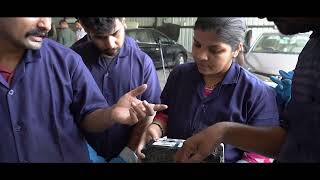
🔧 Hands-On
EV Hands-on Training in Pune on Tata Tiago EV 🚘🔧
🎓 Placement
Build Your Career in the EV Industry Like Prabhat Gautam!
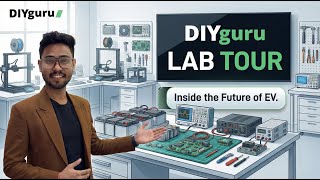
🏭 Lab Tour
DIYguru Lab Tour — E-Mobility Hardware Lab

🔩 Hardware
Introducing the Ultimate EV Training Kit by DIYguru & EVI Technologies

🌟 Alumni
Empowering Futures: Nitin Agarwal's Journey with DIYguru in EV
🚀 About Us
Welcome to DIYguru — India's #1 E-Mobility & FutureTech Platform

📊 Placement
Placement Spotlight: A Journey of Skills, Sustainability & Smart Choices

💬 Story
This Is More Than a Career Story — When Learning Meets Purpose

🌍 International
Mustafa From North Africa 🔥🔥 — Global EV Training
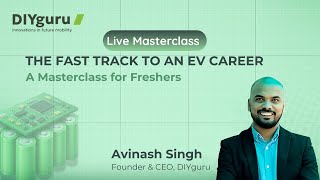
🎤 Masterclass
THE FAST TRACK TO AN EV CAREER — Masterclass by Avinash Singh
Ready to build your EV career? Talk to our counsellors today.
BOOK FREE CONSULTATION →
Your journey starts here.
DIYguru is India's leading AICTE-approved platform, equipping engineers, graduates, and professionals with the future-ready skills needed in Electric Vehicles (EVs), Battery Technology, Solar Energy, Green Hydrogen, and Clean Mobility.
Whether you're starting out or shifting your career toward sustainability — your journey begins here.
Why Choose DIYguru?
- AICTE-Approved Certifications
- Industry-Curated Courses (EV, Battery Design, Solar, Embedded Systems, BMS, MATLAB & more)
- Project-Based Learning using real case studies from Tesla, Tata Motors, Ather, and others
- Global Opportunities – Connect with 300+ hiring partners and international universities
- Work on Real-World Tools like MATLAB, SolidWorks, Python, Simulink, Ansys
Your journey starts here.
Ready to Begin? Drop your info, and we'll help you get there!
🔒 Your information is secure and will never be shared.
🎬 Unlock This Video
Enter your details to watch
Get instant access + free EV career guidance from our counsellors.
Please fill all fields correctly.
🔒 Your data is secure. We'll send you free EV career resources.


Let's Connect
Training programs · B2B partnerships · College workshops
Certification
Programs
Programs
B2B Corporate
Training
Training
College
Workshops
Workshops
Partnership &
Collaboration
Collaboration
Your data is secure · No spam · Expert callback within 2 hours