⚡ UPDATES
PG in EV & Embedded Systems — IIT Jammu (12 Months) Flagship M.Tech in EV Technology — 24 Month Program Open DET Entrance Test — Unlock Scholarship Up to ₹25,000 Scholarship 50,000+ Professionals Trained Nationwide Placement Drive — 183+ Hiring Partners ASDC & AICTE NEAT Certified Programs PG in EV & Embedded Systems — IIT Jammu (12 Months) Flagship M.Tech in EV Technology — 24 Month Program Open DET Entrance Test — Unlock Scholarship Up to ₹25,000 Scholarship 50,000+ Professionals Trained Nationwide Placement Drive — 183+ Hiring Partners ASDC & AICTE NEAT Certified Programs
Accredited by


📅
Bharat eMobility Recruitathon 2026
Delhi: Mar 21-23 | Pune: May 21-24
Call: 9910918719
WhatsApp Us
ASDC
AICTE NEAT
IIT Jammu
50K+ Trained
© 2026 DIYguru Mobility Pvt. Ltd.


- Program Highlights
This program offers a thorough understanding of electric vehicle (EV) engineering, emphasizing design, simulation, and analysis techniques. Covering essential EV technology concepts, powertrain simulation, finite element analysis, and meshing, this program equips students with practical and theoretical skills necessary to excel in the EV industry.
Leverage the prestige of IIT Guwahati
- Admission Closes on 1st Nov
Days
Hours
Minutes
Seconds
- Get more information
Want to know more? Enter your information to learn more about this program from EICT – IIT Guwahati.
- Career Opportunities
- EV System Design: Developing and refining EV components, including powertrains and energy storage.
- Battery and Power Management: Optimizing battery performance and implementing power management solutions.
- Vehicle Simulation and Modeling: Conducting simulations to assess and improve EV design.
- Finite Element Analysis: Analyzing structural integrity of EV Components.
- Automotive Design: Working on conceptual and 3D designs for automotive applications.
- Structural Analysis: Utilizing meshing and structural analysis tools for precise EV component modeling.
- Safety and Compliance: Ensuring designs meet industry standards and safety regulations.
- EV Systems Engineer: Designs, develops, and tests core EV systems.
- Battery Engineer: Focuses on battery optimization and power management in EV applications.
- Simulation Engineer: Conducts performance simulations using MATLAB and Simulink.
- FEA Analyst: Performs finite element analysis to ensure durability and structural stability.
- Power Electronics Engineer: Specializes in inverters, converters, and power management systems.
- Compliance Engineer: Ensures that EV components adhere to regulatory standards and safety protocols.
- Battery and BMS Knowledge: Expertise in battery chemistries and management systems.
- Simulation and Modeling: Proficiency in MATLAB, Simulink, and ANSYS.
- Power Electronics Design: Knowledge of converters, inverters, and power management.
- 3D Modeling: Skills in creating precise models with ANSYS for 3D Simulation.
- Advanced Vehicle Design: Advanced skills in vehicle sub system and system level design and simulations using MATLAB with toolboxes SIMULINK & SIMSCAPE.
- Finite Element Analysis (FEA): Proficiency in FEA techniques for testing component integrity.
- Regulatory Compliance: Familiarity with automotive safety and compliance standards.
- Tata Motors
- Mahindra Electric
- Ather Energy
- Ola Electric
- TVS Motor Company
- Hyundai Motor India
- Ashok Leyland
- MG Motor India
- Hero Electric
- Kinetic Green Energy & Power Solutions
- FOR ENTERPRISE
Looking to enroll your employees into this program ?
- Inquire Now
- Program Outcomes

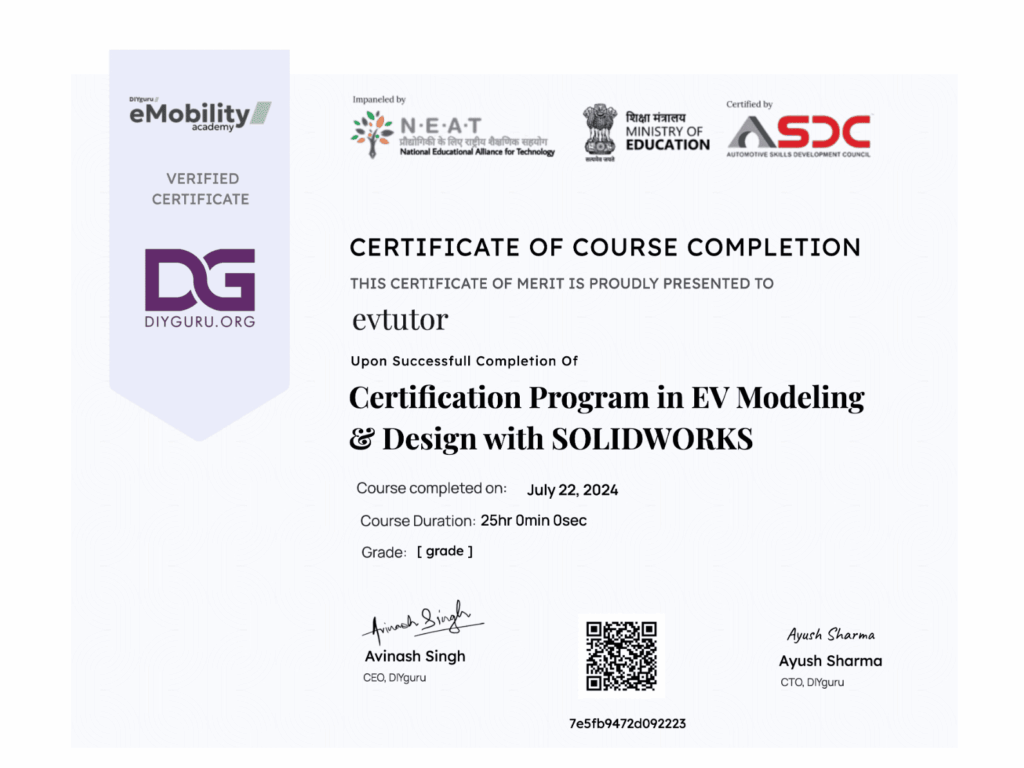

- Program Curriculum
Module 1: EV Engineering Essentials Part I and II
- Module Description:
- This foundational module introduces students to the essentials of electric vehicle (EV) technology, focusing on core engineering principles and the major components of EV systems. It begins with an overview of EV technology, including key components and advancements. Students will explore the transition from Internal Combustion Engine (ICE) vehicles to electric systems, understanding the benefits and challenges associated with electrification. This module covers EV design principles, battery technology, power electronics, and motor systems, offering insights into types of motors, control strategies, and efficiency optimization. Additional topics include vehicle electrification systems, such as wiring, voltage distribution, and essential high and low voltage components. The module concludes with an in-depth look at EV charging technologies, including infrastructure, standards like CCS and CHAdeMO, and fast-charging solutions.
- Module Details:
- Starting with EV Technology: Overview of Electric Vehicles, Components, Key Technologies
- Understanding ICE to EV Transition: Key Differences, Benefits, Challenges
- Electric Vehicle Engineering: EV Design Principles, Key Subsystems, Safety Considerations
- Battery Technology for EV Systems: Battery Chemistries, Energy Density, Charging Cycles
- Power Electronics for EV Systems: Inverters, Converters, Power Management
- Motor Systems for Electric Vehicles: Types of Motors, Control Strategies, Efficiency Optimization
- Vehicle Electrification Systems: Vehicle Wiring, Voltage Distribution, High and Low Voltage Components
- Electric Vehicle Charging Technology: Charging Infrastructure, Standards (CCS, CHAdeMO), Fast Charging Solutions
Module 2: MATLAB, SIMULINK Certification Course For Electric Vehicle Design & Simulation
- Module Description:
- This module focuses on advanced design and simulation techniques specific to EV systems, providing hands-on experience with MATLAB, Simulink, and the Quasi-Static Simulation (QSS) toolbox. Students will engage in EV architecture modeling, learning to simulate powertrain layout, energy flow, and system performance.
- Module Details:
- MATLAB Simulink: Block Diagrams, System Modeling
- Understanding Advisor Toolbox: Vehicle Powertrain Design, Simulations for EVs
- Understanding QSS Toolbox: Quasi-Static Simulation, Performance Analysis for EVs
- EV Architecture Modelling & Simulations: Vehicle Layout, Powertrain Architecture, Energy Flow Modeling
- MATLAB Simulink: Block Diagrams, System Modeling
Module 3: Advanced Certification in EV Design & Simulation using MATLAB-Simulink, SIMSCAPE
- Module Description:
This module focuses on the comprehensive understanding and simulation of road load forces acting on electric vehicles, including aerodynamic drag, rolling resistance, and gradient forces. Learners will explore inverter design and thermal management, along with detailed Simscape-based modeling of electrical, mechanical, and thermal subsystems. The module also covers advanced BMS modeling techniques to analyze battery performance and energy flow, equipping learners with hands-on skills in EV system simulation and optimization.
- Module Details:
- Road Load Understanding: Forces acting on vehicles, load distribution
- Road Load Analysis: Modeling aerodynamic drag, rolling resistance, gradient forces
- Inverter Design and Modeling: Sizing, efficiency, thermal management
- Advanced Simscape Modeling: Electrical, mechanical, thermal modeling for EV systems
- BMS Modeling and Energy Analysis: Battery performance modeling, energy flow simulations
Module 4: Certification Course in ANSYS Engineering for Electric Vehicle : Fundamental to Structural Analysis
- Module Description:
- In this module, students learn to apply Computer-Aided Engineering (CAE) tools and finite element analysis (FEA) using ANSYS for electric vehicle engineering. Starting with an introduction to CAD and CAE, students will explore how ANSYS can be used for EV-specific engineering design. Fundamental FEA techniques are taught alongside material properties selection tailored to EV applications, allowing students to understand how different materials respond under stress. Through meshing, structural analysis, and boundary condition setup, students perform simulations to assess component durability and structural integrity.
- Module Details:
Introduction to CAD/CAE and ANSYS: Overview of CAD tools, ANSYS for engineering design
Fundamentals of FEA and Material Properties: Finite Element Analysis, material selection for EVs
ANSYS Project Setup and Geometry Handling: Building CAD models, importing into ANSYS
Meshing, Analysis Setup, and Structural Analysis: Mesh generation, boundary conditions, load applications
- Skills Covered
Battery and BMS Knowledge
Simulation and Modeling Skills with MATLAB
Power Electronics Design
3D Modeling with ANSYS
Finite Element Analysis (FEA)
Regulatory Compliance
- Projects
Comprehensive Design and Modelling of an EV System using MATLAB Simulink
Design and Model EV systems with MATLAB Simulink.
Structural Analysis of Engineering Component System
Perform structural analysis on EV components under dynamic conditions, focusing on 3D behaviour to enhance reliability and safety.
EV component design and simulations using MATLAB Simscape and QSS systems
Allowing students to work on advanced toolboxes with MATLAB systems for designing over 8 EV sub systems and components.
- Benefits
- Foundation in EV technology and design principles.
- Practical experience with essential engineering software.
- Enhanced employability in the EV industry.
- Skills in simulation and analysis for immediate application.
- Competitive edge in sustainable and innovative engineering careers.
- Gain advanced technical expertise in EV systems.
- Hands-on experience with industry-leading tools.
- Access to high-demand roles in the EV sector.
- Valuable insights into simulation, analysis, and EV design.
- Competitive advantage for transitioning to green mobility technology roles.
- Design and Model EV Powertrains and Components: Develop and refine electric vehicle powertrains and system components for enhanced performance.
- Conduct Advanced EV Simulations: Use MATLAB, Simulink, and ANSYS for simulations in energy flow, efficiency, and thermal analysis.
- Develop Battery Management Systems: Design BMS strategies for efficient monitoring, control, and performance of EV batteries.
- Apply Power Electronics Principles: Implement power management solutions in EVs, including inverter and converter technologies.
- Perform FEA and Dynamic Analysis: Conduct finite element analysis and dynamic simulations to ensure EV reliability and safety.
- Create CAD Models for EV Components: Develop 3D models for parts such as batteries, motors, and structural components.
- Ensure Compliance and Safety Standards: Integrate industry-standard safety protocols and regulatory compliance into EV design.
- Mode of Learning
Complete on-site
classroom program
Location: Mumbai
LIVE + Recorded + Onsite + Hardware + Workshop
LIVE + Weekend on-site sessions
Location: Pune, Delhi
LIVE + Recorded + Hardware + Workshop
Location: Global
- Tools Covered


Hardware Labs Access
Two-Wheeler Simulator & Test Bench
The 2 Wheeler Simulator & Testbench focuses on evaluating EV battery performance, including voltage, current, discharge profiles, and capacity testing under various load conditions. It also covers Battery Management System (BMS) testing and dynamic load analysis to optimize electric bike performance and safety.
LAB 1
Charging Station Simulator and Test Bench
The Charging Station Simulator and Test Bench covers experiments focusing on the efficiency, behavior, and safety features of EV charging systems. It includes the measurement of voltage, current, and power consumption during charging, and tests security features like RFID and OTP-based authentication. Key areas include energy efficiency analysis, protection unit testing, and charging behavior under different conditions
LAB 2
EV In-house manufacturing & Development KIT
The EV In-house Manufacturing & Development KIT provides all the essential tools and components for building and prototyping electric vehicles, supporting the entire development process from concept to production. It includes equipment for battery monitoring, motor control, system integration, and real-time data analysis, ensuring seamless development for EV projects
LAB 5