⚡ UPDATES
PG in EV & Embedded Systems — IIT Jammu (12 Months) Flagship M.Tech in EV Technology — 24 Month Program Open DET Entrance Test — Unlock Scholarship Up to ₹25,000 Scholarship 50,000+ Professionals Trained Nationwide Placement Drive — 183+ Hiring Partners ASDC & AICTE NEAT Certified Programs PG in EV & Embedded Systems — IIT Jammu (12 Months) Flagship M.Tech in EV Technology — 24 Month Program Open DET Entrance Test — Unlock Scholarship Up to ₹25,000 Scholarship 50,000+ Professionals Trained Nationwide Placement Drive — 183+ Hiring Partners ASDC & AICTE NEAT Certified Programs
Accredited by


📅
Bharat eMobility Recruitathon 2026
Delhi: Mar 21-23 | Pune: May 21-24
Call: 9910918719
WhatsApp Us
ASDC
AICTE NEAT
IIT Jammu
50K+ Trained
© 2026 DIYguru Mobility Pvt. Ltd.


♻️ India Battery Recycling Hub 2026 · Curated by DIYguru × IIT Jammu I3C · ASDC · AICTE NEAT · Call +91-9910918719
♻️ Circular Economy Knowledge Hub
Battery Recycling in India — The ₹16,000 Cr Circular Economy Opportunity
From EPR rules and ₹1,500 Cr Ministry of Mines incentives to hydrometallurgy, second-life storage, and the 128 GWh of recyclable batteries India will generate by 2030. The complete 2026 guide to urban mining as India's answer to Chinese lithium dominance.
$1,996 M
Market size by 2034 (17.98% CAGR)
128 GWh
Recyclable batteries by 2030 (NITI)
₹1,500 Cr
Ministry of Mines recycler scheme
90%
EV battery recovery mandate by 2026-27
SECTION 1 · WHY IT MATTERS
Why Battery Recycling Is India's Biggest Underrated EV Opportunity
For every EV sold today, a battery will need management 8–10 years from now. India has barely begun building this infrastructure — which is exactly what makes it one of the highest-margin opportunities in the entire EV value chain.
India imports nearly 100% of its lithium-ion battery cells, primarily from China. Domestic lithium extraction from the 5.9 million tonne reserves in Reasi (J&K) is 8–10 years away. That leaves one pragmatic path to reduce our critical mineral import dependence in this decade: urban mining — recovering lithium, cobalt, nickel and manganese from end-of-life batteries.
As Ritu Sachdeva of CEEW put it plainly in a ThePrint interview (March 2025): "Even after locating and auctioning mines, it takes at least 15 years for it to be operational and produce minerals in a viable manner. Until then, if we are to make a dent in our import dependence for critical minerals, it is through recycling and refining."
The economics are stark. In just one year after October 2022, India exported black mass containing approximately 350 tonnes of cobalt, 71.7 tonnes of lithium, and 215 tonnes of nickel — billions in lost economic value that could have fed directly into Indian battery manufacturing. Every kilogram of lithium carbonate produced domestically from recycled batteries is a kilogram India doesn't have to import.
Three compounding drivers making 2026 the inflection year
1. Volume hits an inflection point. India sold 14 lakh e-2Ws alone in FY26. Assuming 5–8 year battery life on 2-wheelers, the end-of-life wave begins hitting scale around 2028 — and the infrastructure must be built NOW to handle it.
2. EPR compliance becomes enforceable. Battery Waste Management Rules 2022 targets take effect from 2027–28 with 90% material recovery mandates for EV batteries by FY26-27 per CPCB guidelines. Producers are already contracting with recyclers.
3. The oil crisis has reframed critical minerals as national security. Every kilogram of lithium recovered domestically is a kilogram India doesn't import — directly reducing forex outflow and strategic vulnerability.
SECTION 2 · MARKET SIZE
The Numbers Behind India's Battery Recycling Boom
Multiple credible projections — from Inkwood, Mordor, NITI Aayog, and BDO India — all point to India becoming one of the fastest-growing battery recycling markets globally.
$531.84 M
India recycling market value in 2026 (Inkwood)
17.98%
CAGR 2026–2034, nearly 2x global average
128 GWh
Recyclable batteries by 2030 (NITI Aayog)
46%
Of 2030 recyclable volume from EVs
$4.5 Bn
Li-ion recycling market projection by 2032
$95 Bn
Global battery recycling market by 2040
60,000 TPA
Current Indian recycling capacity (BDO India)
~2 GWh
Operational Li-ion recycling capacity today
India Battery Recycling Market Growth — 2026 to 2034
Market value USD millions · 17.98% CAGR · 3.75x growth
Sources: Inkwood Research India Battery Recycling Market Analysis (Dec 2025); Mordor Intelligence ($152.68M 2025→$235.57M 2030 at 9.06%); NITI Aayog 128 GWh projection by 2030
The capacity numbers tell the real story. According to a BDO India report, India has current recycling capacity of around 60,000 tonnes of battery material yearly. Lohum contributes ~20,000 TPA, Attero ~17,500 TPA, Rubamin ~10,000 TPA. Of total throughput, only about 50% converts to usable black mass — approximately 30,000 tonnes — from which minerals are extracted.
In one tonne of black mass, there's approximately 10% lithium. So from India's current 60,000-tonne capacity, roughly 3,000 tonnes of lithium carbonate could be produced annually — enough to power 100,000 electric vehicles. Given EV sales of 24.5 lakh units in FY26 and growing 25% YoY, current recycling capacity is 40x below what India actually needs at scale by 2030.
SECTION 3 · HOW IT WORKS
From Dead Battery to New Cathode — The Recycling Process Explained
Every lithium-ion battery that reaches end-of-life passes through a 5-stage process. Understanding it is essential whether you're a policymaker, entrepreneur, or aspiring battery engineer.
1
Collection & Reverse Logistics
OEMs and EPR-authorised aggregators collect end-of-life packs from dealers, service centres, fleet operators, and consumer drop-offs.
2
Sorting & Discharge
Packs are tested for remaining capacity. Those above ~70% SoH are routed to second-life; below-threshold packs proceed to safe discharge.
3
Mechanical Processing
Discharged packs are disassembled, shredded in controlled atmosphere, and separated into steel, aluminium, copper, plastics, and "black mass".
4
Metal Recovery
Black mass is processed via hydrometallurgy (chemical leaching) or pyrometallurgy (smelting) to extract Li, Co, Ni, Mn, graphite.
5
Re-entry to Manufacturing
Recovered battery-grade lithium carbonate, cobalt sulphate, nickel sulphate are sold back to CAM makers for new cell production.
Hydrometallurgy vs Pyrometallurgy — The Two Dominant Technologies
Hydrometallurgy 🧪
Chemical leaching — used by Lohum, Attero, Tata Chemicals, Rubamin, ACE Green
ProcessAcid leaching + solvent extraction
Recovery rate90–97%
Lithium recoveryYes (high purity)
Energy intensityLower
CapexModerate
ThroughputFlexible (small/medium)
Best forLFP, NMC, mixed chemistries
India's statusDominant — 7+ major players
Pyrometallurgy 🔥
High-temperature smelting — used by global majors like Umicore, Glencore
ProcessSmelting at 1400–1600°C
Recovery rate70–80%
Lithium recoveryNo (lost in slag)
Energy intensityHigh
CapexVery high (scale required)
ThroughputOnly viable at high volume
Best forNMC, cobalt-rich chemistries
India's statusLimited — volumes too low today
Why India went hydrometallurgy-first
India's battery recycling ecosystem has overwhelmingly chosen hydrometallurgy — and this is a strategic advantage, not an accident. Three reasons:
1. Volume economics. Pyrometallurgy requires massive throughput (typically 50,000+ TPA) to justify the capex on smelters. India's EoL volumes simply don't support that today, but are ideal for hydrometallurgy's smaller modular plants.
2. Lithium recovery. Pyrometallurgy loses lithium in the smelter slag. Given India's strategic import dependence on lithium, this is unacceptable — every gram of lithium must be recovered. Hydrometallurgy recovers lithium at high purity.
3. Chemistry flexibility. India's battery mix is dominated by LFP (which has low cobalt/nickel value), with NMC only in premium EVs. Hydrometallurgy handles LFP economically; pyrometallurgy does not.
The flip side is that hydrometallurgy requires water, reagents, and effluent management — making site selection, pollution control, and reagent recovery critical operational challenges. This is where engineering talent matters most.
SECTION 4 · KEY PLAYERS
The Companies Building India's Recycling Ecosystem
From startup pioneers to industrial majors, India's battery recycling industry has grown from ~5 active players in 2020 to 15+ organised operators by 2026. Here are the ones that matter.
Noida · 70% Market Share
Lohum Cleantech
Founded 2018. Greater Noida HQ. India's largest Li-ion recycler by market share. Hydrometallurgical process achieving 95%+ recovery rates. Partnerships with Glencore, Mercedes-Benz Energy Asia, IIT Kanpur. Raised $127 M across 13 rounds.
Capacity: ~20,000 TPA → target 50,000 TPA by 2026 · Revenue ₹835 Cr (Mar 2025)
Uttarakhand · E-waste Pioneer
Attero Recycling
Founded 2007. India's largest e-waste recycler. Partnerships with ~90% of Indian auto OEMs including MG Motors, Tata Motors, Hyundai. Announced ₹2,000 Cr expansion for rare earth recycling; plans listing on Indian stock exchanges.
Capacity: 4,000 TPA → expanding to 19,500 TPA · ₹8,300 Cr investment plan · Target 300K MT Li-ion
Gurugram · Integrated Startup
BatX Energies
Founded 2020 by Utkarsh Singh & Vikrant Singh. Focuses on domestic black mass processing — keeping critical mineral value in India rather than exporting. Integrated approach spanning battery design + recycling.
Focus: Black mass value retention + critical mineral recovery
Gujarat · Catalytic Converter Heritage
Rubamin
Gujarat-based. Traditional strength in catalytic converter processing, expanded into Li-ion with 10,000 TPA hydrometallurgy facility (operational 2024). Phased expansion plan to 30,000 TPA.
Capacity: 10,000 TPA → 30,000 TPA in phases
Mundra, Gujarat · LFP Specialist
ACE Green Recycling
Building India's largest LFP-specific battery recycling facility in Mundra, Gujarat. 10,000-tonne annual capacity using zero-emissions hydrometallurgy. Critical for India given LFP dominance in 2W/3W.
Capacity: 10,000 TPA LFP-specific by 2026
Industrial Scale · Multi-chemistry
Tata Chemicals
Tata's entry validates recycling as a legitimate industrial activity. Hydrometallurgical approach; strategic fit with Tata Motors' EV push, Tata Power's storage business, and Tata's 20 GWh Sanand cell gigafactory.
Position: Scale player integrating with group EV ecosystem
Global Heritage · Lead-acid Expertise
Gravita India
Decades of lead-acid metal recycling experience now expanding into Li-ion. Strength in global metal trading markets, logistics, and collection networks — advantages most startups lack.
Position: Heritage player bridging lead-acid to Li-ion
Telangana · Korean Tech
SungEel Hitech India
Subsidiary of South Korea-based SungEel. Telangana processing facility with ~10,000 TPA capacity. Brings proven Korean recycling technology and global customer relationships.
Capacity: 10,000 TPA e-waste/battery processing
Mumbai · Expanding Hydrometallurgy
LICO Materials
Mumbai-based. Currently mechanical processing + black mass production (3,000 TPA). Expanding into hydrometallurgy with 10,000 TPA facility planned.
Capacity: 3,000 TPA mechanical → 10,000 TPA hydrometallurgy
Established battery manufacturers — Exide Industries, Amara Raja Energy & Mobility — are also entering organised Li-ion recycling to leverage their lead-acid collection networks (12,000+ dealers combined). This gives them a major logistics advantage over startups: the reverse-logistics infrastructure is already in place.
Strategic partnerships are the new battleground. In January 2024, Lohum announced a collaboration with Tork Motors to collect and recycle all Kratos R end-of-life batteries. In May 2024, Attero committed $361.5 million over 5 years for capacity expansion. These OEM–recycler tie-ups are the fastest-growing structural shift in the ecosystem.
SECTION 5 · SECOND-LIFE APPLICATIONS
Before Recycling Comes Reuse — The Second-Life Opportunity
An EV battery retains 70–80% of its capacity at end-of-automotive-life. For 8–10 more years, it can power stationary applications before being fully recycled. This is a massive, underserved market in India.
The global second-life EV battery market is valued at USD 1.70 billion in 2026 and projected to reach USD 224.24 billion by 2040 at 41.72% CAGR. For India, second-life applications are uniquely compelling because our grid faces peak-demand stress, many rural areas lack reliable power, and solar rooftop adoption is rising — all use cases where a "good enough" battery at 40–60% of the price of new cells is ideal.
Lohum Cleantech, which supplies second-life battery modules to Mercedes-Benz Energy in Asia, has made the business case clear. The waterfall of battery life looks like this: Primary use in EV (8–10 years) → Second-life in stationary storage (6–10 more years) → Recycling to reclaim minerals (full material recovery). Three life stages instead of one — multiplying the economic value extracted per mined tonne of lithium.
🌞
Rooftop Solar Storage
Pairing retired EV batteries with residential or commercial solar. Lower upfront cost than new Li-ion ESS. 40–60% of new battery price for 60–80% of new capacity — ideal ROI for price-sensitive Indian consumers.
📡
Telecom Tower Backup
India has 4 lakh+ telecom towers, most still on lead-acid + diesel genset. Second-life Li-ion replaces diesel, extends battery life by 6–8 years, and improves reliability — a multi-billion-dollar addressable market.
🏘️
Rural Microgrids
Off-grid villages and tribal areas. Second-life batteries paired with solar provide affordable, reliable electricity where grid extension is economically unviable. Major social + commercial impact.
🏭
C&I Peak Shaving
Commercial and industrial consumers on time-of-day tariffs use batteries to reduce peak-hour grid purchases. Second-life economics unlock payback periods of 3–5 years — viable without subsidies.
🔋
EV Charging Buffer Storage
DC fast-charging stations use buffer batteries to reduce peak demand charges on the grid and deliver faster charge rates. Second-life packs are a natural fit given lower required energy density.
🏥
Critical-Infrastructure UPS
Hospitals, data centres, critical facilities replacing lead-acid UPS with Li-ion. Second-life packs offer lower cost entry while still providing longer backup than legacy systems.
The missing standards layer
Second-life adoption is held back not by technology but by lack of standardised labelling, BMS re-flashing, and battery health certification. A second-life buyer today can't reliably verify remaining capacity or safe operating parameters. This is a clear opportunity — state-level battery diagnostic labs (part of India's 5-layer service ecosystem) can emerge as the certification authority.
SECTION 6 · POLICIES & EPR
The Regulatory Backbone — BWMR 2022, EPR Targets & ₹1,500 Cr Recycler Scheme
Recycling economics only work when producers are legally required to take responsibility for their end-of-life batteries. India's Battery Waste Management Rules 2022 establish that framework — and the compliance clock starts ticking in 2027-28.
🏛️ Central
National Regulatory Framework
- Battery Waste Management Rules 2022Extended Producer Responsibility (EPR) framework. Producers must finance collection, processing, and recycling of all batteries they sell.
- CPCB Centralised EPR PortalDigital tracking of every tonne of battery waste. Producers and recyclers register, submit annual compliance reports, and generate EPR certificates.
- Minimum Recovery TargetsProgressive mandates: 90% material recovery for EV batteries by FY26-27. Lithium, cobalt, nickel recovery minimums specified by CPCB.
- Ministry of Mines ₹1,500 Cr SchemeDirect financial incentive scheme for recyclers — capex support, capacity-linked benefits, and technology upgrade grants.
- Union Budget 2025-26Basic Customs Duty (BCD) exemption on cobalt powder, waste Li-ion batteries, lead, zinc, and 12 other critical minerals — reduces recycling feedstock cost.
- National Critical Minerals MissionStrategic framework positions recycling as a primary critical minerals sourcing strategy (alongside mining).
🏛️ States
State-Level Support
- GujaratHosts ACE Green (Mundra LFP facility), Rubamin, and Manikaran Power's ₹1,000 Cr lithium refinery. State offers 25% capital subsidy + 100% electricity duty exemption.
- Uttar PradeshAttero's Uttarakhand facility and Lohum's Greater Noida HQ. UP/Uttarakhand together host India's highest recycling concentration.
- Tamil Nadu50% land cost subsidy for EV projects, extending to recycling infrastructure. Growing hub alongside cell manufacturing.
- Karnataka15% capital subsidy for EV sector investment, applicable to recycling. Hosts AIMS Energy Solutions and supports Bangalore-area startups.
- TelanganaSungEel Hitech India and Attero's expansion plant. ₹15,000 retrofit subsidy drives old battery replacement → recycling feedstock.
- Maharashtra₹535 Cr EV subsidy outlay creates the demand pull; recycling infrastructure layered on top as EV volumes mature.
🏭 Industrial
Ecosystem Support
- OEM–Recycler PartnershipsContractually-mandated tie-ups: Tata Motors–Attero, Hyundai–Attero, MG Motors–Attero, Tork Motors–Lohum, Mahindra contracts in progress.
- Informal-to-Organised Transition670+ CPCB-authorised lead-acid recyclers across India with 3.5+ million MT capacity. Li-ion space still fragmented — consolidation underway.
- R&D PartnershipsLohum × IIT Kanpur research alliance. Attero's ₹2,000 Cr rare earth R&D investment. ARCI and CSIR-CECRI developing next-gen processes.
- Skilling PartnershipsDIYguru, ASDC, AICTE NEAT driving battery recycling training. ITIs adding battery handling and safety modules.
- Black Mass Export Controls (Under Discussion)Policy debates on restricting raw black mass exports to retain domestic refining value. Would be transformative if enacted.
- Viability Gap Funding for BESSUp to 40% capital cost coverage — directly creates demand for second-life batteries as lower-cost ESS input.
EPR Recovery Targets — The Enforcement Timeline
| Year | EV 4W Recovery Target (% of FY23 batteries) | EV 2W/3W Recovery Target | Minimum Material Recovery Rate | Key Milestone |
|---|---|---|---|---|
| FY25–26 | Pre-compliance phase | Pre-compliance phase | Voluntary | EPR portal registration mandated |
| FY26–27 | Initial targets | Initial targets | 90% for EV batteries | First hard compliance checkpoint |
| FY27–28 | Ramp-up | Ramp-up | Progressive increase | EPR certificate trading active |
| FY28–29 | Intermediate target | Intermediate target | Progressive increase | Penalties for non-compliance enforced |
| FY30–31 | 70% recovery | Scaling targets | Mature enforcement | Recycling ecosystem at scale |
| FY35–36 | Full cycle target | Full cycle target | Peak enforcement | Circular economy fully operational |
Source: CPCB Battery Waste Management Rules 2022 (Second Amendment); Nomura Research Institute EPR analysis. Specific numerical targets per year available in CPCB notifications.
SECTION 7 · OIL CRISIS CONNECTION
Why the 2026 Oil Crisis Makes Recycling a National Security Asset
The 2026 Strait of Hormuz crisis didn't just change India's oil calculus — it reframed recycling from an environmental good-to-have into a strategic must-have.
⚠ STRATEGIC IMPLICATION · APRIL 2026
Every Kilogram of Lithium Recycled Is a Kilogram India Doesn't Import
The IEA called the 2026 Hormuz disruption the largest supply disruption in the history of the global oil market — but the deeper lesson for India is about all critical resource dependencies. India imports 85% of crude oil. It also imports near 100% of its lithium-ion battery cells and battery-grade refined minerals. Replacing oil with imported batteries doesn't solve the dependence problem. Replacing oil with domestically recycled batteries does.
Source: IEA Energy Markets Update April 2026, CEEW Critical Minerals Framework, ThePrint (March 2025) "Urban miners spinning e-waste into white gold"
The three-way strategic link: Oil → Batteries → Recycling
Most policy discussions treat the oil crisis and battery recycling as separate topics. They shouldn't be. The chain is direct and concrete:
1. Oil crisis creates urgency for EV acceleration. India's 85% crude import dependency, compounded by Middle East volatility, makes electrification a national security imperative — not a climate nice-to-have. This was the argument we made on the India EV Policy 2030 Roadmap.
2. EV acceleration creates battery demand. 30% EV penetration by 2030 implies ~115 GWh of annual Li-ion demand (ICEA). India's ACC PLI has delivered 2.8% of its 50 GWh target so far. The gap is currently filled by Chinese cell imports.
3. Battery imports from China recreate the same vulnerability — just in a different commodity. Replacing one import dependency with another solves nothing strategically.
Domestic recycling is the only pathway that structurally breaks the loop. Every tonne of lithium carbonate produced from recycled Indian batteries:
• Reduces critical mineral imports that India has zero near-term ability to replace via domestic mining (given the 8–10 year Reasi extraction timeline).
• Keeps economic value in India (black mass exports lose ~₹300 Cr/year of cobalt, lithium, and nickel value).
• Creates skilled employment at exactly the layer of the battery value chain that India can realistically build in this decade (unlike cell manufacturing, which requires massive capex and Chinese technology transfer).
• Builds the institutional and regulatory muscle India needs when end-of-life volumes scale 40x by 2030.
Wood Mackenzie's April 2026 analysis projects global oil demand could be 20% below baseline by 2050 from accelerated electrification. For India, recycling is what makes that electrification strategically sustainable rather than merely geopolitically transposed.
SECTION 8 · READINESS SCORECARD
India's Battery Recycling Readiness — An Honest 2026 Scorecard
Where does India actually stand on each component of the recycling value chain? Here's the unsparing scorecard against 2030 scale requirements.
India's Battery Recycling Capability — 2026 vs 2030 Requirements
Where India is ready vs where critical gaps remain
Regulatory Framework (BWMR 2022, EPR)
~85%
BWMR 2022 and EPR framework are in place. CPCB portal operational. Minor gaps in enforcement and penalty strictness. Compliance targets begin 2027-28.
Hydrometallurgy Processing Technology
~70%
Lohum, Attero, Rubamin, Tata Chemicals, ACE Green all operational. Process yields 90-97%. India leads global South on hydrometallurgical expertise.
Lead-acid Collection Networks (heritage)
~90%
670+ CPCB-authorised lead-acid recyclers. 3.5+ million MT capacity. Exide and Amara Raja extending networks to Li-ion. Logistics advantage.
Li-ion Processing Capacity (current vs 2030 demand)
~2 GWh
Against NITI Aayog's 128 GWh of recyclable batteries by 2030, current operational Li-ion capacity is ~2 GWh. 40x scale-up needed. Biggest single gap.
Battery-Grade Refining (domestic final product)
~30%
Much recovered material still exported as black mass. Only Lohum, Attero, Rubamin produce final battery-grade lithium carbonate/cobalt sulphate domestically.
Reverse Logistics & Collection (consumer level)
~25%
Major gap. No consumer drop-off networks for EV batteries. Deposit schemes not yet mandated. OEM dealer takeback inconsistent. Urban mining discovery is the challenge.
Second-Life Certification Standards
~10%
No standardised SoH testing protocols, BMS re-flashing standards, or second-life certification. This is the single biggest bottleneck to unlocking ₹20,000+ Cr of second-life market value.
Skilled Recycling Workforce
~15%
Chemical process engineers, hydrometallurgy specialists, battery diagnostics technicians all in short supply. Less than 5,000 trained recycling professionals across India today.
Pyrometallurgy Capacity (for high-volume NMC future)
<5%
Minimal domestic pyrometallurgy. Acceptable today given LFP dominance, but will become a gap if NMC adoption grows or volumes cross pyro thresholds.
The three-priority fix list
The readiness scorecard makes the priority order unambiguous:
Priority 1: 40x processing capacity scale-up. From 2 GWh current to ~80 GWh by 2030. This requires Lohum's 50,000 TPA target hitting, Attero's 300,000 MT target hitting, and 3–5 new entrants of similar scale. Financing and land are the binding constraints.
Priority 2: Consumer-level reverse logistics. EPR certificates are worthless without physical collection. Deposit schemes (₹50–500 returned on battery surrender), OEM mandatory takeback at dealerships, and CPCB-tracked aggregator networks are all needed.
Priority 3: Second-life certification infrastructure. State battery diagnostic labs that can certify SoH and safe operating parameters. Without this, ₹20,000+ Cr of potential second-life market value stays on the table.
For entrepreneurs, these are also the three highest-return opportunities in the battery ecosystem. The charging infra gold rush (2020–2024) is saturated. Cell manufacturing requires ₹2,000+ Cr of capex and Chinese tech transfer. Recycling infrastructure is where capital-efficient, technology-light, policy-aligned businesses can still be built in 2026.
🎯 INDIA'S CIRCULAR ECONOMY TARGET
Recycling Is India's Shortest Path to Critical Mineral Self-Reliance
Domestic mining won't scale until 2033+. Cell manufacturing is capped at 2.8% of its 50 GWh target. Recycling is the only pathway that can meaningfully reduce India's critical mineral import dependency in this decade — while creating urban-mining businesses, skilled jobs, and a circular economy foundation for 2030 and beyond.
128 GWh
Recyclable batteries by 2030
90%
EV battery material recovery mandate
₹16,000 Cr+
2034 Indian market opportunity
₹300 Cr
Annual value lost today via black mass exports
♻️ CONSULTING & ADVISORY
DIYguru Battery Recycling Practice
We help recyclers, OEMs, investors, state missions, and international partners build India's circular battery economy. From market entry and capex modelling to EPR compliance, workforce planning, and B2B training — DIYguru brings the policy, technical, and skilling expertise under one roof.
Market Entry StudiesFeasibility, capex, capacity sizing for new recyclers
OEM EPR ComplianceBattery Waste Mgmt Rules, CPCB portal, recycler partnerships
Workforce PlanningHydrometallurgy, safety, BMS diagnostics training
Second-Life StrategyBusiness models, certification frameworks, ESS applications
State Policy InputsBattery recycling incentives, critical minerals strategy
International MarketsAustralia, Fiji, Saudi, Malaysia recycling expansion
Engage DIYguru Recycling Team
We work with leading recyclers, OEMs, Tier-1 suppliers, MSMEs, ITIs, and international partners. Advisors include IIT Delhi and IIT Jammu I3C faculty, ASDC leadership, and industry veterans from Bosch, Tata, Exide.
IIT Jammu I3C
ASDC
AICTE NEAT
NSDC
Tata
Exide
Bosch
Hyundai
FICCI
CPCB (consulting)
Talk to Recycling Team →
SECTION 9 · LEARN & UPSKILL
DIYguru Programs Aligned to Battery Recycling Careers
Every DIYguru program maps to a specific skill gap in India's battery value chain. For recycling careers, these are the most relevant learning pathways.
FLAGSHIP · 6-month Nanodegree
Battery & BMS Design, Analysis & Simulation
Foundation for recycling + second-life careers → 3-month Professional CertBattery Technology & Powertrain Engineering
Chemistry + pack engineering foundation → ITI/Diploma FriendlyCertified EV Technician (CEVT)
HV safety, battery handling, diagnostics → Business TrackEV Sales, Business & Policy
For MBA / business roles in recycling → Flagship · 6 monthsElectric Vehicle Course (IIT Jammu × ASDC)
India's #1 EV course · 4.8★ from 5,345 learners → Full CatalogueBrowse All 52 DIYguru Programs
M.Tech, PG Cert, Nanodegree, Professional Cert →
FAQ
Frequently Asked Questions — Battery Recycling India 2026
The questions investors, policymakers, engineers, and entrepreneurs ask most often about battery recycling in India.
Inkwood Research values India's battery recycling market at $531.84 million in 2026, projected to reach $1,996.03 million by 2034 at a 17.98% CAGR — nearly 2x the global average (10.63%). Mordor Intelligence (narrower Li-ion scope) estimates $152.68M in 2025 growing to $235.57M by 2030 at 9.06% CAGR. NITI Aayog projects India will generate 128 GWh of recyclable batteries by 2030, with EVs comprising 46% of that volume. Current physical throughput capacity: ~60,000 tonnes/year per BDO India; ~2 GWh operational Li-ion processing capacity today against a 128 GWh 2030 target — a 40x scale-up gap.
By market share and capacity: Lohum Cleantech (Greater Noida, ~70% market share, 20,000 TPA expanding to 50,000 TPA by 2026, $127M raised, ₹835 Cr revenue FY25). Attero Recycling (Uttarakhand, partnerships with ~90% of Indian auto OEMs, ₹8,300 Cr expansion plan, targeting 300,000 MT Li-ion capacity). Rubamin (Gujarat, 10,000 TPA hydrometallurgy, expanding to 30,000 TPA). Others: BatX Energies (Gurugram), ACE Green Recycling (Mundra LFP specialist), Tata Chemicals, Gravita India, Exide Industries, Amara Raja, SungEel Hitech India, LICO, Exigo. Informal sector still handles significant lead-acid volumes.
The BWMR 2022, notified by the Ministry of Environment, establishes an Extended Producer Responsibility (EPR) framework for all battery types — portable, automotive, industrial, and EV. Producers (manufacturers + importers) must register on the CPCB centralised portal, meet progressive collection and recycling targets, submit annual compliance reports, and either build their own infrastructure or partner with registered recyclers. Per CPCB, EV batteries must achieve 90% material recovery by FY26-27. EPR certificate trading between producers and recyclers is enabled. Penalties apply for non-compliance. Hard compliance targets take effect from 2027-28 per the Second Amendment.
Both are processes to extract valuable metals (lithium, cobalt, nickel, manganese) from battery "black mass" — the concentrated electrode material left after shredding. Hydrometallurgy uses chemical leaching (acids, solvent extraction); recovery rates 90-97%; lower energy and capex; recovers lithium at high purity; works on any chemistry including LFP. Used by Lohum, Attero, Rubamin, Tata Chemicals, ACE Green. Pyrometallurgy uses high-temperature smelting (1400-1600°C); recovery rates 70-80%; loses lithium in slag; very high capex; needs massive throughput (50,000+ TPA) to be economic; better for cobalt-rich chemistries. India has overwhelmingly chosen hydrometallurgy — correct strategic choice given lithium recovery importance and current volumes.
Black mass is the fine, black powder recovered after shredding and mechanical processing of Li-ion batteries. It's a concentrated mixture of cathode and anode active materials — lithium, cobalt, nickel, manganese, and graphite. In one tonne of typical NMC black mass, there's ~10% lithium content plus cobalt, nickel, and manganese. Black mass is the intermediate product sold between mechanical recyclers and refiners. Problem for India: in one year after October 2022, India exported black mass containing ~350 tonnes of cobalt, 71.7 tonnes of lithium, and 215 tonnes of nickel — critical minerals that left the country instead of feeding domestic battery manufacturing. Domestic black mass refining is a top strategic priority.
EV batteries typically retain 70-80% of their original capacity when they're retired from vehicle use. Rather than immediate recycling, they can be repurposed for stationary applications for 6-10 more years before final recycling. Global second-life market: USD 1.70 billion in 2026, projected USD 224.24 billion by 2040 at 41.72% CAGR. India-relevant applications: rooftop solar storage, telecom tower backup (4 lakh+ towers), rural microgrids, C&I peak shaving, EV charging buffer storage, hospital/data centre UPS. Key unlock: standardised SoH testing, BMS re-flashing, and battery health certification — a layer India has not yet built.
India imports 85% of crude oil — and faces acute vulnerability during events like the 2026 Strait of Hormuz disruption. Electrification (EVs, BESS) is the long-term answer. But India also imports ~100% of Li-ion battery cells and battery-grade critical minerals (lithium, cobalt, nickel). Replacing oil with imported batteries just trades one dependency for another. Domestic battery recycling is the only pathway that structurally reduces critical mineral imports in this decade — because domestic lithium mining from Reasi (J&K) is 8-10 years away. Every kilogram of lithium carbonate produced from recycled Indian batteries is a kilogram India doesn't import, directly reducing forex outflow and strategic vulnerability.
India's battery recycling industry needs ~25,000+ trained professionals by 2030 against ~5,000 today. Core roles and typical compensation: Chemical Process Engineer (hydrometallurgy) — ₹8-18 LPA. Battery Diagnostics Engineer (SoH assessment, second-life routing) — ₹8-15 LPA. Plant Operations Manager — ₹12-25 LPA. Reverse Logistics & Collection Lead — ₹8-16 LPA. EPR Compliance Officer — ₹7-14 LPA. Research Scientist (process optimisation, next-gen extraction) — ₹10-22 LPA. Plant Technician (handling, mechanical processing, safety) — ₹3-6 LPA. DIYguru's Battery & BMS Nanodegree (6 months) is the flagship training pathway; CEVT (2 months) fits ITI/Diploma candidates; Battery Technology Professional Certification (3 months) serves working professionals.
Consumer-level drop-off infrastructure is one of India's weakest recycling links. There's no national equivalent of Best Buy's in-store battery collection. Today, individuals typically hand batteries back to the dealer at vehicle service, to the OEM at end-of-life pack replacement, or via informal e-waste aggregators. Going forward, deposit schemes (₹50-500 deposit returned when the battery is surrendered) are being debated, and CPCB is developing tracking systems through its EPR portal. Major OEMs including Tata, MG, Hyundai are contractually obligating their dealer networks to accept end-of-life batteries. If you have an EV battery at end-of-life, contact your OEM's authorised service centre or reach registered recyclers like Lohum and Attero directly.
Yes. DIYguru's Battery Recycling Practice serves recyclers (existing and new entrants), OEMs seeking EPR compliance, investors evaluating recycling opportunities, state missions drafting recycling policies, ITIs building safety and diagnostics curricula, and international partners. Services include market entry studies and capex modelling, EPR compliance frameworks for OEMs, hydrometallurgy workforce planning, second-life certification strategy, state-level battery recycling policy inputs, and international market entry (Australia, Fiji, Saudi, Malaysia). Our advisors include IIT Delhi and IIT Jammu I3C faculty, ASDC leadership, and battery industry veterans from Bosch, Tata, Exide. Reach us via WhatsApp at +91-9910918719 or visit our offices in Delhi (Sultanpur) or Bangalore (JP Nagar, Micelio Mobility).
Continue Reading from the DIYguru Knowledge Hub
Pillar Page
Battery Technology Knowledge Hub
The complete guide to LFP vs NMC chemistries, BMS architecture, and India's 115 GWh demand by 2030.
Pillar Page
Electric Vehicle Knowledge Hub
The complete India & global EV landscape — market, projections, charging, service infrastructure.
Policy Hub
India EV Policy 2030 Roadmap
The 3-pillar policy architecture: central + state policies, oil crisis, local manufacturing. PM E-DRIVE + ACC PLI explained.
Course
India's #1 Electric Vehicle Course
6-month flagship by IIT Jammu × ASDC × AICTE NEAT. 4.8★ from 5,345 learners.
India's Urban Mining Decade Needs Builders
Whether you're launching a recycler, driving OEM compliance, training a workforce, or shaping policy — DIYguru is the trusted partner for India's circular battery economy. 50,000+ professionals trained, 300+ companies served, 170+ countries reached.
Our Clients
Trusted by 528+ Companies & OEMs
From global automotive OEMs and Tier-1 suppliers to EV startups, government bodies, and Fortune 500 companies.


Swipe to see more partners
Showing 39 of 528+ corporate training partners
Accreditations
Programs Recognised by Govt. Bodies & Industries
DIYguru is recognized and endorsed by major educational and governmental organizations including the Ministry of Education, NITI Aayog, and NEAT AICTE for its commitment to upskilling in automotive and EV technologies. The institute also collaborates with industry leaders like TATA Technologies and the Ola Mobility Institute to ensure the relevance and practicality of its training programs.


Swipe to see more accreditations
In The Media
DIYguru in the Press
ANI News
IIT Jammu Enters Into Collaboration With DIYguru To Launch Certificate Programs in EV Sector
Read →
PTI News
Tata Technologies Partners With DIYguru for Industry-Relevant E-Mobility Programs
Read →
The Print
DIYguru Partners With L&T Edutech for E-Mobility Training — Hardware-Enabled PG Program
Read →
Times of India
DIYguru and ADYPU Launch M.Tech Program in Electric Vehicle
Read →
Economic Times
DIYguru and Ajeenkya DY Patil University To Launch Integrated PG, M.Tech in EV
Read →
India Education Diary
AICTE–DIYguru MOU To Provide Jobs To One Million EV Workforce
Read →
Autocar Professional
ASDC & DIYguru Launch Nanodegree Program To Upskill Students in EV Technology
Read →
SiliconIndia
Tata Technologies & DIYguru Join Forces To Power India's Next-Gen eMobility Talent
Read →
TV9 Hindi
इलेक्ट्रिक कारों के मैकेनिक की बढ़ रही मांग — DIYguru से बना सकते हैं करियर
Read →
Zee News
Great Opportunity To Earn in the World of Electric Vehicles — Training & Method
Read →
National Skills Network
Roundtable on Skill Development for Electric Vehicles — DFID, ASDC & SSOU
Read →
Hindustan
DIYguru से हार्डवेयर सक्षमता के साथ EV बिजनेस और इंजीनियरिंग सीखें
Read →
Watch DIYguru
Lab Tours, Placements & Real Stories
🔧 Hands-On
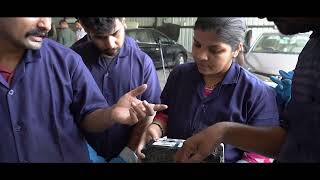
EV Hands-on Training in Pune on Tata Tiago EV 🚘🔧

🎓 Placement
Build Your Career in the EV Industry Like Prabhat Gautam!
🏭 Lab Tour
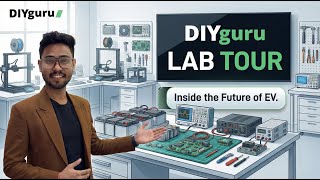
DIYguru Lab Tour — E-Mobility Hardware Lab

🔩 Hardware
Introducing the Ultimate EV Training Kit by DIYguru & EVI Technologies

🌟 Alumni
Empowering Futures: Nitin Agarwal's Journey with DIYguru in EV

🚀 About Us
Welcome to DIYguru — India's #1 E-Mobility & FutureTech Platform

📊 Placement
Placement Spotlight: A Journey of Skills, Sustainability & Smart Choices

💬 Story
This Is More Than a Career Story — When Learning Meets Purpose

🌍 International
Mustafa From North Africa 🔥🔥 — Global EV Training
🎤 Masterclass
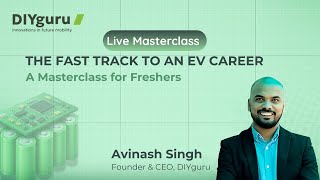
THE FAST TRACK TO AN EV CAREER — Masterclass by Avinash Singh
Ready to build your EV career? Talk to our counsellors today.
BOOK FREE CONSULTATION →
Your journey starts here.
DIYguru is India's leading AICTE-approved platform, equipping engineers, graduates, and professionals with the future-ready skills needed in Electric Vehicles (EVs), Battery Technology, Solar Energy, Green Hydrogen, and Clean Mobility.
Whether you're starting out or shifting your career toward sustainability — your journey begins here.
Why Choose DIYguru?
- AICTE-Approved Certifications
- Industry-Curated Courses (EV, Battery Design, Solar, Embedded Systems, BMS, MATLAB & more)
- Project-Based Learning using real case studies from Tesla, Tata Motors, Ather, and others
- Global Opportunities – Connect with 300+ hiring partners and international universities
- Work on Real-World Tools like MATLAB, SolidWorks, Python, Simulink, Ansys
Your journey starts here.
Ready to Begin? Drop your info, and we'll help you get there!
🔒 Your information is secure and will never be shared.
🎬 Unlock This Video
Enter your details to watch
Get instant access + free EV career guidance from our counsellors.
Please fill all fields correctly.
🔒 Your data is secure. We'll send you free EV career resources.
We help you solve your career growth problems
FIND YOUR PERFECT EV PROGRAM
Course Advisor Tool
ADMISSIONS 2026
Download Prospectus
Over 1.2 Million+ EV learners impacted worldwide

innovating mobility, creating futures.
DIYguru represents a dynamic and integral part of the e-mobility ecosystem, offering a comprehensive suite of services that encompasses R&D, training, hiring, and consulting. The trusted emobility education, research & consulting firm providing expert guidance and personalized solutions to help clients unlock their full mobility potential.


🎯 Free 5-Minute Assessment
Where do you stand in the EV revolution?
India will create 1 crore EV jobs by 2030. Take this 5-minute assessment to discover:
- ✅ Your current EV knowledge score
- ✅ Your strongest & weakest domains
- ✅ Career pathway & salary band that matches you
- ✅ Free EV Career Path Guidebook (PDF)
⏱️ 5 minutes
📝 10 questions
🎁 Free PDF guide
Used by 50,000+ EV professionals trained by DIYguru.
Question 1 of 10
⏱ 5:00
✅ Assessment Complete
Your result is ready!
Tell us where to send your detailed result + EV Career Path Guidebook (PDF). Our counselor will also guide you personally on WhatsApp.
By submitting, you agree to receive career guidance from DIYguru. Call: 9910918719
Analyzing your EV profile...
Matching you with career pathways...
0%
💪 Strongest Area
—
📈 Area to Improve
—
💰 Salary Potential
—
📊 Your Domain Breakdown
📘
Your Free EV Career Path Guidebook
50+ pages of career roadmaps, salary benchmarks & certification guidance for India's EV industry.
🎓 DIYguru Recommended Track
Explore this program →
🤖 Why EV is the AI-Proof Career Choice
Let's Connect
Training programs · B2B partnerships · College workshops
🎓
Certification
Programs
Programs
🏢
B2B Corporate
Training
Training
🏫
College
Workshops
Workshops
🤝
Partnership &
Collaboration
Collaboration
Your data is secure · No spam · Expert callback within 2 hours