⚡ UPDATES
PG in EV & Embedded Systems — IIT Jammu (12 Months) Flagship M.Tech in EV Technology — 24 Month Program Open DET Entrance Test — Unlock Scholarship Up to ₹25,000 Scholarship 50,000+ Professionals Trained Nationwide Placement Drive — 183+ Hiring Partners ASDC & AICTE NEAT Certified Programs PG in EV & Embedded Systems — IIT Jammu (12 Months) Flagship M.Tech in EV Technology — 24 Month Program Open DET Entrance Test — Unlock Scholarship Up to ₹25,000 Scholarship 50,000+ Professionals Trained Nationwide Placement Drive — 183+ Hiring Partners ASDC & AICTE NEAT Certified Programs
Accredited by


📅
Bharat eMobility Recruitathon 2026
Delhi: Mar 21-23 | Pune: May 21-24
Call: 9910918719
WhatsApp Us
ASDC
AICTE NEAT
IIT Jammu
50K+ Trained
© 2026 DIYguru Mobility Pvt. Ltd.


🔋 India Battery Technology Hub 2026 · Curated by DIYguru × IIT Jammu I3C · ASDC · AICTE NEAT · Call +91-9910918719
🔋 Battery Technology Knowledge Hub
India's Battery Technology Landscape — The Complete 2026 Guide
From cell chemistries (LFP, NMC, NCA, solid-state) to BMS architecture, thermal management, recycling, and the ₹18,100 Cr ACC PLI scheme powering India's 115 GWh battery demand by 2030. With 2026 data, policy context, and the oil crisis that's reshaping everything.
115 GWh
India's Li-ion demand by 2030 (ICEA)
903 GWh
Total energy storage target 2030 (CEEW)
₹18,100 Cr
ACC PLI for 50 GWh cell manufacturing
~100%
India's current Li-ion cell import reliance
SECTION 1 · FUNDAMENTALS
How Lithium-Ion Batteries Actually Work — The 2-Minute Primer
Before you can evaluate LFP versus NMC or design a battery pack, you need to understand what's happening inside the cell. Here's the essential physics in plain English.
A lithium-ion battery is, at its heart, a device that stores energy by moving lithium ions between two materials — a cathode (positive electrode) and an anode (negative electrode) — separated by an electrolyte and a thin porous separator. When you charge the battery, lithium ions travel from the cathode to the anode, storing energy. When you discharge it (drive your EV, power your phone), the ions migrate back, releasing that stored energy as electricity.
The genius of lithium-ion, discovered commercially in 1991 by Sony, is that this shuttling can happen thousands of times with minimal degradation — unlike lead-acid or nickel-cadmium chemistries that physically consume or corrode their electrodes. This reversibility is what makes Li-ion the dominant chemistry for EVs, consumer electronics, and grid storage.
Why batteries are the single most important EV component
Batteries account for 40–50% of an EV's total cost. They determine range, charge speed, lifespan, safety profile, and even weight distribution. The entire EV industry's competitiveness rides on one number: cost per kWh. In 2010, that number was $1,100/kWh. By 2025, it was around $130/kWh. By 2030, it's projected to approach $80/kWh — the point at which EVs become unambiguously cheaper than ICE vehicles on every metric.
For India specifically, batteries are the single largest strategic chokepoint. India assembles 85% of its EVs domestically but imports nearly 100% of its cells — almost all from China. Solving this import dependency is the defining industrial challenge of India's EV decade.
Global Battery Pack Price Decline — The Story of a Decade
Volume-weighted average Li-ion pack price, $/kWh, 2010–2030 projection
Source: BloombergNEF Battery Price Survey 2024; Argonne National Laboratory ANL/CSE-24/1; IEA Global EV Outlook 2025
SECTION 2 · CELL CHEMISTRIES
The Battery Chemistry Wars — LFP, NMC, NCA, Solid-State & Sodium-Ion
Not all lithium-ion batteries are the same. The cathode chemistry determines cost, safety, range, lifespan, and even which raw materials you depend on. Here's the 2026 landscape.
| Chemistry | Energy Density | Cycle Life | Cost (2026) | Safety | Best For |
|---|---|---|---|---|---|
| LFP (LiFePO4) | 90–160 Wh/kg | 3,000–5,000 cycles | $80–100/kWh | ★★★★★ (stable to 270°C) | Entry EVs, e-buses, fleet, ESS |
| NMC (NCM) | 150–250 Wh/kg | 1,000–2,000 cycles | $120–150/kWh | ★★★ (runaway at ~210°C) | Mid/premium EVs, long-range PV |
| NMC 811 / NCA | 250–300 Wh/kg | 800–1,500 cycles | $130–170/kWh | ★★ (lowest thermal margin) | Luxury EVs, performance cars |
| LTO (Li-Titanate) | 60–120 Wh/kg | 10,000+ cycles | $150–200/kWh | ★★★★★ (extreme temp tolerant) | Ultra-fast charging, e-buses |
| Sodium-ion | 100–160 Wh/kg | 2,000–4,000 cycles | $60–90/kWh (est.) | ★★★★★ (abundant raw materials) | Stationary storage, e-rickshaws |
| Solid-state (emerging) | 400–500+ Wh/kg | 1,000–2,000 cycles | TBD (2027+) | ★★★★★ (no flammable electrolyte) | Premium EVs post-2027 |
Sources: UFine Battery (2026), EV Lithium, ScienceDirect Comparative Studies, BloombergNEF, go-e Magazine (Oct 2025). Energy density figures are at cell level; pack-level densities are typically 15–25% lower.
The LFP Comeback — Why India's Market is Pivoting
For most of the 2010s, NMC dominated EV cells because range anxiety was the consumer's #1 fear. NMC's higher energy density (150–250 Wh/kg vs LFP's 90–160) meant a longer-range car in the same space. But 2023–2026 has seen a quiet revolution: LFP has overtaken NMC in global EV production volume, driven by four compounding advantages.
1. Cost: LFP is 15–30% cheaper per kWh — no cobalt (which costs $30–40/kg), less nickel. Raw materials are iron and phosphate, abundant everywhere.
2. Safety: LFP is stable up to 270°C vs NMC's 210°C thermal runaway threshold. In a puncture or crash, LFP typically emits some smoke; NMC can ignite.
3. Lifespan: LFP delivers 3,000–5,000 full cycles before reaching 80% capacity vs NMC's 1,000–2,000. In fleet applications (buses, taxis, delivery), this is decisive.
4. Cell-to-pack innovation: BYD's Blade Battery and CATL's Qilin CTP architecture have narrowed the pack-level energy density gap with NMC to just 10–15%.
For India specifically, LFP is the pragmatic winner. Our use cases are dominated by 2-wheelers, 3-wheelers, e-buses, and entry-level PVs — where safety, cycle life, and cost trump maximum range. Ola Electric, Tata Motors, and most Indian fleet OEMs have standardised on LFP. Tesla uses LFP in its standard-range Model 3 and Model Y. Volkswagen, Renault, and SAIC have announced expanded LFP adoption for 2026+.
What's coming next — Solid-state and Sodium-ion
Solid-state batteries replace the liquid electrolyte with a solid one (ceramic or polymer). Projected energy densities of 400–500+ Wh/kg could enable 500-mile EVs with sub-15-minute charging — and with no flammable electrolyte, catastrophic fire risk drops to near zero. Toyota, QuantumScape, Solid Power, and CATL are racing to production. Limited commercial launches expected 2027–2028, mainstream adoption 2030+.
Sodium-ion batteries swap lithium for sodium — abundant in seawater, no supply chain chokepoints. Reliance New Energy (using acquired Faradion IP) is commissioning 2 GWh of sodium-ion capacity in 2026 for stationary storage. For India, this chemistry is strategically important because it completely sidesteps the lithium import problem. Expect e-rickshaw, entry 2W, and ESS applications from 2027 onwards.
SECTION 3 · BATTERY COMPONENTS
Anatomy of a Cell — The 4 Critical Components
Every lithium-ion cell is built from four active components. Understanding them is essential to understanding why India's cell manufacturing is 100% import-dependent today.
⚡
Cathode
The positive electrode — determines chemistry name (LFP, NMC, NCA). Made from lithium compounds + iron/nickel/cobalt/manganese. India: 0% refining capacity today. Global leader: China.
🔋
Anode
The negative electrode — typically graphite, moving toward silicon-doped graphite for higher capacity. Petroleum-coke based (synthetic) or mined (natural). India: minimal domestic capacity.
💧
Electrolyte
The medium through which lithium ions travel between electrodes. Typically LiPF6 salt in organic carbonate solvents. Flammable — which is why solid-state is the holy grail. India: near-zero production.
🛡️
Separator
Thin porous membrane (polyethylene/polypropylene) that prevents direct contact between electrodes while allowing ions to pass. Critical safety component. India: minimal specialty capacity.
Why component-level manufacturing is the missing layer
The ACC PLI scheme funds cells. But cells are built from cathode powder, anode graphite, electrolytes, and separators — and India has almost zero domestic production of any of these inputs. Even Ola Electric's commissioned 1.4 GWh of cells depends on imported CAM (cathode active material) and graphite.
This is the quiet crisis behind the ACC PLI delivery gap. The IEEFA/JMK Research January 2026 report called it out directly: "India lacks a mature cell manufacturing ecosystem, including critical mineral refining and cell component production, which leaves the industry almost entirely dependent on imports from China." Fixing this requires a parallel PLI at the component level, which multiple policy think tanks have now recommended.
Early movers addressing this gap include Epsilon Advanced Materials (announced cathode plants in Telangana, Karnataka, Tamil Nadu; acquired German LFP CAM facility in Feb 2024) and Himadri Specialty Chemicals (anode graphite). But India's cathode and anode output will remain below 5% of domestic demand through at least 2028.
SECTION 4 · BATTERY MANAGEMENT SYSTEM
The BMS — The Brain Inside Every EV Battery
A battery pack is a collection of hundreds to thousands of cells wired in series and parallel. Without a Battery Management System (BMS), they would degrade or catch fire within weeks. Here's what the BMS actually does.
What the BMS manages
The BMS is an electronic control system — typically a printed circuit board with a microcontroller, voltage/current/temperature sensors, balancing circuits, and communication interfaces (CAN bus, sometimes wireless). It performs six critical functions continuously, every few milliseconds, over the entire 8–15 year life of the battery pack.
1. State of Charge (SoC) estimation — how full is the battery? This sounds simple but isn't: Li-ion voltage doesn't vary linearly with charge, and temperature and age both distort readings. Modern BMS use Kalman filters and coulomb counting to achieve ±2% SoC accuracy.
2. State of Health (SoH) monitoring — how degraded is the battery? Tracks cycle count, capacity fade, and internal resistance rise over thousands of cycles.
3. Cell balancing — cells drift from each other over time. The weakest cell limits the whole pack. Active or passive balancing keeps them aligned.
4. Thermal management — commands the cooling system to keep cells in their ideal 15–45°C window. Overheating triggers thermal runaway; undercooling kills cycle life.
5. Safety protection — disconnects the pack via contactors if voltage, current, or temperature limits are exceeded. This is what prevents most EV fires.
6. Communication — reports to the vehicle's main ECU, to charging infrastructure (via ISO 15118 or CHAdeMO protocol), and increasingly to cloud fleet management platforms.
Why BMS is where Indian startups can actually compete
Unlike cell manufacturing (capex-heavy, technology-licensed from Asia), BMS is software + standard electronics. India has strong talent in embedded systems, power electronics, and control theory — and BMS design does not require a gigafactory. Several Indian startups and Tier-1s have built competitive BMS platforms: Ola Electric's Move OS, Ather's battery pack BMS, Log9 Materials, Tata AutoComp, Lucas-TVS, Exicom, Inverted Energy, and Inverted Labs.
For DIYguru learners specifically, BMS engineering is the single highest-ROI skill in India's battery industry. A trained BMS engineer commands ₹12–28 LPA in India's top EV OEMs, and the talent gap is acute: fewer than 3,000 properly trained BMS engineers exist in India today, against a projected 25,000+ needed by 2028.
SECTION 5 · INDIA MARKET
India's Battery Market — Where the Numbers Are Going
India is the fastest-growing battery market in the world. Here's the 2026 snapshot and the 2030 projection.
$14.01 Bn
India battery market 2026 (Mordor)
$23.3 Bn
Projected market by 2031 at 10.71% CAGR
115 GWh
Li-ion demand by 2030 (ICEA/Accenture)
48% CAGR
EV battery demand growth (ICEA)
Segment split — who's driving battery demand
India's battery demand is concentrated across four application segments, each with different chemistry preferences and volume trajectories:
• Automotive (EVs) — 39.6% of battery market share in 2025, growing at 15.2% CAGR. Predominantly LFP for 2W/3W/e-buses/entry PV; NMC for premium PV. Ola, Tata, Mahindra, Ather, TVS, Bajaj, Hyundai, MG — all major consumers.
• Consumer electronics — 28% share in 2023. Smartphones, laptops, wearables. Dominated by NMC/NCA for energy density. India largely imports cells; pack assembly domestic.
• Stationary energy storage — fastest growth segment. 12.8 GWh of grid-scale BESS auctioned 2022–May 2025. India needs 903 GWh of total energy storage by 2030 (CEEW). LFP and sodium-ion dominate.
• Industrial & telecom backup — data centres, UPS, telecom towers. Transitioning from lead-acid to Li-ion. Long, steady growth curve.
Manufacturing cluster geography
Four states — Gujarat, Tamil Nadu, Karnataka, and Maharashtra — host 72% of India's installed and announced battery manufacturing capacity. The driver: port access for imported components, state-level capital subsidies (15–30% in Tamil Nadu/Karnataka), electricity duty exemptions, and dedicated industrial land.
Marquee investments include Tata Group's 20 GWh facility at Sanand, Gujarat (₹13,000 Cr Phase 1, potential 40 GWh expansion), Ola Electric's Krishnagiri gigafactory (Tamil Nadu), Reliance New Energy's Jamnagar complex (integrated cell + ESS), and Waaree Energy Storage Solutions' 20 GWh facility (raised ₹1,003 Cr in 2026).
SECTION 6 · POLICIES IN EFFECT
The Policy Architecture Supporting India's Battery Ambition
Three layers of policy — central, state, and industrial — are simultaneously active in 2026 to build the 30% EV by 2030 target. Batteries are at the centre of all of them.
🏛️ Central Govt
National Schemes for Batteries
- ACC PLI Scheme (₹18,100 Cr)50 GWh battery cell manufacturing target by 2026. Beneficiaries: Reliance, Ola, Rajesh Exports. Re-tender after Hyundai Global exit. Min DVA 25% in 2 years, 60% in 5 years.
- PM E-DRIVE (₹10,900 Cr)Flagship EV demand-incentive scheme. ₹2,000 Cr for 72,300 chargers — directly creates battery demand. Active Oct 2024 – Mar 2026, extended to 2028 for several categories.
- Auto & Components PLI (₹25,938 Cr)Covers BMS, motors, power electronics — the layer around the cell. Growing Indian Tier-1 supplier ecosystem.
- Union Budget 2026-27Removes basic customs duty (BCD) on Li-ion battery cell machinery and critical minerals processing equipment — lowers capex barrier for new entrants.
- Battery Waste Management Rules 2022Extended Producer Responsibility (EPR) framework with phased recycling targets from 2027-28. Creates demand for Attero, Lohum, BatX, Gravita.
- GST: 5% on EVs, 18% on batteriesStructural fiscal advantage. Batteries sold separately have higher GST but swappable battery models can be structured as service.
🏛️ States
State-Level Battery Support
- Gujarat25% capital subsidy on charging infra. 100% electricity duty exemption. Hosts Tata's 20 GWh Sanand gigafactory. Dedicated EV/battery manufacturing policy.
- Tamil NaduIndia's battery manufacturing hub. Up to 50% land cost subsidy for EV projects. Hosts Ola Electric's Krishnagiri gigafactory. Capital subsidy 25–30%.
- KarnatakaFirst state with EV policy (2017). 15% capital subsidy for EV sector investment. Epsilon Advanced Materials cathode plant in Karnataka.
- Maharashtra₹535 Cr total EV subsidy outlay (highest in India). ₹5,000/kWh incentive for all EV categories — directly subsidises bigger battery packs.
- Delhi₹6,000 home charger subsidy. EV tariff just ₹4.5/kWh. Mandates 1 EV charger per 5 parking spots in new construction.
- Telangana₹15,000 retrofit subsidy (for converting petrol to EV — creates retrofit battery demand). Hyderabad is a growing battery assembly hub.
🏭 Industrial
Upstream & Skilling
- National Critical Minerals MissionStrategic framework for domestic sourcing & refining of lithium, cobalt, nickel, manganese — addresses the ACC PLI's biggest bottleneck.
- NMET Auctions (Lithium)5.9 million tonne lithium reserves in Reasi (J&K). Re-tendered after first auction failed; fresh exploration blocks in Karnataka & Rajasthan.
- Viability Gap Funding for BESSUp to 40% project capital cost coverage for 4 GWh of battery energy storage systems by 2030-31.
- Skill India Mission (1 Cr EV Jobs)ASDC-driven curriculum expansion. NSDC-AICTE collaboration on EV and battery nanodegrees. DIYguru is a leading ASDC training partner.
- PM-SETU / ITI TransformationModernising ITIs to include battery assembly and testing labs.
- State Industrial PoliciesTamil Nadu/Maharashtra/Gujarat/Karnataka offer 15–30% capital subsidy + electricity duty exemption + interest subvention for battery manufacturing.
SECTION 7 · THE OIL RESILIENCE PILLAR
Why the 2026 Oil Crisis Is the Biggest Tailwind Batteries Have Ever Had
Every barrel of oil India doesn't import is a barrel of battery demand created. The 2026 Strait of Hormuz crisis has reframed batteries from "climate solution" to "national security hardware".
⚠ ACTIVE GLOBAL CRISIS · APRIL 2026
"The Greatest Threat to Global Energy Security in History"
The IEA Executive Director Fatih Birol called the 2026 Strait of Hormuz disruption the largest supply disruption in the history of the global oil market. Iran's closure of the strait disrupted 20% of global oil supplies. Brent crude surged 60%+ in March 2026. On 11 March, IEA member countries unanimously agreed to release 400 million barrels of emergency oil stocks — the largest-ever coordinated release.
Source: IEA Energy Markets Update April 2026, IEEFA Middle East Crisis Tracker, World Economic Forum (April 2026)
The chain reaction — from Hormuz to battery demand
India imports 85% of its crude oil and 45% from the Middle East. When the Strait of Hormuz closes, the effect on domestic fuel prices, forex reserves, and inflation is immediate and severe. As of mid-March 2026, 1.6 million tonnes of crude oil sat stranded aboard Indian-flagged vessels awaiting passage. The Government proposed a ₹573 billion economic stabilization fund to manage the shock.
The only structural fix — not just a short-term subsidy — is electrification. And electrification depends on batteries. Three concrete shifts are already visible in policy formation:
1. Battery manufacturing urgency has been elevated from "industrial policy" to "national security imperative". Expect faster approvals, extended timelines for ACC PLI beneficiaries, and new PLI rounds for cell components.
2. Grid-scale BESS deployment is accelerating — the IEEFA April 2026 analysis confirms India is accelerating permitting for wind, solar, and batteries as direct response to the crisis.
3. Fleet electrification (e-buses, e-3W, last-mile delivery) is being fast-tracked — these segments deliver the largest oil displacement per rupee of subsidy, and they're predominantly LFP-powered.
Wood Mackenzie's prolonged-disruption scenario (April 9, 2026) projects that global oil demand could be 20% below the base case by 2050 — with that displacement coming primarily from accelerated battery-powered electrification. For India, every percentage point of EV penetration translates directly to reduced oil import bills and improved balance of payments.
SECTION 8 · MANUFACTURING READINESS
India's Battery Manufacturing Self-Sufficiency Scorecard
Batteries only deliver energy security if they're made here. Here's the honest 2026 scorecard of where India stands on each component of the battery value chain.
India's Battery Value Chain Readiness — 2026 vs 2030 Targets
Where India is self-sufficient vs where import dependency remains
Battery Pack Assembly (BMS, thermal, casing)
~70%
Pack assembly is well-localised. All major EV OEMs (Tata, Ola, Ather, Mahindra, TVS) build their own packs. Cells imported, pack-level value addition domestic.
BMS Design & Manufacturing
~55%
Indian BMS engineering ecosystem is growing rapidly. Ola, Ather, Tata AutoComp, Lucas-TVS, Log9, Exicom active. Chips imported but design local.
Battery Cell Manufacturing (vs 50 GWh PLI target)
~2.8%
Only 1.4 GWh of the 50 GWh ACC PLI target commissioned by Oct 2025 (entirely Ola Electric). Reliance to commission 10 GWh on time. Tata 20 GWh Sanand under construction. Major shortfall.
Cathode Active Material (CAM)
<3%
Epsilon Advanced Materials building CAM plants in Telangana, Karnataka, Tamil Nadu. Most CAM still imported from China. Dedicated component-level PLI needed.
Anode Active Material (AAM / Graphite)
~5%
Himadri Specialty Chemicals and Epsilon developing domestic anode graphite. Synthetic graphite vulnerable to 2026 petroleum coke disruption.
Electrolytes & Separators
<5%
Near-zero domestic capacity for specialty electrolyte salts and high-quality separator membranes. 100% import dependency, primarily from China, Japan, Korea.
Lithium / Cobalt / Nickel Refining
<5%
5.9 MT lithium reserves identified in Reasi (J&K) — 8-10 year extraction timeline. Manikaran Power building ₹1,000 Cr lithium refinery in Gujarat. Almost 100% battery-grade material imported.
Battery Recycling Capacity (vs 128 GWh demand by 2030)
~2 GWh
Attero, Lohum, BatX Energies, Tata Chemicals, Gravita, ACE Green ramping. NITI Aayog projects 128 GWh recyclable batteries by 2030. Largest single opportunity in the ecosystem.
Trained Battery Workforce (vs 25K BMS engineers + 70K technicians)
~8%
Fewer than 3,000 properly trained BMS engineers in India today. DIYguru, IIT Jammu I3C, and ASDC addressing this gap via structured programs.
What the honest scorecard tells us
India is strong at the top of the battery stack (pack, BMS) and weak at the bottom (materials, refining, cells). This is the inverse of what a self-sufficient industry looks like. The fix requires layered intervention:
• Critical Minerals Mission with dedicated incentives for refining (not just mining) of lithium, cobalt, nickel, manganese.
• Component-level PLI for cathode materials (CAM), anode materials (AAM), electrolytes, and separators — the layers below cells that India currently has near-zero capacity for.
• Tariff protection via Basic Customs Duty (BCD) and anti-dumping measures while domestic capacity ramps.
• Skilled visa flexibility — PLI beneficiaries have repeatedly cited Chinese technical specialist visa delays as a delivery blocker.
• R&D and talent development — IIT-led research centres (like IIT Jammu I3C), industry-aligned training (DIYguru, ASDC), and dedicated battery engineering tracks at AICTE-approved institutions.
The 2030 picture, if all pillars deliver: India produces ~50 GWh of cells, refines its own lithium and nickel, recycles 60+ GWh of batteries domestically, supports 1 crore EV sales annually, and saves ~$50 billion in annual oil import bills. The maths works. Execution is the only variable.
🎯 INDIA'S 30% BY 2030 COMMITMENT
Batteries Are the Linchpin of India's EV Decade
30% EV penetration by 2030 is impossible without a domestic battery industry. The ACC PLI must deliver, the Critical Minerals Mission must refine raw materials, and 25,000+ BMS engineers must be trained. Every other pillar — charging, policy, oil resilience — compounds through batteries.
30%
EV penetration target by 2030
50 GWh
Domestic cell manufacturing target
$50 Bn
Annual oil import savings potential
25,000+
BMS engineers needed by 2028
SECTION 9 · REAL-WORLD APPLICATIONS
Where Batteries Are Being Deployed in India Today
Beyond EVs, batteries underpin renewable energy integration, telecom, industrial backup, and grid stability. Here's where demand is coming from.
Automotive · 39.6%
Electric Vehicles
India's biggest battery consumer. 2W/3W/buses dominate today (LFP-heavy); PVs growing fastest. 24.52 lakh EVs sold FY26 per FADA. Tata Nexon, Ola S1, Ather 450X, Mahindra XUV 400 among volume leaders.
Grid Storage · Fastest Growth
Stationary Energy Storage (BESS)
12.8 GWh auctioned 2022–May 2025 for hybrid and standalone grid applications. CEEW projects 903 GWh storage demand by 2030. LFP and emerging sodium-ion dominate for cost and cycle life.
Consumer Electronics · 28%
Smartphones, Laptops, Wearables
Mature market. NMC/NCA chemistry dominant for energy density. Cells imported; India's role is pack assembly for device OEMs. Dixon Technologies, Bharat FIH, Foxconn India active.
Telecom & Data Centres
Backup Power (UPS/BMS)
Transitioning from lead-acid to Li-ion. Telecom towers (4 lakh+ in India) moving to LFP for longer life. Data centres adopting Li-ion for higher efficiency. Exide, Amara Raja, Schneider, Vertiv serving.
Residential · Rising
Home Energy Storage
Rooftop solar pairing with home batteries growing in tier-2/3 cities. Luminous Power, Su-Vastika, Tata Power active. LFP preferred for safety and 10+ year lifespan.
Battery Swapping
Battery-as-a-Service (BaaS)
Ather's Bangalore swap network does 8,000 transactions/day. Sun Mobility, Battery Smart, Bounce Infinity growing. Decouples battery cost from vehicle cost — a uniquely Indian business model.
🏛️ THINK TANK & CONSULTING
DIYguru Battery Technology Practice
We help governments, OEMs, battery startups, ITIs, and international partners build India's battery ecosystem. Our work spans OEM workforce planning, cell manufacturing feasibility, BMS curriculum design, lab infrastructure, state policy inputs, and international market entry.
OEM Workforce PlanningBMS engineers, technicians, battery assembly staff
Gov AdvisoryState battery policies, critical minerals strategy, PLI inputs
Cell/Pack FeasibilityMarket sizing, chemistry selection, capex modelling
Lab SetupBattery testing, BMS dev labs, ITI modernisation
B2B NanodegreesCorporate L&D on battery tech, BMS, thermal mgmt
International MarketsAustralia, Fiji, Saudi, Malaysia battery expansion
Engage DIYguru Battery Team
We work with Tier-1 suppliers, OEMs, startups, MSMEs, ITIs, state missions, and international partners. Advisors include IIT Delhi and IIT Jammu I3C faculty, ASDC leadership, and battery industry veterans from Bosch, Tata, Exide.
IIT Jammu I3C
ASDC
AICTE NEAT
NSDC
Bosch
Tata
Hyundai
Exide
FICCI
EMO Energy
Talk to Battery Team →
SECTION 10 · LEARN & UPSKILL
DIYguru Battery Technology Programs
From beginner BMS basics to IIT Jammu-certified nanodegrees — the learning pathway to India's battery industry careers.
FLAGSHIP · 6-month Nanodegree
Battery & BMS Design, Analysis & Simulation
IIT Jammu × ASDC × AICTE NEAT · ₹12-28 LPA roles → 3-month Professional CertBattery Technology & Powertrain Engineering
For working professionals · upskill path → Short Cert · SpecialistElectric Vehicle Powertrain Engineering
Motor + battery + controls integration → ITI/Diploma FriendlyCertified EV Technician (CEVT)
Battery handling, diagnostics, repair → 3-month Professional CertCharging Technologies & Hydrogen Fuel Cell
EVSE, CCS-2, battery charging systems → Flagship · 6 monthsElectric Vehicle Course (IIT Jammu × ASDC)
Covers battery + motor + VCU + charging →
FAQ
Frequently Asked Questions — Battery Technology 2026
The questions learners, engineers, and EV industry professionals ask most often about battery technology in India and globally.
LFP (Lithium Iron Phosphate) and NMC (Nickel Manganese Cobalt) are two dominant Li-ion cathode chemistries. LFP has lower energy density (90-160 Wh/kg vs NMC's 150-250 Wh/kg) but is cheaper ($80-100/kWh vs $120-150/kWh), safer (thermal stability to 270°C vs 210°C), and lasts longer (3,000-5,000 cycles vs 1,000-2,000). NMC is preferred for long-range premium EVs where range per kg matters; LFP is preferred for entry EVs, e-buses, fleet vehicles, and stationary storage. In 2026, LFP has overtaken NMC in global EV production volume, driven by cost advantage and BYD/CATL's cell-to-pack innovations.
Mordor Intelligence (Feb 2026) values India's battery market at $14.01 billion in 2026, projecting $23.30 billion by 2031 at a 10.71% CAGR. ICEA/Accenture project India's Li-ion battery demand will reach 115 GWh by 2030, with EV battery consumption growing at 48% CAGR. CEEW projects total energy storage demand (EV + stationary) at 903 GWh by 2030. India's share of global EV battery market revenue was 8.6% in 2024, and India is the fastest-growing regional market in Asia Pacific.
The Advanced Chemistry Cell Production Linked Incentive (ACC PLI) scheme launched October 2021 with ₹18,100 crore outlay to establish 50 GWh of battery cell manufacturing capacity by 2026. As of October 2025, only 2.8% (1.4 GWh) has been commissioned — entirely by Ola Electric. Reliance plans to commission 10 GWh on time. Reasons for underperformance per IEEFA/JMK Research (Jan 2026): India lacks upstream ecosystem (critical mineral refining and cell components are nearly 100% imported from China), aggressive 2-year installation timeline, stringent domestic value addition requirements (25% in 2 years, 60% in 5 years), and visa delays for Chinese technical specialists.
A BMS is the electronic brain of a battery pack. It continuously monitors voltage, current, and temperature of every cell (hundreds to thousands in an EV), estimates State of Charge (SoC) and State of Health (SoH), balances cells to prevent drift, commands the cooling system, communicates with the vehicle ECU and charging infrastructure, and disconnects the pack via contactors if safety limits are exceeded. Without a BMS, Li-ion packs would degrade rapidly or catch fire. BMS design requires embedded systems expertise, control theory, and battery chemistry knowledge — making it one of the highest-paying skills in India's EV industry (₹12-28 LPA).
The 2026 Iran/Hormuz crisis has elevated battery manufacturing from industrial policy to national security imperative. India imports 85% of crude oil and 45% from the Middle East — the crisis disrupted 20% of global oil supplies and pushed Brent crude up 60%+ in March 2026. The IEEFA's April 2026 analysis confirms India is accelerating permitting for batteries and EVs as direct response. Wood Mackenzie projects global oil demand could be 20% below baseline by 2050 from accelerated electrification. Concretely: battery manufacturing timelines are being expedited, fleet electrification (e-buses, e-3W) is being fast-tracked, and grid-scale BESS deployment is accelerating.
India imports nearly 100% of its lithium-ion battery cells, primarily from China. Reasons: (1) Cell manufacturing requires massive capex ($325-450 million per 5 GWh facility per CEEW) and supply chain expertise India's first-time manufacturers lack. (2) Upstream components — cathode active material (CAM), anode graphite, specialty electrolytes, separator membranes — have near-zero domestic production. (3) Critical minerals (lithium, cobalt, nickel) are 100% imported in battery-grade refined form. 5.9 MT lithium reserves were discovered in Reasi J&K in 2023, but extraction is 8-10 years away. The Critical Minerals Mission is the strategic response to this gap.
Gujarat, Tamil Nadu, Karnataka, and Maharashtra host 72% of India's installed and announced battery manufacturing capacity. Gujarat offers 25% capital subsidy + 100% electricity duty exemption and hosts Tata's 20 GWh Sanand gigafactory. Tamil Nadu provides up to 50% land cost subsidy and hosts Ola Electric's Krishnagiri gigafactory. Karnataka offers 15% capital subsidy and hosts Epsilon's cathode materials plant. Maharashtra's ₹535 Cr EV subsidy outlay creates the largest demand pull. State subsidies stack with central PLI incentives — making the combined support the strongest since India's EV manufacturing ambitions began.
Solid-state batteries replace the liquid electrolyte in conventional Li-ion cells with a solid one — typically ceramic or polymer. The key advantages: (1) Energy densities of 400-500+ Wh/kg at cell level (2x current NMC), enabling 500-mile EVs. (2) No flammable liquid electrolyte — dramatically reduces fire risk. (3) Potential sub-15-minute charging. Major developers: Toyota, QuantumScape, Solid Power, CATL, Samsung SDI. Limited commercial launches expected 2027-2028, mainstream EV adoption 2030+. For India, solid-state is a long-term opportunity — buying time means catching up on current Li-ion chemistry while preparing for the next transition.
India's battery industry needs 25,000+ BMS engineers, 70,000+ battery-trained technicians, and thousands of cell manufacturing, testing, and quality engineers by 2028. Roles and typical compensation: (1) BMS Engineer — ₹12-28 LPA. (2) Battery Pack Design Engineer — ₹10-22 LPA. (3) Thermal Management Engineer — ₹10-20 LPA. (4) Cell Manufacturing Engineer — ₹8-16 LPA. (5) Battery Testing & Validation — ₹7-14 LPA. (6) Battery Service Technician — ₹3-6 LPA. DIYguru's Battery & BMS Nanodegree (6 months, IIT Jammu × ASDC certified) is the flagship pathway for engineering graduates; Certified EV Technician (CEVT) is the path for ITI/diploma candidates.
Battery recycling recovers lithium, cobalt, nickel, manganese, and graphite from end-of-life cells and reintroduces them into new cell manufacturing. Two dominant processes: (1) Pyrometallurgical — high-temperature smelting; recovers metals but loses lithium. (2) Hydrometallurgical — chemical leaching; higher recovery rates. NITI Aayog projects 128 GWh of recyclable batteries available by 2030 (46% from EVs). India's current recycling capacity is just ~2 GWh — making this the largest single opportunity in the battery ecosystem. Active companies: Attero, Lohum Cleantech, BatX Energies, Tata Chemicals, Gravita, ACE Green Recycling. Battery Waste Management Rules 2022 establish Extended Producer Responsibility (EPR) with phased targets from 2027-28.
Yes. DIYguru's Battery Technology Practice serves governments, battery OEMs and startups, Tier-1 suppliers, MSMEs, ITIs, and international partners. Services include OEM workforce planning, cell/pack feasibility studies, BMS curriculum design, battery testing lab setup, ITI modernisation, state battery policy advisory, B2B corporate nanodegrees, and international market entry (Australia, Fiji, Saudi, Malaysia). Our advisors include faculty from IIT Delhi (Dr. BK Panigrahi, Head CART), IIT Jammu I3C, ASDC leadership, and battery industry veterans. Reach us via WhatsApp at +91-9910918719 or our offices in Delhi (Sultanpur) and Bangalore (JP Nagar, Micelio Mobility).
Continue Reading from the DIYguru Knowledge Hub
Pillar Page
Electric Vehicle Knowledge Hub
The complete India & global EV landscape — market, projections, charging, recycling, service infrastructure.
Policy Hub
India EV Policy 2030 Roadmap
The 3-pillar policy architecture: central + state policies, oil crisis, local manufacturing. PM E-DRIVE + ACC PLI explained.
Course
India's #1 Electric Vehicle Course
6-month flagship by IIT Jammu × ASDC × AICTE NEAT. 4.8★ from 5,345 learners. Covers battery + motor + controls.
All Programs
52 EV & Battery Programs
From M.Tech degrees to 5-day workshops. Browse the complete DIYguru training catalogue.
Batteries Will Power India's EV Decade — Be a Builder
Whether you're an engineer, a policymaker, an OEM, or a startup founder — DIYguru is the training and consulting partner trusted by 50,000+ professionals, 300+ companies, and government bodies across 170+ countries.
Our Clients
Trusted by 528+ Companies & OEMs
From global automotive OEMs and Tier-1 suppliers to EV startups, government bodies, and Fortune 500 companies.


Swipe to see more partners
Showing 39 of 528+ corporate training partners
Accreditations
Programs Recognised by Govt. Bodies & Industries
DIYguru is recognized and endorsed by major educational and governmental organizations including the Ministry of Education, NITI Aayog, and NEAT AICTE for its commitment to upskilling in automotive and EV technologies. The institute also collaborates with industry leaders like TATA Technologies and the Ola Mobility Institute to ensure the relevance and practicality of its training programs.


Swipe to see more accreditations
In The Media
DIYguru in the Press
ANI News
IIT Jammu Enters Into Collaboration With DIYguru To Launch Certificate Programs in EV Sector
Read →
PTI News
Tata Technologies Partners With DIYguru for Industry-Relevant E-Mobility Programs
Read →
The Print
DIYguru Partners With L&T Edutech for E-Mobility Training — Hardware-Enabled PG Program
Read →
Times of India
DIYguru and ADYPU Launch M.Tech Program in Electric Vehicle
Read →
Economic Times
DIYguru and Ajeenkya DY Patil University To Launch Integrated PG, M.Tech in EV
Read →
India Education Diary
AICTE–DIYguru MOU To Provide Jobs To One Million EV Workforce
Read →
Autocar Professional
ASDC & DIYguru Launch Nanodegree Program To Upskill Students in EV Technology
Read →
SiliconIndia
Tata Technologies & DIYguru Join Forces To Power India's Next-Gen eMobility Talent
Read →
TV9 Hindi
इलेक्ट्रिक कारों के मैकेनिक की बढ़ रही मांग — DIYguru से बना सकते हैं करियर
Read →
Zee News
Great Opportunity To Earn in the World of Electric Vehicles — Training & Method
Read →
National Skills Network
Roundtable on Skill Development for Electric Vehicles — DFID, ASDC & SSOU
Read →
Hindustan
DIYguru से हार्डवेयर सक्षमता के साथ EV बिजनेस और इंजीनियरिंग सीखें
Read →
Watch DIYguru
Lab Tours, Placements & Real Stories
🔧 Hands-On
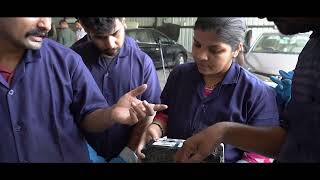
EV Hands-on Training in Pune on Tata Tiago EV 🚘🔧

🎓 Placement
Build Your Career in the EV Industry Like Prabhat Gautam!
🏭 Lab Tour
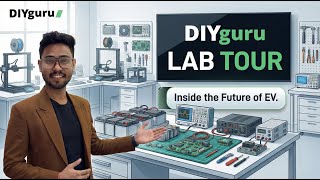
DIYguru Lab Tour — E-Mobility Hardware Lab

🔩 Hardware
Introducing the Ultimate EV Training Kit by DIYguru & EVI Technologies

🌟 Alumni
Empowering Futures: Nitin Agarwal's Journey with DIYguru in EV

🚀 About Us
Welcome to DIYguru — India's #1 E-Mobility & FutureTech Platform

📊 Placement
Placement Spotlight: A Journey of Skills, Sustainability & Smart Choices

💬 Story
This Is More Than a Career Story — When Learning Meets Purpose

🌍 International
Mustafa From North Africa 🔥🔥 — Global EV Training
🎤 Masterclass
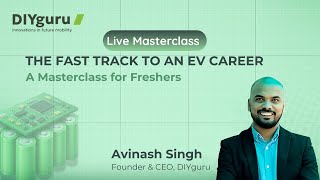
THE FAST TRACK TO AN EV CAREER — Masterclass by Avinash Singh
Ready to build your EV career? Talk to our counsellors today.
BOOK FREE CONSULTATION →
Your journey starts here.
DIYguru is India's leading AICTE-approved platform, equipping engineers, graduates, and professionals with the future-ready skills needed in Electric Vehicles (EVs), Battery Technology, Solar Energy, Green Hydrogen, and Clean Mobility.
Whether you're starting out or shifting your career toward sustainability — your journey begins here.
Why Choose DIYguru?
- AICTE-Approved Certifications
- Industry-Curated Courses (EV, Battery Design, Solar, Embedded Systems, BMS, MATLAB & more)
- Project-Based Learning using real case studies from Tesla, Tata Motors, Ather, and others
- Global Opportunities – Connect with 300+ hiring partners and international universities
- Work on Real-World Tools like MATLAB, SolidWorks, Python, Simulink, Ansys
Your journey starts here.
Ready to Begin? Drop your info, and we'll help you get there!
🔒 Your information is secure and will never be shared.
🎬 Unlock This Video
Enter your details to watch
Get instant access + free EV career guidance from our counsellors.
Please fill all fields correctly.
🔒 Your data is secure. We'll send you free EV career resources.
We help you solve your career growth problems
FIND YOUR PERFECT EV PROGRAM
Course Advisor Tool
ADMISSIONS 2026
Download Prospectus
Over 1.2 Million+ EV learners impacted worldwide

innovating mobility, creating futures.
DIYguru represents a dynamic and integral part of the e-mobility ecosystem, offering a comprehensive suite of services that encompasses R&D, training, hiring, and consulting. The trusted emobility education, research & consulting firm providing expert guidance and personalized solutions to help clients unlock their full mobility potential.


🎯 Free 5-Minute Assessment
Where do you stand in the EV revolution?
India will create 1 crore EV jobs by 2030. Take this 5-minute assessment to discover:
- ✅ Your current EV knowledge score
- ✅ Your strongest & weakest domains
- ✅ Career pathway & salary band that matches you
- ✅ Free EV Career Path Guidebook (PDF)
⏱️ 5 minutes
📝 10 questions
🎁 Free PDF guide
Used by 50,000+ EV professionals trained by DIYguru.
Question 1 of 10
⏱ 5:00
✅ Assessment Complete
Your result is ready!
Tell us where to send your detailed result + EV Career Path Guidebook (PDF). Our counselor will also guide you personally on WhatsApp.
By submitting, you agree to receive career guidance from DIYguru. Call: 9910918719
Analyzing your EV profile...
Matching you with career pathways...
0%
💪 Strongest Area
—
📈 Area to Improve
—
💰 Salary Potential
—
📊 Your Domain Breakdown
📘
Your Free EV Career Path Guidebook
50+ pages of career roadmaps, salary benchmarks & certification guidance for India's EV industry.
🎓 DIYguru Recommended Track
Explore this program →
🤖 Why EV is the AI-Proof Career Choice
Let's Connect
Training programs · B2B partnerships · College workshops
🎓
Certification
Programs
Programs
🏢
B2B Corporate
Training
Training
🏫
College
Workshops
Workshops
🤝
Partnership &
Collaboration
Collaboration
Your data is secure · No spam · Expert callback within 2 hours