



E-rickshaws in India: the biggest EV segment nobody talks about
E-rickshaws move millions of people every day, especially in north and east India, and they're one of India's largest EV categories by volume.
Uttar Pradesh, West Bengal, Bihar, Assam and Delhi together account for close to 80% of e-rickshaw registrations. In Assam, e-rickshaws make up about half of all EV registrations.
E-rickshaw (L3) vs electric auto (L5): what's the difference?
| E-rickshaw / e-cart (L3) | Electric auto (L5) | |
|---|---|---|
| Top speed | Up to 25 km/h | Above 25 km/h (typically 45–55 km/h) |
| Motor | Low power, typically 1–1.5 kW (BLDC) | Several kW (PMSM / BLDC) |
| Load | 4 passengers + 40 kg luggage (e-rickshaw), or goods (e-cart) | 3 passengers or goods, like a CNG auto |
| Battery | 48 V lead-acid or 51.2 V lithium | Lithium, often 7–10 kWh |
| Price | Entry models from around ₹60,000; most under ₹2 lakh | Typically ₹3–4 lakh+ |
| Where you see them | Last-mile city routes, small towns, markets | City routes, longer trips, cargo |
E-rickshaw rules in India: licence, registration, permits and subsidy
| Requirement | What applies |
|---|---|
| Definition | Battery-operated three-wheeler for hire, max speed 25 km/h, up to 4 passengers (excluding the driver) and 40 kg luggage. E-carts carry goods. |
| Type approval | Buy only models approved under CMVR (tested by agencies such as ICAT or ARAI). Unapproved "local" e-rickshaws can't be registered. |
| Registration | Mandatory, with a number plate. States are cracking down on unregistered vehicles: West Bengal ran a mandatory registration drive for its "toto" e-rickshaws in 2025–26. |
| Driving licence | The driver needs a valid licence for e-rickshaws. Commercial operation may also need a PSV badge, depending on the state. |
| Permit | Battery-operated vehicles have long been exempt from transport permits. A July 2026 MoRTH notification extends the exemption for seven years and links it to fitting an AIS-140 vehicle tracking device. Ask your RTO how this applies to e-rickshaws in your state. |
| Insurance & fitness | Third-party insurance is compulsory; commercial vehicles need a valid fitness certificate. |
| Number plate | EVs carry green plates; commercial EVs use yellow lettering on green. |
| Subsidy (PM E-DRIVE) | For registered e-rickshaws and e-carts: ₹2,500 per kWh of battery, capped at ₹12,500 per vehicle and at 15% of the ex-factory price, within a limited national quota. Electric 3-wheeler support runs until 31 March 2028. The dealer claims it at sale, so ask whether your model is on the approved list. |
Delhi: draft rules published 18 October 2026Delhi's draft E-Rickshaw (Registration and Operation) Scheme 2026 proposes a cap of 2.5 lakh e-rickshaws in the city, a limit of five vehicles for individual owners (who must be Delhi residents) and 100 for companies, and an aggregator licence for fleets of 25 or more. Every vehicle would need an e-rickshaw compliance certificate (linked to registration, fitness and insurance, valid for two years), and every driver a valid licence and PSV badge. Existing owners would get 90 days to comply. The draft was open for public feedback for 30 days, so check the final notification.
Rules differ by state and change often. Check with your local RTO or transport department before buying, registering or converting a vehicle.
How an e-rickshaw works
Follow the e-rickshaw energy path
- The battery supplies DC energy within its operating limits.
- The controller interprets demand and switches motor phase power.
- The motor drives the axle through the vehicle transmission.
- Road load, passenger mass and hills affect the energy required.
Why range varies
Usable energy, speed, tyre condition, gradients, stops and payload all matter. A nominal battery label cannot establish real route range.
- Battery: usually under the passenger seat. Lead-acid sets are four 12 V batteries in series (48 V); lithium packs are one unit, often 51.2 V.
- Controller: turns battery power into three-phase current for the motor and handles speed modes, reverse and regen. See our motor controller guide for wiring and error codes.
- Motor and differential: a frame-mounted BLDC motor, typically 1–1.5 kW, drives the rear axle through a differential gearbox.
- Charger: an off-board charger that plugs into a wall socket and must match the battery type.
- DC-DC converter: steps 48 V down to 12 V for lights, horn and indicators.
Lead-acid vs lithium battery for e-rickshaws
Explore series and parallel cells
Example cells are identical 3.2 V nominal, 5 Ah units. This small arithmetic example is not an e-rickshaw pack specification or construction guide. Actual full-charge voltage, cell limits, protection and charger compatibility require validated manufacturer data.
Lead-acid is cheaper to buy. Lithium is usually cheaper to own.
Lead-acid (4 × 12 V)
- Lower upfront cost, typically ₹28,000–40,000 a set
- Often needs replacing about every 12 months with daily use
- ~8 hours to charge
- Heavy: around 120–140 kg for the set
- Needs water topping and terminal cleaning
- Range drops noticeably as it ages
- Old batteries have scrap / exchange value
Lithium (51.2 V LFP)
- Higher upfront cost, often ₹70,000–1,00,000 for ~100 Ah
- Lasts several years (LFP cells rated for thousands of cycles)
- ~3–4 hours to charge with a matched charger
- Light: often 40–55 kg, so better pickup and range
- No water topping; a BMS protects the cells
- Range stays steady for most of its life
- Needs the right charger and controller settings
| Lead-acid | Lithium (LFP) | |
|---|---|---|
| Usable capacity | ~50–60% (deep discharge shortens life) | ~80–90% |
| Charge efficiency | Lower: more electricity wasted as heat | Higher: less electricity per km |
| Typical daily range | ~70–80 km when new | ~100+ km on a 100 Ah pack |
| Opportunity charging | Short top-ups harm life | Quick top-ups between shifts are fine |
| Safety | Acid and hydrogen gas while charging; ventilate | LFP is the safest lithium chemistry; buy certified packs with a BMS |
Prices and life vary by brand, capacity, usage and heat. Use your own quotes in the calculator below.
How much would you save by switching? Enter your daily km and battery prices.
Use the savings calculator ↓Lead-Acid → Lithium Savings Calculator
Your lead-acid set is due for replacement. Should you buy another one or switch to lithium? Enter your daily running and the prices you've been quoted. You'll see your 5-year saving, monthly saving and break-even point. Unlock the full report to get the lithium pack, charger and controller settings for your rickshaw, a cost chart, and the questions to ask before you buy.
1. Your rickshaw & batteries
Battery voltage: 48 V = four 12 V batteries, 60 V = five. Extra earning: faster charging and steadier range can mean more trips. Leave it at 0 for a cautious estimate. Paying at a charging point? Enter its rate per unit (kWh) as the electricity cost.
2. Your saving with lithium
🔒 Get your lithium conversion spec & payback report (free)
The exact pack, BMS, charger and controller settings for your rickshaw, a 5-year cost chart, what-if scenarios, the questions to ask any battery seller, and a safe-fitting checklist. Print it and take it to your dealer.
Estimates for planning only. Battery life depends on brand, depth of discharge, heat, load and charging habits. Use real quotes, and follow the battery maker's instructions.
Converting an e-rickshaw from lead-acid to lithium, safely
Work through compatibility before conversion
1. Identify the existing vehicle
Record its exact model, battery configuration, controller operating range, charger and vehicle approval documentation. Similar nominal voltages do not prove compatibility.
2. Review the complete replacement system
Have a qualified provider assess battery mounting, mass distribution, cables, protection, charger, communication, warranty and applicable approval requirements together.
3. Validate and document
Obtain the approved procedure and commissioning records. Confirm charging behaviour and route performance without exceeding the rated payload. Do not bypass the BMS or modify live battery wiring.
A lithium pack isn't just a bigger battery. The charger and controller have to match it too.
- Check your system voltageMost e-rickshaws are 48 V (four 12 V batteries); some are 60 V (five). The lithium replacement is usually 51.2 V (16 LFP cells in series) or 64 V (20 cells).
- Choose the capacity for your daily kmRoughly 45 Wh per km for a loaded passenger e-rickshaw. For 90 km a day at 51.2 V, that's about a 100 Ah pack with some reserve. The calculator above sizes it for you.
- Buy a certified pack with a proper BMSLFP cells, a BMS rated for your controller's current, a metal or IP65 casing, and a written warranty. Ask for test reports and BIS certification for the cells.
- Use a matching lithium chargerA 16S LFP pack needs a 58.4 V CC-CV lithium charger. Never charge lithium with the old lead-acid charger.
- Reset or replace the controllerSet the low-voltage cut-off to suit lithium (about 44–45 V for 16S LFP) and make sure the controller accepts 58.4 V when the pack is full.
- Fit it securely with a fuseMount the pack firmly in the tray on rubber pads, away from water splash, with a DC fuse on the positive cable and proper crimped lugs.
- Test and keep the paperworkCheck voltage, charging and a test run with full load. Keep the invoice and warranty card, and ask your insurer and RTO whether the change needs recording.
Avoid cheap "assembled" packsMany e-rickshaw fires start with uncertified packs: recycled cells, no BMS or a weak one, loose wiring, or the wrong charger. A lower price today can cost the whole vehicle. Read our EV fire & battery safety guide.
Lithium options without buying a pack
- Battery leasing / rental: pay monthly for a lithium pack instead of buying it. EVreporter reported one model at about ₹3,600 a month over 36 months.
- Battery swapping: swap a discharged pack for a charged one at a station, paying per swap or per month. Good for high-km drivers in cities with dense swap networks. Waiting times at peak hours can be long.
- Buying a new lithium e-rickshaw: many makers now fit lithium as standard, often with longer battery warranties.
E-rickshaw motor and controller: common problems
Explore BMS and drive fault scenarios
These scenarios explain possible responses, not the cause of a real fault. Codes and protective behaviour vary by model and firmware.
Most e-rickshaws use a 48 V BLDC motor of about 1,000–1,500 W driving the rear axle through a differential, with a 48 V controller that has forward/reverse and two or three speed modes. When a rickshaw "won't pull", the motor is rarely the first suspect.
| Symptom | Check first |
|---|---|
| Weak pickup, slows on bridges and slopes | Battery voltage under load (an ageing lead-acid set sags), loose battery links, overloading |
| Jerks when starting | Hall sensor connector and wires, throttle signal |
| Cuts off, then works after a rest | Low-voltage cut-off from a weak battery; controller overheating |
| Display on, but no movement | Brake cut-off switch stuck, reverse or speed switch fault |
| Humming, grinding or noise from the rear | Phase wires, differential oil and bearings, brake drag |
| Range drops suddenly | One weak battery in the set (test each 12 V battery), tyre pressure, brake drag |
| Random faults after rain | Water in connectors; dry, clean and seal them |
Seeing an error code or LED blink? Look it up by number or symptom.
Open the controller error-code lookup →Running cost and earnings of an e-rickshaw
Estimate energy cost per kilometre
Cost per kilometre = wall energy in Wh/km ÷ 1,000 × tariff. Add battery depreciation, tyres, servicing, finance and downtime separately. Measure wall energy over a representative route; do not count charging losses twice.
Electricity is the small part of the bill. A loaded e-rickshaw uses around 4–5 units (kWh) from the wall for 90 km on lithium, a little more on lead-acid. At ₹8–12 a unit, that's ₹35–60 a day. Battery replacement is the big cost, and that's where lead-acid hurts.
| Typical monthly cost (90 km/day, 26 days) | Lead-acid | Lithium |
|---|---|---|
| Electricity (₹10/unit) | ~₹1,500 | ~₹1,150 |
| Battery (cost spread over its life) | ~₹2,170 (₹26,000 net every 12 months) | ~₹1,320 (₹79,000 over 5 years) |
| Battery upkeep | ~₹100 | Negligible |
| Total | ~₹3,770 | ~₹2,470 |
Illustrative, using the calculator's default values. Your own quotes will change the result.
What do drivers earn?
Earnings depend heavily on the city and route. EVreporter's 2023 study of e-rickshaw drivers found typical incomes of around ₹20,000 a month, with many paying an EMI of around ₹8,000 on the vehicle. That's why the jump from a ₹30,000 lead-acid set to a ₹80,000–90,000 lithium pack is hard without finance, leasing or swapping, even though lithium is cheaper over its life.
- Own vs rent: many drivers rent the rickshaw daily from an owner; the owner pays for batteries, so lithium mainly helps owners and fleets.
- Charging time is earning time: lead-acid needs about 8 hours; lithium about 3–4 hours, and short top-ups between shifts don't harm it.
- Lighter is better: dropping 70–80 kg of battery weight improves pickup on bridges and slopes and reduces wear.
E-rickshaw maintenance and charging safety
Save a daily operating checklist
0 of 6 reviewed
Saved ticks record your review in this browser; they do not certify vehicle safety.
Daily
Tyre pressure, brakes, lights and horn. Look for loose or hot battery cables. Don't run lead-acid below about 20%.
Weekly
Clean battery tops and terminals; apply petroleum jelly on lead-acid terminals. Check for swollen or leaking batteries.
Monthly
Top up lead-acid with distilled water only. Check each 12 V battery voltage after charging; one weak battery pulls the whole set down.
Every 3–6 months
Differential oil, wheel bearings, brake shoes, suspension, chassis welds and the controller and motor connectors.
Charging safety
- Use the charger made for your battery type and voltage. A lithium pack needs a lithium charger.
- Charge in an open, ventilated place. Lead-acid gives off hydrogen while charging.
- Use a proper metered socket with an earthed connection and an MCB/RCCB. Avoid loose extension boards and illegal hooking.
- Don't charge a battery that is swollen, leaking, smelling or very hot.
- Don't charge many rickshaws unattended in a closed room or under a staircase.
- Keep a fire extinguisher (ABC or CO₂ for the electrics) near any charging point used by several rickshaws.
Running a charging point for several rickshaws? Use the safety checklist in our EV fire & battery safety guide and the load checks in our EV charging guide.
Buying an e-rickshaw: a checklist
- The model is type-approved (ask for the approval certificate) and can be registered at your RTO
- Battery type, voltage, capacity (Ah) and its warranty in writing
- Motor power and controller rating; spare parts available locally
- A strong chassis, good brakes, and a proper roof and seats
- Whether the model qualifies for the PM E-DRIVE incentive, and that it's shown on the invoice
- Registration, insurance and number plate included in the on-road price
- Service support near you: how far is the nearest workshop?
- Finance or EMI terms, and the total amount you'll pay
E-rickshaw business and careers
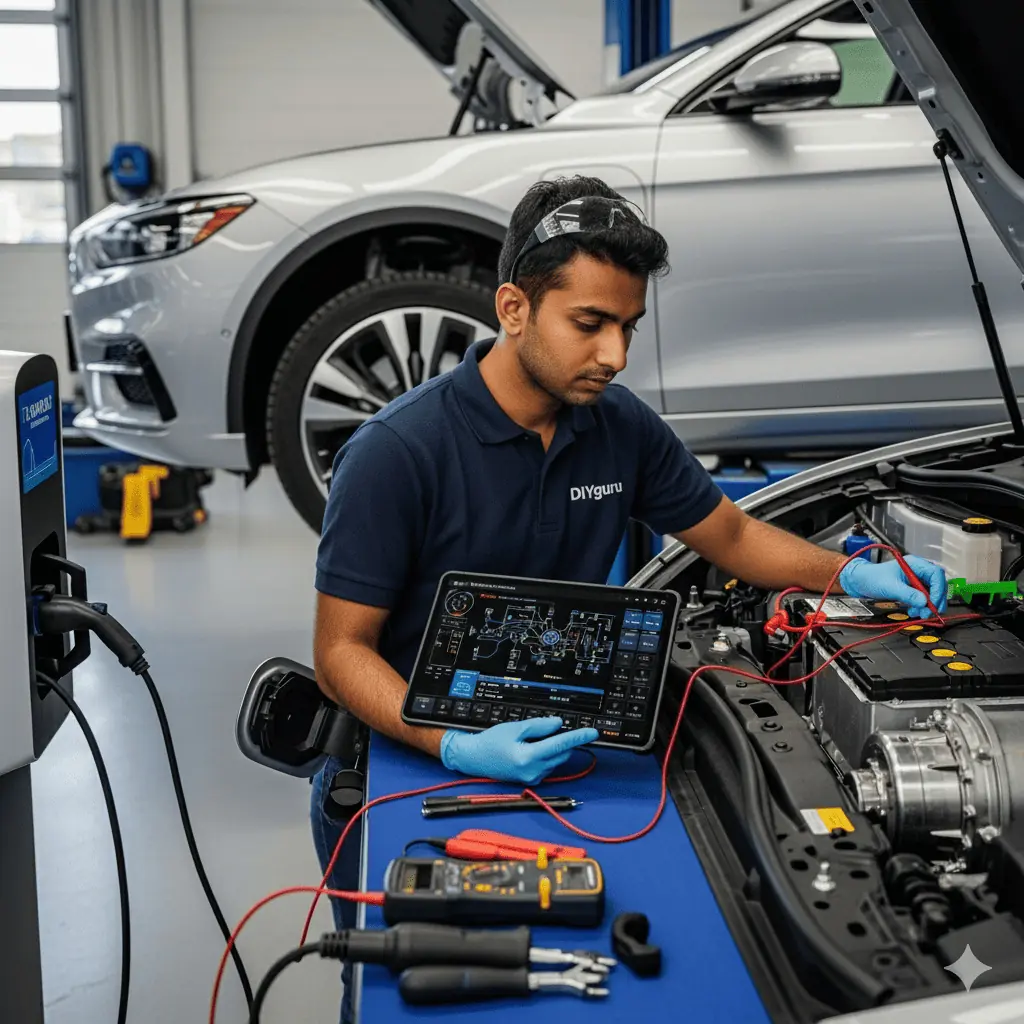
With lakhs of e-rickshaws added every year, the bigger opportunity is often keeping them running: battery service, lithium conversion, controller repair and fleet maintenance. Trained EV technicians are in short supply in most towns.
E-rickshaw & 3W EV technician
Diagnoses battery, controller, motor and wiring faults. The skill every e-rickshaw workshop needs.
Battery & lithium conversion specialist
Tests lead-acid sets, fits and configures lithium packs, BMS and chargers.
Workshop / service-centre owner
Runs a 2W/3W EV service business, with repairs, AMCs for fleets and spares.
Fleet operator
Owns and rents out e-rickshaws or e-carts; battery cost and uptime decide profit.
Dealer
Sells vehicles, batteries and service; a trained technician turns one sale into years of business.
Charging-point operator
Runs a safe, metered charging point for local rickshaws.
ई-रिक्शा: लेड-एसिड या लिथियम बैटरी?
ज़्यादातर ई-रिक्शा में 48 वोल्ट की लेड-एसिड बैटरी (12 वोल्ट की चार बैटरियाँ) लगती है। यह सस्ती है, लेकिन रोज़ चलाने पर अक्सर लगभग हर साल बदलनी पड़ती है। लिथियम (LFP) बैटरी शुरू में महँगी है, पर कई साल चलती है, 3–4 घंटे में चार्ज होती है, हल्की है और बिजली भी कम खाती है।
- रोज़ 80–100 किमी चलाने पर लिथियम का खर्च आमतौर पर लगभग 1.5–2 साल में निकल आता है।
- लिथियम बैटरी के साथ लिथियम चार्जर ही इस्तेमाल करें। पुराना लेड-एसिड चार्जर कभी न लगाएँ।
- कंट्रोलर की लो-वोल्टेज कट-ऑफ़ लिथियम के हिसाब से सेट करवाएँ।
- सिर्फ़ BMS वाली, सर्टिफ़ाइड बैटरी और लिखित वारंटी के साथ खरीदें।
- ई-रिक्शा का रजिस्ट्रेशन, बीमा और ड्राइवर का लाइसेंस ज़रूरी है।
- चार्जिंग खुली, हवादार जगह पर और सही अर्थिंग वाले सॉकेट से करें।
अपनी बचत जानने के लिए ऊपर दिया सेविंग्स कैलकुलेटर इस्तेमाल करें। ई-रिक्शा मैकेनिक बनना चाहते हैं? DIYguru का CEVT कोर्स देखें, या हमें +91 99109 18719 पर कॉल करें।
E-rickshaw glossary
16 terms
- Ah
- Ampere-hours describe charge capacity, not energy by themselves.
- Wh
- Watt-hours describe energy; nominal volts multiplied by ampere-hours gives nominal watt-hours.
- BMS
- Battery management system monitors and limits battery operation.
- Series
- Identical cells in series add nominal voltage.
- Parallel
- Identical cells in parallel add ampere-hour capacity.
- SOC
- State of charge is an estimate of remaining charge.
- SOH
- State of health describes ageing relative to a defined reference.
- Controller
- Electronics that regulate power supplied to the motor.
- Regen
- Regeneration recovers some mechanical energy when the vehicle supports it.
- Payload
- The permitted carried load, as specified for the vehicle.
- Cycle life
- Cycles achieved under stated test conditions, not a universal calendar guarantee.
- Payback
- Time for defined savings to recover an incremental cost under model assumptions.
- Wall energy
- Energy measured at the electricity supply, including charging losses.
- Nominal voltage
- A representative label; not necessarily full-charge or minimum voltage.
- Derating
- Reduction of allowable output to stay within operating limits.
- Precharge
- Controlled charging of circuit capacitance before normal connection.
E-rickshaw official resources and learning
Check Parivahan vehicle and driving-licence services and your state transport authority for requirements that apply to your exact vehicle and location. Rules, route restrictions and incentives can change; do not assume a general guide confirms eligibility.
Continue with DIYguru electric vehicle training or explore DIYguru EV learning videos to build your understanding of batteries, controllers and service work.