- Case Study 2: Priya Sharma
- Transformation Journey
- Initial Challenges
- Skill Development Path
- Key Transformation Strategies
- Career Impact
- Narrative Takeaway
- FAQs1. What skills are required to transition from an ICE mechanic to an EV technician?
- 2. Why is high-voltage safety certification important for EV technicians?
- 3. How can traditional mechanics learn EV repair and maintenance?
- 4. What are the major differences between ICE and EV service jobs?
- 5. Do EV technicians earn more than traditional mechanics?
- 6. Which tools are essential for EV diagnostics and repair?
- 7. What is the role of software in EV servicing?
- 8. Can women succeed in EV servicing careers like Priya Sharma?
- 9. What certifications are required to work on EV high-voltage systems in India?
- 10. How does EV upskilling improve career growth for service technicians?
Case Study 2: Priya Sharma #
Previous Role: Automotive Service Technician
Current Role: Electric Vehicle Diagnostics Expert
Transformation Journey #
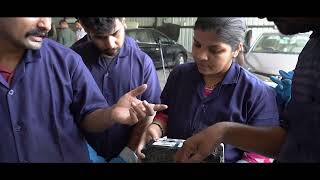
Priya Sharma’s career began in a modest neighborhood garage in Jaipur, where she worked as a service technician specializing in two- and four-wheeler ICE repairs. Her daily routine revolved around oil changes, carburetor cleaning, clutch plate replacements, and engine overhauls.
While her mechanical instincts were sharp, the rise of electric mobility presented a new frontier she was unequipped to handle. When her workshop began receiving EVs for servicing, she quickly realized:
- Traditional expertise was insufficient – no spark plugs, fuel pumps, or gearboxes to repair.
- High-voltage systems posed safety risks far beyond the 12V systems she was used to.
- Diagnostics shifted from spanners to software tools — laptops and OBD-II scanners replaced screwdrivers.
Rather than risk being left behind in the transition, Priya made a decisive pivot to upskill herself in high-voltage EV systems.
Initial Challenges #
- Knowledge Barrier: Priya had almost no background in electrical engineering.
- Certification Pressure: High-voltage safety training was mandatory, but costly and time-consuming.
- Fear Factor: Handling 400V+ battery packs carried risks of electrocution if protocols were not followed.
- Gender Bias: As a woman in a male-dominated garage ecosystem, her choice to specialize in EVs was often doubted by peers.
Skill Development Path #
Priya mapped out a structured learning approach:
- High-Voltage Safety Certification
- Completed Level 1 & 2 training for safe handling of battery systems.
- Learned lockout-tagout (LOTO) procedures and proper use of insulated tools & PPE.
- Advanced Diagnostic Tool Training
- Mastered usage of CAN analyzers, OBD-II scanners, and diagnostic laptops.
- Gained expertise in reading real-time voltage/current data from BMS (Battery Management Systems).
- EV Maintenance Specialization
- Enrolled in an EV Maintenance Technician Program covering:
- Battery pack dismantling/reassembly
- Inverter & motor troubleshooting
- Charging system diagnostics
- Enrolled in an EV Maintenance Technician Program covering:
- Digital Diagnostic Technologies
- Attended workshops on cloud-based service platforms that remotely monitor EV health.
- Practiced predictive maintenance workflows using IoT-driven alerts.
Key Transformation Strategies #
- Hands-On Practical Training: Volunteered at EV service camps organized by OEMs to get live practice.
- Safety-First Culture: Adopted a “safety over speed” approach — double-checking isolation before working on high-voltage systems.
- Continuous Updates: Followed new releases in EV repair manuals and joined WhatsApp/Telegram groups of certified EV technicians.
- Industry Certifications: Earned recognition through courses endorsed by Automotive Skills Development Council (ASDC), enhancing her credibility.
Career Impact #
- 38% Salary Increase within two years, due to specialization in high-demand EV diagnostics.
- Specialized Technical Expertise in battery and power electronics troubleshooting, making her indispensable.
- Enhanced Employability — received offers from both EV startups and established OEM service centers.
- Critical Industry Role — became a trainer for new technicians, empowering others to make the ICE-to-EV transition.
Narrative Takeaway #
Priya Sharma’s journey symbolizes the ground-level transformation of India’s automotive workforce. Mechanics who once thrived on carburetors and crankshafts must now become comfortable with high-voltage batteries, inverters, and digital diagnostics.
Her story highlights that the EV revolution is not just about engineers in R&D centers but also about grassroots technicians who keep vehicles on the road. By embracing upskilling, Priya not only secured her relevance but also positioned herself as part of the backbone of India’s EV service ecosystem.
FAQs
1. What skills are required to transition from an ICE mechanic to an EV technician? #
To transition successfully, technicians need to learn high-voltage safety protocols, battery pack handling, EV diagnostics using OBD-II/CAN tools, and inverter/motor troubleshooting.
2. Why is high-voltage safety certification important for EV technicians? #
Because EV systems operate at 400V+ (sometimes up to 800V), which can be fatal without proper insulation tools, PPE, and LOTO (Lockout-Tagout) procedures.
3. How can traditional mechanics learn EV repair and maintenance? #
They can enroll in EV maintenance certification programs, attend OEM service training workshops, and take ASDC-approved courses on EV diagnostics and high-voltage systems.
4. What are the major differences between ICE and EV service jobs? #
ICE repairs focus on engines, gearboxes, and fuel systems, whereas EV servicing involves batteries, power electronics, electric motors, and software-based diagnostics.
5. Do EV technicians earn more than traditional mechanics? #
Yes. Due to high demand and limited skilled workforce, certified EV technicians can earn 30-50% higher salaries compared to ICE mechanics.
6. Which tools are essential for EV diagnostics and repair? #
Essential tools include insulated hand tools, high-voltage gloves, CAN analyzers, OBD-II scanners, thermal cameras, and EV-specific diagnostic software.
7. What is the role of software in EV servicing? #
Software plays a key role in diagnostics, predictive maintenance, and real-time monitoring of battery health, inverter status, and motor performance.
8. Can women succeed in EV servicing careers like Priya Sharma? #
Absolutely. With proper safety training and technical certifications, gender is no barrier in EV servicing roles, and many women are now entering this space.
9. What certifications are required to work on EV high-voltage systems in India? #
ASDC Level 1 & 2 High Voltage Safety certifications and OEM-specific EV maintenance programs are highly recommended.
10. How does EV upskilling improve career growth for service technicians? #
Upskilling in EV technology opens opportunities in OEM service centers, EV startups, and fleet maintenance companies, often with significant salary hikes and leadership roles.