



Your chapter progress
Progress is stored on this browser when available.
EV retrofitting in India: how conversion works
What changes in a conversion
Retrofitting replaces a vehicle's engine and fuel system with an electric powertrain, so the body, chassis, wheels, brakes and interior you already own keep working, now on battery power.
Pure electric conversion vs hybrid retrofit
Pure electric conversion
- Engine removed; the vehicle runs only on battery
- Standard: AIS-123 Part 3
- Fuel type on the RC changes to "Electric"
- What most people mean by "EV retrofit"
Hybrid retrofit
- Engine kept; an electric motor and battery assist it
- Standard: AIS-123 Part 1 (up to 3,500 kg) or Part 2 (heavier)
- Fuel use drops, but tailpipe emissions remain
- Rare in the Indian market today
Which vehicles are retrofitted in India
- Petrol scooters and motorcycles: hub-motor kits for popular models, mainly for daily commuters and delivery riders.
- Three-wheelers: diesel, petrol and CNG autos and cargo three-wheelers, the most active segment because they run 80–150 km a day.
- Cars: mostly small hatchbacks and sedans with approved kits, often for owners whose diesel or petrol car has crossed Delhi NCR's age limit.
- Goods vehicles and buses: fleet conversions of small trucks and city buses, usually through company or government contracts.
Is EV retrofitting legal? The rules explained
Approval is a documented chain
Retrofitting is legal under the Central Motor Vehicles Rules, but the approval is for a kit on a specific vehicle model, not for the conversion idea in general.
Changing a vehicle's propulsion is an alteration under the Motor Vehicles Act, so it needs the registering authority's approval. Rule 115D of the Central Motor Vehicles Rules (CMVR), inserted by the CMVR (First Amendment) Rules, 2019 (G.S.R. 167(E), 1 March 2019), sets out how hybrid and electric kits can be fitted to existing vehicles. The kit maker or supplier must get a type approval certificate from a test agency notified under CMVR Rule 126, and the kit must meet the matching part of AIS-123.
| Standard | Type of retrofit | Vehicles covered |
|---|---|---|
| AIS-123 Part 1 | Hybrid electric system kit (engine kept) | L, M and N category, gross weight up to 3,500 kg |
| AIS-123 Part 2 | Hybrid electric system kit (engine kept) | M and N category above 3,500 kg (buses, trucks) |
| AIS-123 Part 3 | Pure electric propulsion kit (engine removed) | L (two- and three-wheelers), M (passenger) and N (goods) categories |
What the approval process checks
Approval has two stages: the kit's components are tested, then the kit is tested fitted to a target vehicle. Tests include the change in weight, gradeability, brake performance, motor power, electromagnetic compatibility, functional and high-voltage safety, traction battery safety and wiring. Once passed, the certificate covers that kit on that vehicle model (and listed variants), and the maker can appoint dealers and installers to fit it.
The approval is model-specificA kit approved for one car model is not approved for a different model, even if the engine is the same. Before you pay anything, ask for the type approval certificate number and check that your exact make, model and variant is listed.
The four legal conditions, in short
- Approved kitType-approved under AIS-123 by a test agency such as ARAI, ICAT, NATRAX or VRDE, for your vehicle model.
- Authorised installationFitted by the kit maker or a dealer or retrofit centre it has authorised (and, where a state requires it, empanelled with the transport department).
- RTO endorsementThe RTO inspects the vehicle and records the change of fuel type to "Electric" on the RC.
- Insurance updatedYour insurer is told about the new powertrain and battery value. Without this, a claim can be rejected.
Once the RC says "Electric", the vehicle is treated as a battery-operated vehicle for registration. Ask your RTO about the green number plate and any road-tax benefit in your state, as practice varies. Retrofits do not get new-EV purchase subsidies such as PM E-DRIVE.
Delhi NCR: what the age limits mean for your old vehicle
Check before you commit
For an older vehicle in Delhi NCR, do not assume that fitting an electric kit automatically restores road-use or registration eligibility.
Start with your registration status, vehicle age, fuel type, category and exact variant. Ask the registering authority to confirm whether the proposed conversion and RC endorsement are permitted for that vehicle. Obtain this confirmation before committing to a kit.
Check the official retrofit route
Delhi publishes retrofit process information and manufacturer/installer notices. Check the current documents and certificate coverage with the authority and supplier; an older list is not proof that every listed approval remains valid today.
Switch Delhi retrofit process · Transport Department process-flow notice
Confirm eligibility and incentives separately
Registration permission, kit type approval, installer authorisation, insurance acceptance and any subsidy are separate questions. Do not include an incentive in your budget until the current notified scheme and your eligibility are confirmed. This guide does not establish the current outcome of age-limit litigation or guarantee a subsidy.
Before paying a deposit
- Request the current type-approval certificate and relevant extensions.
- Confirm coverage for the vehicle and configuration proposed.
- Confirm the installer’s authorisation and the RTO process.
- Get written scope, warranty, exclusions and refund conditions.
EV retrofitting in India: costs and feasibility
Understand the complete conversion budget
The battery is the biggest cost, usually 40–60% of the total. The bigger the range you want, the more you pay.
| Vehicle | Typical battery | Typical range | All-in cost (approx.) |
|---|---|---|---|
| Petrol scooter | 1.5–3.5 kWh | 50–100 km | ₹40,000–65,000 |
| Passenger three-wheeler (auto) | 5–12 kWh | 80–150 km | ₹95,000–1.9 lakh |
| Cargo three-wheeler | 6–14 kWh | 80–150 km | ₹1.15–2.2 lakh |
| Small car (hatchback / compact sedan) | 15–25 kWh | 80–150 km | ₹4–6 lakh |
| Larger car, SUV or small goods vehicle | 25–35 kWh | 100–150 km | ₹5–8 lakh+ |
Ranges from published Indian retrofit guides and market reports, 2025–2026. Quotes vary by kit maker, model, battery chemistry and city.
Where the money goes
- Battery pack with BMS: priced per kWh; LFP packs are cheaper per kWh and last more cycles, NMC packs are lighter.
- Kit: motor, controller, on-board charger, DC-DC converter, vehicle controller and display, high-voltage wiring, mounting brackets, and for cars a vacuum pump and electric drive for the AC compressor and power steering where needed.
- Installation: removing the engine and fuel system, fabrication, fitting and testing.
- Approvals and paperwork: inspection, RTO endorsement and fees. Kit makers often bundle these.
Running costs drop sharply: a small car that spends about ₹5.9 per km on petrol (₹95 a litre at 16 km/l) spends roughly ₹1.1 per km on home electricity at ₹8 a unit. Maintenance also falls, as there is no engine oil, filters, clutch or exhaust to service. Use the estimator below to work out your own numbers.
EV Conversion Feasibility & Cost Estimator
Tell us about your vehicle and how you use it. You'll see whether it's a good candidate for electric conversion, the likely all-in cost, the battery size and range you'd get, your monthly savings and the payback time, plus what Delhi NCR's age rules mean for you. Unlock the full report for the cost breakdown, a 5-year cost comparison, a kit specification and your paperwork checklist.
1. Your vehicle
2. How you use it
Mileage, fuel price and range are filled with typical values when you change the vehicle or fuel; edit them to match yours. Costs are 2026 market estimates, not quotes.
3. Your result
Estimated all-in conversion cost
🔒 Get your full Retrofit Feasibility Report (free)
Item-by-item cost breakdown, kit and battery specification, charging time, a 5-year cost comparison with your current vehicle, the paperwork checklist for your state, pre-conversion checks and the questions to ask any retrofitter. Print it or save it as a PDF.
Estimates for planning only, based on typical 2026 Indian market prices and energy use. Real quotes depend on the kit maker, your exact model, battery chemistry and city. Age-rule notes summarise court orders and policies and are not legal advice.
Approved retrofit kits, and how to check one
Match the certificate to the proposal
There is no single national list you can rely on for every model, so the check is yours: ask for paperwork before you pay.
Ask every retrofitter for these
- The type approval certificate number and the test agency that issued it (for example ARAI, ICAT, NATRAX or VRDE)
- Proof that your exact make, model and variant is covered by that certificate
- An authorisation letter from the kit maker, if the installer is a dealer or workshop
- In Delhi, confirmation that the kit maker is empanelled with the Transport Department
- Written warranty terms for the motor, controller and battery (years and km)
- Who files the RTO endorsement, and whether the quote includes it
- Where you'll get service and spare parts after the conversion
- Two or three customers with converted vehicles of the same model you can talk to
Companies reported in India's retrofit market
| Segment | Examples reported (2021–2026) |
|---|---|
| Delhi empanelled kit makers (first list, Dec 2021) | Etrio Automobiles, 3EV Industries, Booma Innovative Transport Solutions, Zero21 Renewable Energy Solutions, VELEV Motors India (ICAT-approved kits for two-, three- and four-wheelers) |
| Two-wheelers | Green Tiger Mobility (petrol scooter conversions, fixed or swappable battery) |
| Three-wheelers | Exponent Energy (Exponent Oto, for CNG/LPG autos), Compage Automation Systems (swappable batteries via Indofast Energy), E-Vidyut, RACEnergy |
| Cars and light commercial | Etrio (small Maruti models reported), Northway Motorsport (commercial vehicles), Loop Moto |
| Buses | Sai Green Mobility and Kalyani Powertrain (Telangana bus conversions) |
Named for information, from news and market reports. This is not an endorsement or a complete list, and approvals are model-specific and can change. NATRAX issued the first type approval for a retrofitted electric three-wheeler in September 2025, and more approvals are being added. Always check the current certificate.
Battery, range and performance after conversion
Nominal energy versus usable energy
Range depends on battery size and how much energy your vehicle uses per km. Choose the battery for your real daily distance plus a margin, not for the biggest number on the brochure.
| Vehicle | Typical energy use (from the battery) | Battery for ~100 km |
|---|---|---|
| Scooter | 25–35 Wh/km | 3–4 kWh |
| Motorcycle | 30–45 Wh/km | 3.5–5 kWh |
| Passenger auto | 50–70 Wh/km | 6–8 kWh |
| Cargo three-wheeler (loaded) | 60–85 Wh/km | 7–10 kWh |
| Small car | 110–140 Wh/km | 13–16 kWh |
| SUV / MUV | 150–190 Wh/km | 17–21 kWh |
| Small goods vehicle | 130–170 Wh/km | 15–19 kWh |
Battery for 100 km assumes 90% of the battery is usable, before any ageing margin. Traffic, load, AC, speed and hills change these numbers.
LFP or NMC?
LFP (lithium iron phosphate)
- Lower cost per kWh and more charge cycles (often 2,000+)
- More tolerant of heat; lower fire risk
- Heavier: about 7 kg per kWh at pack level
- The usual choice for three-wheelers and cars
NMC (nickel manganese cobalt)
- Lighter: about 5–6 kg per kWh at pack level
- More energy in less space, useful where space is tight
- Costs more; typically fewer cycles (around 1,000–1,500)
- Needs good thermal management and a capable BMS
Weight, charging and performance
- Weight: removing the engine, fuel tank and exhaust saves weight, but a large pack can add more. The converted vehicle must stay within its gross vehicle weight and axle limits, which reduces payload on goods vehicles.
- Charging time: battery kWh ÷ charger kW ÷ about 0.9. A 2.2 kWh scooter pack on a 0.5 kW charger takes about 5 hours from empty; a 19 kWh car pack on a 3.3 kW on-board charger takes about 6.5 hours, overnight at home.
- Performance: top speed and pick-up depend on motor power and system voltage. Low-voltage car kits (around 72–96 V) cost less but are usually slower; higher-voltage kits (300 V and above) perform better. Ask for the approved top speed and gradeability figures.
How to convert your vehicle: step by step
Conversion project milestones
- Check the vehicle and the rulesMake sure the body, chassis, brakes and suspension are sound, the RC and insurance are in order, and you understand the age rules where it's registered.
- Find an approved kit for your modelAsk kit makers and their dealers; confirm the type approval certificate covers your exact model and variant.
- Get a written quoteIt should state battery kWh and chemistry, expected range, motor power, top speed, warranty, and the total including installation and RTO work.
- Pre-conversion inspectionFix worn brakes, suspension, steering parts, tyres and rust first. They will carry the battery's weight.
- Conversion at an authorised centreEngine and fuel system out, motor, battery, controller, charger and wiring in. A scooter can take a day; a car can take one to three weeks.
- Testing and handover papersCollect the installer's fitment certificate, a copy of the type approval, the invoice and the warranty card.
- RTO endorsementApply for the alteration to be recorded on the RC with these papers; the RTO inspects the vehicle and changes the fuel type to "Electric". Many installers file this for you.
- Update your insuranceSend the updated RC and invoice to your insurer and get the policy endorsed for the new powertrain and battery value.
- First monthCharge on a proper earthed socket, and have connections and mounting bolts re-checked after the first few hundred km.
Documents you'll usually need
- Registration certificate (RC) and valid insurance
- Owner's ID and address proof
- Kit type approval certificate (copy) and the installer's fitment certificate
- Kit and installation invoice
- NOC from the financier, if the vehicle is on loan
Form names, fees and steps vary by state. Ask your installer or RTO for the current process.
Is EV retrofitting worth it?
When do operating savings recover the cost?
The answer depends on how far you drive, what the conversion costs compared with a new EV, and what would otherwise happen to the vehicle.
Good candidates
- Autos, cargo three-wheelers and delivery scooters running 60–150 km a day
- Vehicles in good condition that would otherwise be scrapped or sold off (e.g. over-age in Delhi NCR)
- Models with an approved kit and a local installer
- Fleets that can convert many identical vehicles
Poor candidates
- Rusty or badly worn vehicles
- Models with no approved kit
- Private cars driven only a little each day, where savings are small
- Nearly new vehicles still under the maker's warranty
Retrofit vs a new EV
| Retrofitted vehicle | New EV | |
|---|---|---|
| Upfront cost | Lower, often 30–60% of a new EV in the same class | Higher, but purchase incentives and road-tax waivers may apply |
| Battery warranty | Typically 2–3 years (or a km limit) on retrofit packs | Often 8 years for cars, 3–5+ years for two-wheelers |
| Range and features | Usually 80–150 km; basic display and controls | Designed in: connected features, fast charging, regen tuning |
| Safety design | Pack fitted into a body designed for an engine | Pack location and crash protection designed and tested from the start |
| Resale | Uncertain; buyers are still few | Established used-EV market |
| Environment | Reuses the existing body and chassis | New vehicle manufacturing footprint |
Safety and quality checks for a converted vehicle
Quality checks cover the whole vehicle
A good conversion looks tidy and well documented. A bad one is a fire and shock risk. Check these before you accept the vehicle.
High-voltage system
- Orange, properly rated high-voltage cables, clipped and protected from sharp edges and heat
- A main fuse, contactors and a manual service disconnect (or isolator) that a technician can reach
- Battery enclosure sealed against water and dust (IP67 is common), firmly mounted and away from crumple zones
- A BMS that monitors cell voltages and temperatures and cuts power on a fault, with SoC and warnings on the display
Mechanical
- Brakes checked and, in cars, a working vacuum pump for the brake booster
- Total weight within the gross vehicle weight and axle limits; tyres rated for the load
- Motor and battery mounts made from proper brackets, not improvised straps
Charging at home
- Use only the supplied charger, on an earthed socket of the right rating, protected by an MCB and RCCB
- Never charge through extension boards or a damaged plug
Warning signs of a poor conversionLoose or unsleeved wiring, no fuse or isolator, a battery sitting loose in the boot or under a seat, no BMS readout, burning smells or hot connectors, and no type approval or fitment certificate. Don't drive it; go back to the installer.
Starting a retrofit workshop, and careers in EV conversion
Build capability before taking customer work
Every converted vehicle needs trained hands: to fit the kit, file the paperwork, and service it for years afterwards. That's an opportunity for workshop owners and technicians.
How a retrofit workshop business works
- Tie up with a type-approved kit maker as its authorised dealer or installer for the models it has approval for. You can't approve your own kit without going through type approval.
- Register where your state requires it, for example empanelment rules in Delhi.
- Earn from installation labour, kit and battery margins, RTO paperwork support, and the service and battery work on converted vehicles afterwards.
- Win fleets: autos, cargo three-wheelers and delivery scooters convert in batches and need regular service.
Space, tools and equipment
| Area | What you need |
|---|---|
| Workshop | Covered bay, ramp or lift, engine hoist, fabrication and welding for brackets, fire extinguishers and a lithium fire blanket |
| High-voltage safety | 1,000 V insulated tools, insulating gloves and mats, safety barriers and lock-out tags |
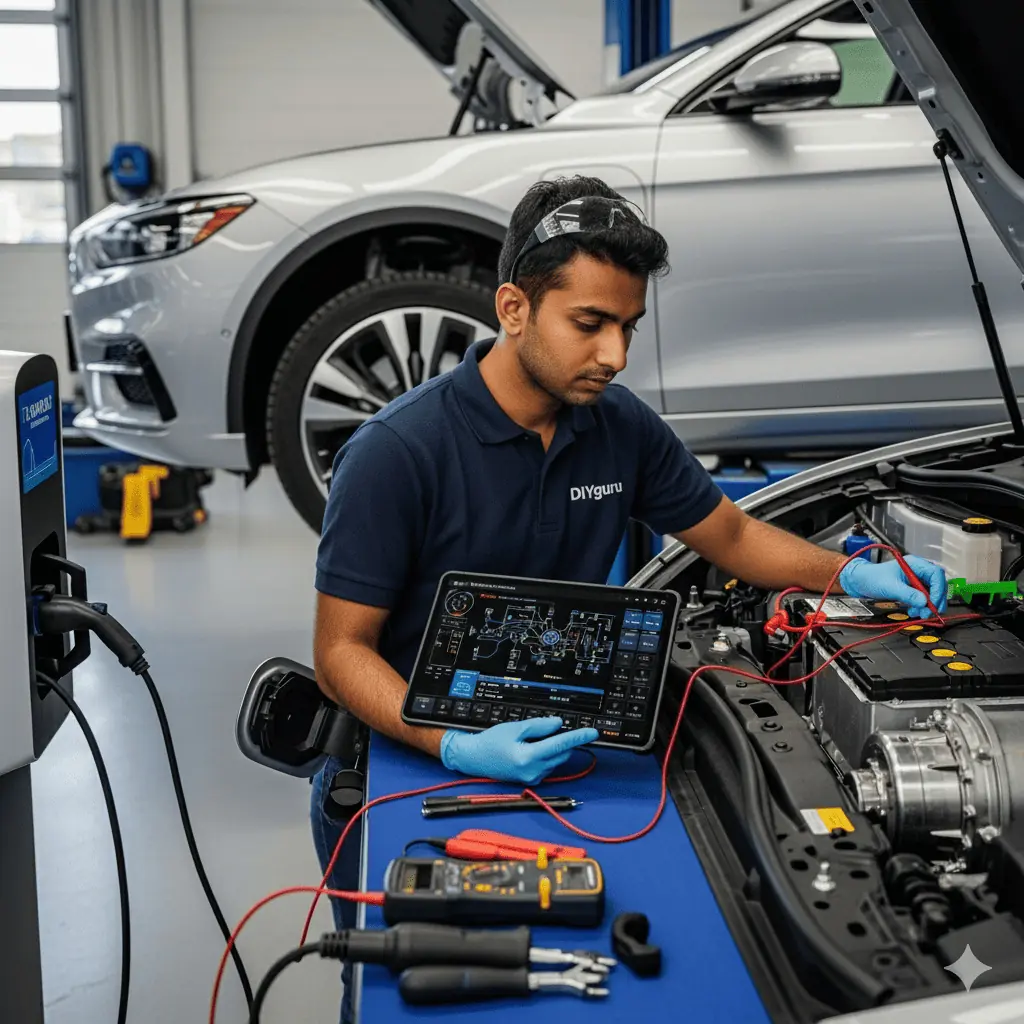
| Test equipment | CAT III multimeter, insulation resistance tester, clamp meter, battery and cell tester, CAN diagnostic adapter |
| Wiring | HV cable crimping tools, heat-shrink, torque wrenches, labelled connector kits |
| Storage | A separate, ventilated area for batteries, away from flammable materials |
Want hands-on practice before you open a workshop?DIYguru's COE labs include an EV retrofit lab alongside two-wheeler, harnessing, charging and diagnostics labs, in Delhi NCR, Pune, Bangalore and Bhubaneswar. Workshop owners who want to build an EV service business can also look at the ev.care service-centre franchise. See the hands-on EV labs →
Careers in EV conversion
EV retrofit technician
Removes the engine system, fits motors, batteries and wiring, and tests the vehicle safely.
EV service technician
Diagnoses and repairs converted and factory EVs: batteries, BMS, controllers, motors and chargers.
Kit design engineer
Designs mounting, packaging, weight distribution and cooling so a kit fits and performs on each model.
Homologation and testing engineer
Prepares kits and vehicles for AIS-123 type approval and works with test agencies.
Battery pack technician
Assembles, tests and maintains packs and BMS wiring for conversions.
Retrofit entrepreneur
Runs an authorised installation and service centre for owners and fleets.
Not sure which EV path fits your background? Get a free personalised roadmap with a learning timeline and companies hiring.
Try the free EV Career Path Advisor →EV retrofitting in India: interactive learning lab
Use these conceptual models to understand the battery and diagnostic behaviour behind a proposed conversion. A calculation is not kit approval, a safety assessment or a vehicle range guarantee. They are learning aids, not pack-building instructions or approved repair procedures. Real protection thresholds and test methods depend on the manufacturer, chemistry, temperature and hardware.
11. EV retrofitting in India: series/parallel simulator
Series count determines nominal voltage. Parallel count determines capacity when identical cells share current appropriately. Nominal energy is voltage × ampere-hours; usable energy is lower and varies with operating limits. This model does not calculate safe current, wiring, thermal design or charger compatibility.
Try doubling parallel count while keeping series count fixed. Capacity and energy double; nominal voltage stays the same. Change chemistry and observe why the same series count need not mean the same pack voltage.
12. BMS fault scenarios and evidence
This fictional 16-group NMC model demonstrates how protection can respond to different evidence. The example limits are not universal service limits. Actual systems may derate, latch a fault, require a reset or implement independent charge and discharge paths.
What the evidence says
Appropriate next step
Never use simulated values as permission to continue driving or charging a damaged battery. A missing reading is missing evidence, not a zero-volt measurement.
13. Guided diagnostic walkthroughs
Record the complaint, conditions, original codes, diagnostic evidence, repair and verification outcome. Do not clear fault history before saving it. A part replacement without a supporting test can hide an intermittent fault and add unnecessary cost.
14. Searchable EV retrofitting in India glossary
16 terms
BMS
Battery management system: monitors battery conditions and requests protection according to its configuration.
SOC
State of charge: an estimate of remaining charge, not a direct capacity measurement.
SOH
State of health: a model-dependent estimate of battery condition.
Series
Connecting cell groups in series adds voltage.
Parallel
Connecting matched cells in parallel adds charge capacity.
Voltage sag
A reduction in terminal voltage under load; resistance, temperature and SOC influence it.
Cell imbalance
A difference between cell-group readings; compare at matching conditions.
Contactor
An electrically controlled switch used to connect or disconnect a power circuit.
Precharge
A controlled process that limits inrush into capacitors before the main connection closes.
Interlock
A safety input that prevents operation in an unsafe or unready state.
DTC
Diagnostic trouble code: a manufacturer-defined clue requiring supporting evidence.
CAN
A communication network used by vehicle controllers.
Isolation
Separation from energy sources using the approved procedure, followed by required verification.
Insulation resistance
Resistance between circuits and accessible structures; a DMM continuity check does not certify it.
Ah
Ampere-hour: charge capacity.
Wh
Watt-hour: energy; nominal voltage multiplied by ampere-hours gives a nominal estimate.
Further learning and primary references
Explore DIYguru training programs and training locations. Read the HSE electric and hybrid vehicle repair guidance for general workshop hazards (UK guidance, not Indian regulation), and Texas Instruments BQ76952 documentation for an example of configurable battery monitoring and protection. Always use the actual vehicle’s service documentation for repair limits.
15. EV retrofitting in India: operating-cost comparison
Change the assumptions to compare fuel and electricity costs. Figures are your inputs, not a market quote or promise of savings. Charging losses are represented by efficiency; battery replacement, finance, taxes and resale value are excluded.
Formula: fuel cost = distance ÷ fuel economy × fuel price. Grid energy = distance × Wh/km ÷ 1000 ÷ charging efficiency. Simple payback = conversion cost ÷ monthly energy-cost savings.
Project walkthrough: choosing a conversion
1. Define the route and vehicle
Record payload, daily distance, gradients, parking and charging availability. Inspect the existing body and running gear before selecting a kit.
2. Confirm eligibility and kit coverage
Ask the registering authority and authorised installer for the approval pathway, current certificate, extensions and covered configuration. Resolve mismatches before paying.
3. Compare written proposals
Separate hardware, installation, tests, registration assistance, charging equipment, warranty and ongoing support. Compare like-for-like scope.
4. Validate and document handover
Obtain the required inspection and registration documentation, insurance update, operating instructions and service schedule. Record test results and warranty contacts.