To demonstrate how professionals across various domains have successfully navigated the shift from traditional automotive to electric mobility, this section presents realistic, India-focused case studies. These examples highlight the transition journey, challenges faced, reskilling investments, and career outcomes.
6.5.1 Case Study 1: ICE Design Engineer to EV Architect #
Professional Profile
- Name: Rajesh Kumar, 35
- Previous Role: Senior Automotive Design Engineer, Maruti Suzuki
- Current Role (2025): Senior EV Design Architect, Tata Motors
Transition Journey
- Challenges Faced
- Redundancy of ICE-focused design skills.
- Lack of exposure to battery integration, lightweight materials, and EV aerodynamics.
- Psychological barrier: fear of competing with younger engineers.
- Reskilling Path
- Enrolled in an M.Tech specialization module in EV Design (1-year, part-time).
- Completed certifications in CATIA & Siemens NX for EV-specific design.
- Participated in a Tata Motors-IIT Delhi collaboration workshop on EV architecture.
- Outcome
- Transitioned within 18 months.
- Salary jump: from ₹12 LPA to ₹18 LPA.
- Promoted as Lead EV Architect within 3 years, leading a team of 15 engineers.
Case Study 2: Mechanical Technician to EV Service Specialist #
Professional Profile
- Name: Priya Sharma, 28
- Previous Role: Automotive Service Technician, Independent Garage, Pune
- Current Role (2025): EV Diagnostics Expert, Ola Electric Fleet Operations
Transition Journey
- Challenges Faced
- Limited exposure to high-voltage systems.
- Fear of handling advanced EV electronics.
- Financial constraint for training investment.
- Reskilling Path
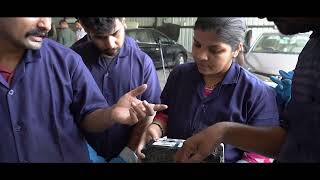
- Completed a Skill India Mission EV Service Program (subsidized).
- Specialized in High-Voltage Safety & Battery Diagnostics (6-month course).
- Hands-on workshops at ARAI Pune for live EV servicing.
- Outcome
- Entry role in Ola Electric at ₹4.8 LPA, double her previous income.
- Gained recognition for reducing fleet downtime through proactive diagnostics.
- Now mentoring 20 junior technicians under a fleet-wide EV service program.
Case Study 3: Software Engineer to EV AI Specialist #
Professional Profile
- Name: Ankit Verma, 30
- Previous Role: Embedded Systems Engineer, Infosys
- Current Role (2025): Senior EV AI & Connectivity Engineer, Bosch India
Transition Journey
- Challenges Faced
- Strong in coding but lacked exposure to mobility systems.
- Needed to understand integration of software with hardware (motors, sensors).
- Reskilling Path
- Enrolled in a Bosch-Skill India EV Software Fellowship.
- Specialized in IoT, vehicle connectivity protocols, and AI-based predictive maintenance.
- Worked on simulation projects in MATLAB and ROS (Robot Operating System).
- Outcome
- Salary increased from ₹9 LPA to ₹15 LPA.
- Contributed to Bosch’s predictive maintenance algorithm that reduced warranty claims by 20%.
- Positioned to move into autonomous driving systems within 2 years.
Case Study 4: Supply Chain Manager to EV Supply Chain Strategist
Professional Profile
- Name: Meera Iyer, 40
- Previous Role: Supply Chain Manager (ICE Components), Hero MotoCorp
- Current Role (2025): EV Supply Chain Strategy Head, Exide Energy
Transition Journey
- Challenges Faced
- Strong knowledge of ICE components but limited exposure to battery sourcing.
- Needed to understand global rare-earth supply risks.
- Had to overcome skepticism from peers about moving “too late” in career.
- Reskilling Path
- Pursued a Global Supply Chain Certification with specialization in EV components (IIM Bangalore + CIPS UK).
- Completed short courses on circular economy & sustainability.
- Built networks with global lithium and cobalt suppliers through industry events.
- Outcome
- Transitioned into Exide Energy with a 40% salary hike.
- Successfully negotiated localization of EV battery supply chains, reducing import dependency by 15%.
- Recognized as a thought leader in EV supply chain transformation.
Case Study 5: Academic Researcher to EV Industry Innovator
Professional Profile
- Name: Dr. Sameer Ali, 34
- Previous Role: Postdoctoral Researcher in Materials Science, IIT Bombay
- Current Role (2025): Battery Technology Specialist, Tata Chemicals
Transition Journey
- Challenges Faced
- Highly academic background with no direct industry exposure.
- Needed to adapt to fast-paced industrial R&D.
- Reskilling Path
- Transitioned via industry-academia collaboration project on solid-state batteries.
- Attended short-term certification on industrial battery safety & testing.
- Developed cross-functional collaboration skills with engineers and designers.
- Outcome
- Joined Tata Chemicals’ R&D division at ₹22 LPA.
- Co-authored 3 patents on high-performance solid-state cells.
- Became a bridge between academia and industry in EV battery innovation.
Key Lessons from Case Studies
- Reskilling pays off — professionals across age groups and experience levels achieved growth after structured upskilling.
- Diverse pathways exist — transitions are not limited to engineers; technicians, managers, and researchers also find opportunities.
- Government and corporate support reduces barriers — subsidies, workshops, and fellowships make EV training accessible.
- Mindset is critical — those who embraced learning, networking, and interdisciplinary collaboration thrived.
- Early movers gain higher rewards — professionals who transitioned by 2025-2026 are positioned to lead the market by 2030.
FAQs #
Q1. What does this chapter on case studies highlight?
This chapter showcases real India-focused case studies of professionals who successfully transitioned from traditional automotive roles to EV-related careers.
Q2. Why are these case studies important for EV professionals?
They provide practical insights into challenges, reskilling paths, and career outcomes, helping aspiring professionals map their own EV transition journey.
Q3. What are some common challenges faced during the transition to EV careers?
The most common challenges include redundancy of ICE-focused skills, lack of EV-specific exposure, psychological barriers, and financial constraints for training.
Q4. How did an ICE Design Engineer transition to an EV Architect?
By pursuing M.Tech specialization, EV-focused design certifications, and industry-academia workshops, enabling a successful role shift at Tata Motors.
Q5. Can technicians also transition into EV careers?
Yes, as seen in the case of Priya Sharma, who transitioned from an automotive service technician to an EV diagnostics expert at Ola Electric.
Q6. What role does software engineering play in EV careers?
Software engineers are crucial for EV AI, connectivity, and predictive maintenance, as demonstrated by Ankit Verma’s journey at Bosch India.
Q7. Are there opportunities in EV supply chain management?
Yes, supply chain professionals can pivot to roles focusing on EV components, rare-earth sourcing, and sustainability strategies, as shown by Meera Iyer’s case.
Q8. How can researchers move into the EV industry?
By collaborating with industry, gaining certifications in applied battery technology, and adapting to fast-paced industrial R&D, researchers like Dr. Sameer Ali successfully transitioned.
Q9. What were the salary growth outcomes for these professionals?
Case studies showed salary hikes ranging from 40% to over 80%, depending on reskilling depth and industry role.
Q10. What are the key lessons from these EV transition stories?
Structured reskilling, government/corporate support, mindset shift, and early adoption are the main success factors for thriving in EV careers.