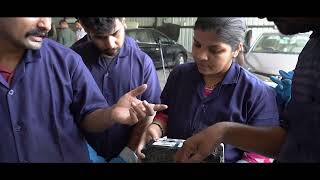
The educational landscape for electric vehicle (EV) careers in India has undergone a dramatic transformation between 2020 and 2025. Driven by strong policy support, industry demand, and global sustainability trends, India’s higher education system has begun aligning its engineering, management, and vocational programs with the requirements of the EV ecosystem.
Current Educational Ecosystem (2025) #
- Total Universities Offering EV Programs:42 (including IITs, NITs, private universities, and deemed institutions). Flagship examples: IIT Bombay, IIT Madras, IIT Delhi, VIT Vellore, PSG Tech, Anna University.
- Specialized EV Engineering Departments: 28, established within premier institutions as standalone EV-focused schools or advanced centers.
- Annual EV-Focused Graduates: Around 12,500 students, covering undergraduate, postgraduate, and diploma programs. This number is projected to rise to 35,000+ by 2030, reflecting both demand and policy-driven expansion.
- Investment in EV Education Infrastructure: Approximately ₹1,850 crore, channelled into laboratories, EV testing facilities, battery research centers, and simulation-based training hubs.
Comparative Global Context #
- China: Over 300 universities with EV/NEV (New Energy Vehicle) programs, producing nearly 100,000+ graduates annually.
- Europe: Specialized institutes like TU Delft (Netherlands), RWTH Aachen (Germany), and Politecnico di Torino (Italy) run advanced EV and battery research programs closely linked to automakers like Volkswagen, BMW, and Stellantis.
- United States: Universities such as MIT, Stanford, and Michigan integrate EV specializations into mechanical, electrical, and computer science streams, supported by collaborations with Tesla, GM, and Ford.
India is rapidly catching up, with its unique advantage being low-cost, high-quality technical education combined with a government-supported skill development ecosystem (Skill India, NSDC, ASDC).
Emerging Trends in 2025 #
- Interdisciplinary Programs: Universities are blurring traditional boundaries, integrating mechanical engineering, electronics, AI, and sustainability under unified EV curricula.
- Industry-Academia Collaboration: Institutions like IIT Madras (with Ola Electric) and IIT Delhi (with EV startups) are setting precedents for co-designed curriculum.
- Virtual Learning & Simulation Labs: Many universities have launched digital twins and AR/VR-based EV training for real-time problem-solving and reduced laboratory costs.
- Research Funding Push: DST (Department of Science and Technology) and MNRE (Ministry of New & Renewable Energy) have funded battery recycling projects, hydrogen fuel cell research, and solid-state battery pilot labs in universities.
- Private Sector Entry: Companies like Tata Motors, Mahindra Electric, Ola Electric, and Hyundai India are sponsoring EV research chairs, scholarships, and advanced testing infrastructure within academic institutions.
Outlook 2025-2030 #
The academic ecosystem in India is expected to triple its EV-focused graduate capacity by 2030, with strong emphasis on battery technology, autonomous mobility, AI-driven design, and sustainability. Moreover, with India’s commitment to net-zero emissions by 2070 and the government’s Production-Linked Incentive (PLI) scheme for Advanced Chemistry Cell batteries, academia will remain central to providing the talent pipeline that powers both domestic manufacturing and global EV supply chains.
FAQs #
Q1. How many universities in India offer EV-related programs in 2025?
As of 2025, 42 universities in India–including IITs, NITs, and private institutions–offer EV-focused programs at undergraduate, postgraduate, and diploma levels.
Q2. Which are the flagship institutions for EV education in India?
Leading institutions include IIT Bombay, IIT Madras, IIT Delhi, VIT Vellore, PSG Tech, and Anna University, all of which have developed advanced EV-focused curricula and research centers.
Q3. How many EV-focused graduates does India produce annually?
India currently produces around 12,500 EV-focused graduates per year, a number projected to rise to 35,000+ by 2030.
Q4. What kind of infrastructure investments are being made in EV education?
Over ₹1,850 crore has been invested in EV labs, testing facilities, battery research centers, and simulation-based training hubs across India.
Q5. How does India’s EV education compare globally?
- China: 300+ universities, 100,000+ graduates annually.
- Europe: Institutes like TU Delft and RWTH Aachen partner with automakers.
- USA: MIT, Stanford, and Michigan integrate EV tracks with industry tie-ups (Tesla, GM, Ford).
India is catching up rapidly, with the advantage of affordable, high-quality technical education.
Q6. What are the emerging trends in India’s EV education system?
Key trends include interdisciplinary programs, industry-academia collaborations, digital twin & AR/VR simulation labs, and research funding in batteries, recycling, and hydrogen fuel cells.
Q7. What role does the private sector play in EV education in India?
Companies like Tata Motors, Mahindra Electric, Ola Electric, and Hyundai India are sponsoring EV research chairs, scholarships, and advanced infrastructure in universities.
Q8. What is the outlook for EV education in India from 2025 to 2030?
The ecosystem is expected to triple graduate capacity by 2030, with a strong focus on battery technology, autonomous mobility, AI-driven design, and sustainability, supporting India’s net-zero 2070 goals and the PLI scheme for advanced batteries.