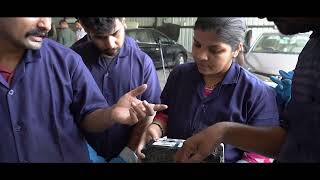
The global automotive industry is experiencing one of the most profound transformations since the invention of the internal combustion engine (ICE). This transformation is being driven by the convergence of sustainability goals, digital technologies, and changing consumer preferences. India, as the world’s third-largest automotive market, stands at the heart of this transition, balancing traditional ICE expertise with new opportunities in electric mobility.
Current Workforce Dynamics (2025) #
- Total Automotive Workforce (India, 2025): ~19 million professionals.
- Includes design engineers, manufacturing specialists, supply chain professionals, software experts, and service technicians.
- Dominant ICE Employment: Nearly 80% of the current workforce is directly or indirectly engaged in ICE-centric activities such as engine design, fuel systems, exhaust treatment, and maintenance.
- Emerging EV Workforce: As of 2025, around 150,000-180,000 professionals in India are employed in EV-related roles, concentrated in R&D, battery manufacturing, and charging infrastructure deployment.
EV-Specific Jobs Projected (by 2030) #
According to NITI Aayog and various industry reports:
- EV-related employment: ~500,000 direct jobs in engineering, R&D, battery production, manufacturing, and aftersales services.
- Indirect job creation: An additional 1.5-2 million opportunities in charging infrastructure, component supply chains, fleet services, and digital mobility solutions.
- Sectoral job distribution (by 2030):
- 35% in EV manufacturing (OEMs and component suppliers).
- 25% in battery manufacturing & recycling.
- 20% in software, electronics, and AI-driven vehicle systems.
- 10% in charging and grid infrastructure.
- 10% in aftersales, fleet, and mobility services.
Workforce Transition Rate #
- An estimated 35% of ICE professionals will need to reskill or transition into EV-specific domains.
- Traditional roles tied to engine design, combustion analysis, and exhaust after-treatment face the highest risk of obsolescence.
- Conversely, professionals with skills in electronics, automation, software, and mechatronics will experience a smoother transition.
Global Context #
- Europe: The EU’s 2035 ban on new ICE car sales has already triggered workforce transitions, with Germany expecting 400,000 jobs at risk in ICE segments, while new EV opportunities are expected to offset nearly 60% of this loss.
- China: Already employs over 1 million professionals in the EV ecosystem, making it the largest global EV employer.
- United States: Projected to add 250,000 EV jobs by 2030, driven by federal clean energy initiatives and Tesla-led ecosystem expansion.
Implications for India #
- Dual Transition Challenge: India must reskill its massive ICE workforce while simultaneously building EV-ready talent pools.
- Urban-Rural Divide: EV jobs are concentrated in industrial hubs like Pune, Chennai, Gurugram, and Bengaluru, creating geographic inequalities unless policies expand training across states.
Skill Evolution: The workforce must evolve from mechanical-heavy expertise to mechatronics and software-centric expertise, blending hardware knowledge with digital fluency.
FAQs #
Q1. Why is the automotive industry experiencing a major transformation?
The industry is shifting due to sustainability goals, digital technologies, and changing consumer demand for cleaner, smarter mobility solutions.
Q2. How many people are currently employed in India’s automotive workforce (2025)?
India’s automotive workforce in 2025 is around 19 million professionals, with nearly 80% still engaged in ICE-focused roles.
Q3. How many professionals are currently employed in EV-related jobs in India?
By 2025, about 150,000-180,000 professionals are working in EV domains such as R&D, battery manufacturing, and charging infrastructure.
Q4. What is the EV job projection for India by 2030?
India is expected to generate ~500,000 direct EV jobs and 1.5-2 million indirect jobs by 2030.
Q5. Which EV sectors will create the most jobs by 2030?
- 35% in EV manufacturing
- 25% in battery manufacturing & recycling
- 20% in software, electronics & AI
- 10% in charging & grid infrastructure
- 10% in aftersales & mobility services
Q6. What percentage of ICE professionals will need reskilling for EVs?
About 35% of ICE professionals must transition or reskill into EV-related domains.
Q7. Which ICE-related roles face the highest risk of obsolescence?
Roles linked to engine design, combustion analysis, and exhaust treatment are at the highest risk.
Q8. Which skill sets make workforce transition smoother?
Skills in electronics, automation, mechatronics, and software development will enable professionals to adapt faster to EV roles.
Q9. How does India’s EV workforce growth compare globally?
- China: Already employs over 1 million in EV sector.
- Europe: Facing ICE job losses but offset with EV jobs by 60%.
- US: Projecting 250,000 EV jobs by 2030.
Q10. What challenges does India face in the EV workforce transition?
India must overcome the dual challenge of reskilling ICE professionals and building EV-ready talent pools, while addressing the urban-rural divide in EV job concentration.