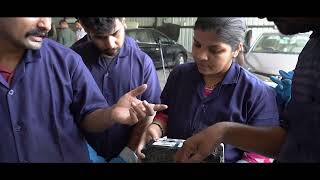
While degree programs and certifications create strong foundations for EV professionals, the true workforce backbone of the electric mobility ecosystem lies in vocational training. These programs are designed to equip technicians, service professionals, and mid-career workers with hands-on, job-ready skills that directly feed into EV manufacturing, repair, diagnostics, and infrastructure deployment.
The Indian Vocational Training Ecosystem #
Skill Development Ecosystem (2025 Snapshot) #
- 18 Skill India Centers specializing in EV manufacturing.
- 5 Centers of Excellence (CoEs) established through government-industry collaboration.
- 250+ vocational training institutes offering EV-specific short-term and diploma programs.
Training Program Categories #
- Short-Term Skill Enhancement Courses (3-6 months):
- EV Technician Fundamentals.
- High-Voltage Safety Basics.
- Charging Station Installation & Maintenance.
- Diploma in EV Technologies (1-2 years):
- Offered by select polytechnic institutes.
- Covers EV assembly, electrical systems, and diagnostics.
- Designed for ITI/diploma graduates.
- Advanced Diploma in Electric Mobility (18-24 months):
- Jointly run by universities & industry bodies.
- Includes modules on BMS, thermal management, and service operations.
- Professional Skill Upgradation Programs (Modular, Flexible):
- Designed for working professionals in ICE automotive.
- Covers conversion kits, retrofitting, and EV fleet management.
Government and Industry Partnerships #
- Ministry of Skill Development & Entrepreneurship (MSDE):
Funding support for EV skill centers under Skill India. - Automotive Skills Development Council (ASDC):
Framework for technician-level skill certification aligned with NSQF (National Skills Qualification Framework). - EV OEM Collaborations:
- Tata Motors: Vocational EV Service Training for dealer technicians.
- Mahindra Electric: Specialized training in EV drivetrain service.
- Ola Electric: Charging and battery swapping technician programs.
- Tata Motors: Vocational EV Service Training for dealer technicians.
Global Vocational Training Models #
=Germany (Dual Vocational Training System) #
Germany #
- Students split time between classroom learning and industry apprenticeships.
- EV-focused dual training now includes:
- EV Mechatronics.
- High-voltage safety certification.
- Battery repair and recycling skills.
- EV Mechatronics.
United States #
- Tesla START Program – 12-16 week intensive vocational training for EV service technicians.
- Community Colleges (California, Michigan): Short-term EV technology diplomas supported by local OEMs.
China #
- National Vocational Institutes offer battery pack assembly and recycling programs.
- BYD & CATL run in-house EV battery technician training centers.
Singapore #
- Nanyang Polytechnic offers a Specialist Diploma in EV Powertrain Systems under SkillsFuture Singapore.
Comparative Overview of Vocational Pathways #
| Region | Program Type | Duration | Focus Area | Career Outcome |
| India | Short-term Skill India EV courses | 3-6 months | Assembly, charging, service | Technician / Installer |
| India | Advanced Diploma in Electric Mobility | 18-24 months | BMS, powertrain, service | Supervisor / Lead Technician |
| Germany | Dual Vocational Training | 2-3 years | EV mechatronics, safety | Certified Mechatronics Specialist |
| USA | Tesla START Program | 3-4 months | Service and repair | EV Service Technician |
| China | Battery Assembly & Recycling Training | 6-12 months | Pack assembly, recycling | Battery Technician |
| Singapore | Specialist Diploma in EV Powertrain | 12 months | Powertrain & electronics | Senior Technician / Associate Engineer |
Key Takeaways #
- India’s focus: Mass skilling to meet technician demand (manufacturing + service).
- Germany’s model: Deep apprenticeships ensuring strong integration with industry.
- USA’s model: OEM-driven training (Tesla, GM, Ford) directly feeding into service centers.
- China’s model: Heavy emphasis on battery lifecycle management (manufacturing + recycling).
- Singapore’s model: Specialized, high-tech diplomas targeting small but skilled workforce.
FAQs #
Q1. Why is vocational training important in the EV sector?
Vocational training provides hands-on, job-ready skills for technicians, service professionals, and mid-career workers. It bridges the gap between classroom theory and real-world EV manufacturing, repair, and charging infrastructure needs.
Q2. What is the current state of EV vocational training in India (2025)?
- 18 Skill India Centers dedicated to EV manufacturing.
- 5 Centers of Excellence co-run by industry & government.
- 250+ institutes offering short-term, diploma, and advanced EV training programs.
Q3. What types of EV vocational training programs are offered in India?
- Short-Term Courses (3-6 months): EV Technician, High-Voltage Safety, Charging Station Maintenance.
- Diplomas (1-2 years): EV assembly, diagnostics, service training for ITI graduates.
- Advanced Diplomas (18-24 months): Focus on BMS, thermal management, and mobility service.
- Professional Skill Upgradation (Modular): Retrofitting, EV fleet management for ICE professionals.
Q4. Which government and industry bodies support EV vocational training in India?
- MSDE (Ministry of Skill Development & Entrepreneurship): Funding for EV skill centers.
- ASDC (Automotive Skills Development Council): Nationally aligned certifications.
- OEMs like Tata Motors, Mahindra, and Ola Electric: Custom programs for technicians, drivetrain service, and charging operations.
Q5. How does India’s EV vocational training compare globally?
- Germany: Dual vocational model (classroom + apprenticeship) in EV mechatronics, high-voltage safety.
- USA: Tesla START program + community colleges offering service-focused diplomas.
- China: Large-scale battery assembly & recycling training (BYD, CATL).
- Singapore: Specialist Diploma in EV Powertrain Systems (Nanyang Polytechnic).
Q6. What are the career outcomes from vocational EV training?
- India: Technician, installer, supervisor, service lead.
- Germany: Certified mechatronics specialist.
- USA: OEM-certified service technician.
- China: Battery assembly & recycling technician.
- Singapore: Senior technician or associate engineer.
Q7. What is the key takeaway from global EV vocational training models?
- India: Mass skilling for scale.
- Germany: Deep apprenticeships with OEM integration.
- USA: OEM-driven technician training (Tesla, GM, Ford).
- China: Battery lifecycle emphasis (manufacturing + recycling).
- Singapore: Specialized diplomas for high-tech workforce.