โšก UPDATES
PG in EV & Embedded Systems โ€” IIT Jammu (12 Months) Flagship M.Tech in EV Technology โ€” 24 Month Program Open DET Entrance Test โ€” Unlock Scholarship Up to โ‚น50,000 Scholarship 95,000+ Professionals Trained Nationwide Placement Drive โ€” 320+ Hndustry Partners ASDC & AICTE NEAT Certified Programs PG in EV & Embedded Systems โ€” IIT Jammu (12 Months) Flagship M.Tech in EV Technology โ€” 24 Month Program Open DET Entrance Test โ€” Unlock Scholarship Up to โ‚น50,000 Scholarship 95,000+ Professionals Trained Nationwide Placement Drive โ€” 320+ Hndustry Partners ASDC & AICTE NEAT Certified Programs
Accredited by
NEAT AICTE Ministry of Education ASDC
DIYguru
โšก Apply Now โ€” PG & Nanodegree Programs Open DET Entrance Test โ€” Get Scholarship up to โ‚น50,000
๐Ÿ“…
Bharat eMobility Recruitathon 2026 Delhi: Mar 21-23 | Pune: May 21-24

The DIYguru EV Master Guide

EV Guide: From curiosity
to capability.

EV guide for India: explore 13 detailed DIY guides on electric vehicle charging, motors, batteries, repair, running costs, careers and business. Each one comes with its own interactive calculator or planner.

Popular:
13in-depth guides
14free calculators & tools
120+questions answered
โ‚น0to read, no sign-up
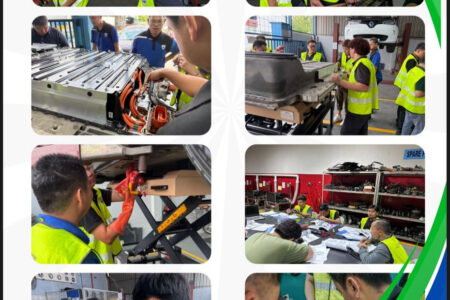
Practical electric vehicle powertrain training in a workshop
LEARN WITH CONTEXTReal systems.
Practical understanding.
Workshop photograph from DIYguru
Your learning workspaceTry the battery labEV Career ToolkitGet free counselling

Start here

Pick your path through the EV guides

Thirteen guides is a lot. Tell us who you are and we'll put the right ones in the right order.

Decide, charge and get the most range, without the jargon.

The library

All 13 DIY guides to electric vehicles

Every guide is free, written for India and built around a hands-on tool you can use straight away.

Showing all 13 guides

Trainees learning on an EV charger (EVSE) trainer at a DIYguru lab01
EV technologyOwning an EVBeginner

EV Charging

How charging really works in India, from a 15 A socket to a 60 kW highway charger.

  • AC vs DC, and the Type 2, CCS2, LECCS and Type 6 connectors
  • Charging time and cost, with worked examples
  • Setting up a home charger, step by step

Free tool insideEV Charging Time & Cost Calculator

Read the guide

DIYguru trainee holding an electric scooter hub motor during hands-on training02
EV technologyIntermediate

EV Motors

The motor types used in Indian EVs, how to read a spec sheet and how to size one.

  • BLDC vs PMSM vs induction motors
  • Hub motor vs mid-drive
  • Reading spec sheets and sizing a motor

Free tool insideEV Motor Sizing Calculator

Read the guide

EV wiring and motor controller trainer board at a DIYguru lab03
EV technologyService & repairIntermediate

Motor Controllers

The box between battery and motor: PWM, wiring, error codes and how to test one.

  • PWM and the three-phase bridge
  • Every connector, plus an error-code lookup
  • Testing with a multimeter and sizing a controller

Free tool insideController Error Code Lookup & Sizing Tool

Read the guide

E-rickshaw and electric vehicles in a DIYguru EV training lab04
Service & repairOwning an EVBeginner

E-Rickshaws

India's biggest EV segment: batteries, rules, earnings and upkeep. Includes a Hindi section.

  • Lead-acid vs lithium, and converting safely
  • Licence, registration, permits and subsidy
  • Running cost, earnings and maintenance

Free tool insideLead-Acid โ†’ Lithium Savings Calculator

Read the guide

Students assembling and testing an EV battery pack at DIYguru05
EV technologyAdvanced

Battery Management Systems

The electronics that keep a lithium pack safe: estimation, balancing, protection and safety standards.

  • SoC, SoH and SoP estimation
  • Active vs passive cell balancing
  • Protection, CAN communication and ISO 26262

Free tool insideBMS Selector & Balancing-Time Calculator

Read the guide

Open motor bay of an electric car during DIYguru 4-wheeler training06
EV technologyOwning an EVAdvanced

Powertrain & Range

Where an EVโ€™s energy goes, why EVs have one gear, and how to estimate real-world range.

  • Powertrain layouts and gear ratios
  • The road-load equation and drive cycles (MIDC)
  • Estimating range and sizing a powertrain

Free tool insideEV Range Estimator & Powertrain Sizer

Read the guide

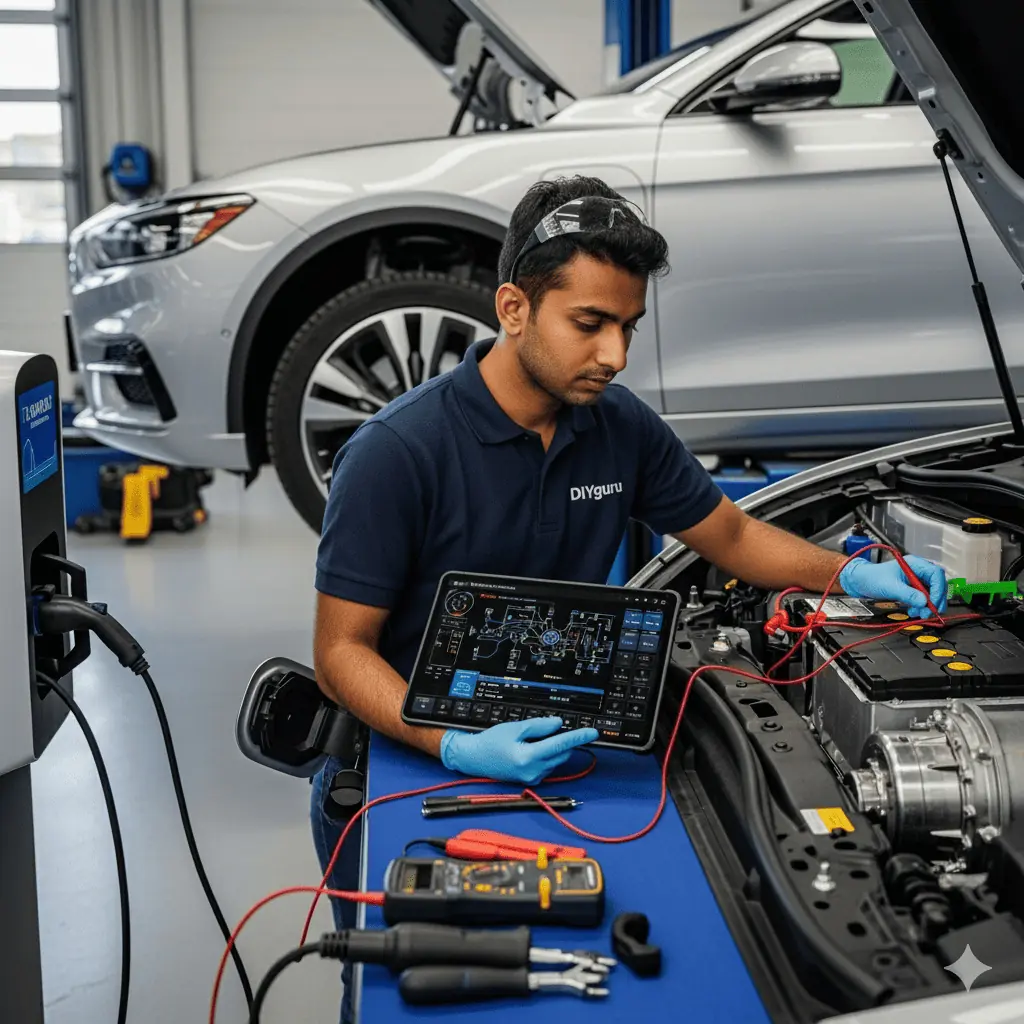
Trainee running an OBD diagnostic scan on a car at DIYguru07
Service & repairBeginner

EV Service & Diagnostics

A workshop-ready method for diagnosing electric scooters, e-rickshaws and e-autos safely.

  • High-voltage safety, the non-negotiables
  • Multimeter tests and reading BMS data
  • Common 2W/3W faults and a maintenance schedule

Free tool insideEV Fault Finder: Symptom โ†’ Likely Cause

Read the guide

Car being worked on at the DIYguru Pune 4-wheeler hands-on workshop08
Service & repairOwning an EVIntermediate

EV Retrofitting

Converting petrol and diesel vehicles to electric legally: approvals, kits, costs and payback.

  • The rules: AIS-123, type approval and RTO endorsement
  • Costs and feasibility by vehicle type
  • Checking an approved kit, and the conversion steps

Free tool insideEV Conversion Feasibility & Cost Estimator

Read the guide

A customer examining an electric vehicle charging connection09
Owning an EVBeginner

EV vs Petrol Cost

What owning an EV really costs against petrol or CNG, once tax, fuel, service and resale are in.

  • Total cost of ownership, layer by layer
  • GST, road tax and subsidies to verify
  • When petrol, CNG or a hybrid still makes sense

Free tool insideEV vs Petrol Total Cost Calculator

Read the guide

Hands-on training on an electric vehicle powertrain in a workshop10
Careers & businessBeginner

EV Careers

The EV roles hiring now, what they pay, and how to get in after 12th, ITI, diploma or a degree.

  • Roles and salaries by track and city
  • EV jobs after ITI, diploma or 12th
  • Switching in from automotive or IT

Free tool insideEV Career Path Finder

Read the guide

EV training and workshop activities featured by DIYguru11
Careers & businessIntermediate

EV Business

Compare EV business models, see what each costs to start, and check the numbers before you invest.

  • Charging station, service centre, dealership or swapping
  • Set-up costs, earnings and site selection
  • Licences, compliance and funding

Free tool insideEV Business ROI Calculator

Read the guide

Workbench with EV motor and battery components at a DIYguru lab12
Careers & businessEV technologyIntermediate

Battery Recycling

What happens to EV batteries after the vehicle: second life, recycling, EPR and Battery Aadhaar.

  • Second-life uses before recycling
  • How lithium-ion recycling works
  • EPR under the 2022 rules, and Battery Aadhaar (BPAN)

Free tool insideBattery Reuse-or-Recycle & EPR Tool

Read the guide

Trainees at an EV charging panel during DIYguru training13
Owning an EVCareers & businessBeginner

Society EV Charging

Turn society parking into a fair, safe charging network: permissions, chargers, load and billing.

  • Resident demand, permissions and ownership models
  • Matching charger speed to parking time
  • Load management, billing and safety

Free tool insideSociety Charging Planner

Read the guide

Not sure which guide fits you?

Tell a DIYguru counsellor what you want to do with EVs: buy, repair, build, work or start a business. We'll point you to the right guides and the right course.

Pick a learning path

No guide matches that search.

EV in 60 seconds

13 quick answers, one from each guide

The single most useful fact from every guide. Open any card for the full explanation, worked examples and the tool.

01EV Charging

Charging time โ‰ˆ energy needed (kWh) รท charger power (kW). A 45 kWh car going from 20% to 80% takes about 4 hours on a 7.2 kW home charger, or about 35 minutes on a 50โ€“60 kW DC charger.

Read the full guide โ†’
02EV Motors

Most EVs use permanent-magnet motors. A BLDC motor runs on simple six-step control; a PMSM uses smooth sinusoidal control (FOC), which is quieter and more efficient. Induction motors need no magnets.

Read the full guide โ†’
03Motor Controllers

A controller switches six power transistors thousands of times a second to feed the motor three-phase current. Sine-wave (FOC) controllers are smoother, quieter and more efficient than square-wave ones.

Read the full guide โ†’
04E-Rickshaws

An e-rickshaw is limited to 25 km/h. For one running 80โ€“100 km a day, a 51.2 V lithium (LFP) pack usually pays back over lead-acid in about 1.5โ€“2 years.

Read the full guide โ†’
05Battery Management Systems

A BMS measures every cell, estimates state of charge and health, balances cells and opens the contactors when limits are crossed. In India, L-category battery packs must also meet AIS-156.

Read the full guide โ†’
06Powertrain & Range

Range = usable battery energy รท energy used per km. Real-world range in India is typically 20โ€“30% lower than the MIDC-certified figure.

Read the full guide โ†’
07EV Service & Diagnostics

Diagnose in a fixed order: make it safe, check the simple things, then test battery โ†’ fuse โ†’ controller supply โ†’ throttle and Hall signals โ†’ motor phases โ†’ charger.

Read the full guide โ†’
08EV Retrofitting

Retrofitting is legal only with a type-approved kit (AIS-123, tested by ARAI or ICAT) fitted by an authorised installer and endorsed by the RTO. Typical cost: โ‚น40,000โ€“65,000 for a scooter, โ‚น1โ€“2 lakh for a three-wheeler, โ‚น4โ€“6 lakh for a small car.

Read the full guide โ†’
09EV vs Petrol Cost

Charged at home, an EVโ€™s energy cost per km is about one-fifth to one-eighth of petrolโ€™s, servicing costs less, and GST on EVs is 5%.

Read the full guide โ†’
10EV Careers

The fastest-growing EV roles are in battery & BMS, power electronics and embedded software. EV technicians typically start at around โ‚น15,000โ€“30,000 a month.

Read the full guide โ†’
11EV Business

A single 30โ€“60 kW DC charging station costs about โ‚น12โ€“30 lakh. Charging is de-licensed: anyone can set up a station that meets the standards, and charger use per day decides profit.

Read the full guide โ†’
12Battery Recycling

An EV battery usually leaves the vehicle at 70โ€“80% of its original capacity, can serve a second life in storage down to about 60%, and is then recycled. Producers carry EPR under the Battery Waste Management Rules, 2022.

Read the full guide โ†’
13Society EV Charging

With load management, one shared supply serves many bays: 20 kW shared across four cars gives each about 5 kW, plenty for an overnight top-up.

Read the full guide โ†’

Free tools

14 free EV calculators and planners

Skip straight to the tool. Each one opens inside its guide, with the explanation right around it.

How it all connects

Follow the energy through an electric vehicle

Each part of an EV has its own guide. Start at the plug and follow the power to the wheels.

Charging

Getting energy in, at home, in societies and on highways.

Battery & BMS

Storing energy safely, and giving old batteries a second life.

Controller

Turning battery power into precisely timed motor current.

Motor

Converting electrical energy into torque.

Powertrain & range

Gearing, road load and how far you really go.

Around the vehicle: from buying it to recycling it

01 / See the system

EV guide to energy in motion

Switch between driving, regeneration and standstill. Follow the energy path before opening the detailed guides.

ENERGY EXPLORER / Try a drive mode

BatteryInverterMotorConceptual energy flow โ€ข not a wiring diagram

During driving, battery DC supplies the inverter, which controls AC power to the traction motor.

02 / Change one variable

Explore the EV guide experiment bench

Each diagram responds to your input. Read the observation, then connect it to a real engineering decision.

CHARGING / ENERGY

Where does AC become DC?

AC supplyOnboardchargerBattery DCSimplified conversion path

AC charging uses the vehicleโ€™s onboard charger to convert incoming AC into DC for the battery.

2.9 hoursIdeal energy รท power estimate

Average power here means power reaching the battery. Nameplate power is not sustained throughout a session. Temperature, tapering and vehicle limits change the result.

MOTOR / MECHANICAL OUTPUT

Speed and torque work together

Conceptual rotor speed, not a motor-design model

12.6 kWCalculated mechanical power

Power = torque ร— angular speed. Electrical input is higher when losses are included. Real motors have torque, speed, voltage and thermal limits; the sliders do not describe an operating envelope.

Walkthrough: why does a larger battery not always charge faster?

1. Define the energy gap. A larger usable capacity can require more energy for the same percentage increase in charge.

2. Find the limiting power. The charger, vehicle conversion hardware, battery and thermal conditions all influence the actual rate.

3. Compare equivalent conditions. Use the same starting state of charge and effective average power. In the calculator, doubling energy while holding power steady doubles the ideal time.

4. Check the real curve. Use the vehicleโ€™s charging data to account for tapering. The calculator is a learning tool, not a charging-time promise.

Check your understanding

At the same effective charging power, what happens when the energy needed doubles?

Select an answer to see the reasoning.

Technical reference: US Department of Energy: electric vehicle components and onboard charging.

EV guide learning lab: understand by experimenting

Change the series and parallel counts, observe protection scenarios, and follow diagnostic reasoning. These simplified educational models do not specify a real battery design or replace manufacturer service procedures. Chapter progress is saved in this browser when storage is available.

EV service and diagnostics: interactive learning lab

Use these conceptual models to connect symptoms with evidence. They are learning aids, not pack-building instructions or approved repair procedures. Real protection thresholds and test methods depend on the manufacturer, chemistry, temperature and hardware.

Your chapter progress

Progress is stored on this browser when available.

ComplaintRecorded dataHypothesisVerification
Moving dashes illustrate the reasoning sequence, not electrical current.

01 / EV guide: series and parallel simulator

Series count determines nominal voltage. Parallel count determines capacity when identical cells share current appropriately. Nominal energy is voltage ร— ampere-hours; usable energy is lower and varies with operating limits. This model does not calculate safe current, wiring, thermal design or charger compatibility.

Try doubling parallel count while keeping series count fixed. Capacity and energy double; nominal voltage stays the same. Change chemistry and observe why the same series count need not mean the same pack voltage.

02 / BMS fault scenarios

This fictional 16-group NMC model demonstrates how protection can respond to different evidence. The example limits are not universal service limits. Actual systems may derate, latch a fault, require a reset or implement independent charge and discharge paths.

What the evidence says

Appropriate next step

Never use simulated values as permission to continue driving or charging a damaged battery. A missing reading is missing evidence, not a zero-volt measurement.

03 / Guided diagnostic walkthroughs

Record the complaint, conditions, original codes, diagnostic evidence, repair and verification outcome. Do not clear fault history before saving it. A part replacement without a supporting test can hide an intermittent fault and add unnecessary cost.

04 / Searchable EV glossary

16 terms

BMS

Battery management system: monitors battery conditions and requests protection according to its configuration.

SOC

State of charge: an estimate of remaining charge, not a direct capacity measurement.

SOH

State of health: a model-dependent estimate of battery condition.

Series

Connecting cell groups in series adds voltage.

Parallel

Connecting matched cells in parallel adds charge capacity.

Voltage sag

A reduction in terminal voltage under load; resistance, temperature and SOC influence it.

Cell imbalance

A difference between cell-group readings; compare at matching conditions.

Contactor

An electrically controlled switch used to connect or disconnect a power circuit.

Precharge

A controlled process that limits inrush into capacitors before the main connection closes.

Interlock

A safety input that prevents operation in an unsafe or unready state.

DTC

Diagnostic trouble code: a manufacturer-defined clue requiring supporting evidence.

CAN

A communication network used by vehicle controllers.

Isolation

Separation from energy sources using the approved procedure, followed by required verification.

Insulation resistance

Resistance between circuits and accessible structures; a DMM continuity check does not certify it.

Ah

Ampere-hour: charge capacity.

Wh

Watt-hour: energy; nominal voltage multiplied by ampere-hours gives a nominal estimate.

Further learning and primary references

Explore DIYguru training programs and training locations. Read the HSE electric and hybrid vehicle repair guidance for general workshop hazards (UK guidance, not Indian regulation), and Texas Instruments BQ76952 documentation for an example of configurable battery monitoring and protection. Always use the actual vehicleโ€™s service documentation for repair limits.

Continue with trusted technical resources

For additional background, explore the US Department of Energy electric vehicle basics and Texas Instruments battery management system resources. For training guidance, visit the DIYguru EV Career Toolkit.

FAQ

EV guide questions, answered

Quick answers about the guides, plus the questions people ask most across all 13 of them.

What is the DIYguru EV Master Guide?

It is the starting point for DIYguruโ€™s series of 13 free, in-depth DIY guides on electric vehicles in India. It covers charging, motors, controllers, batteries and BMS, powertrain and range, service and diagnostics, e-rickshaws, retrofitting, running costs, careers, business, battery recycling and charging in housing societies. Each guide has its own interactive calculator or planner.

Are the EV guides free?

Yes. All 13 guides and their tools are free to read and use, with no sign-up. Some tools let you download a detailed report by entering your email, which is optional.

Which EV guide should I read first?

It depends on your goal. Owners usually start with EV vs Petrol Cost and EV Charging. Mechanics start with EV Service & Diagnostics. Engineering students start with EV Motors. Job seekers start with EV Careers, and entrepreneurs with EV Business. The learning paths on this page put each set in order.

Are these guides written for India?

Yes. They use Indian connectors (Type 2, CCS2, LECCS and Type 6), Indian rules such as AIS-156, AIS-123, CMVR Rule 115D, the Battery Waste Management Rules 2022 and PM E-DRIVE, and costs in rupees. Always confirm subsidies and rules with the official notification before you act.

How long does it take to charge an electric car in India?

Roughly the energy needed divided by the chargerโ€™s power. A 45 kWh car charging from 20% to 80% needs about 27 kWh: around 4 hours on a 7.2 kW home charger or about 35 minutes on a 50โ€“60 kW DC fast charger.

Is an electric vehicle cheaper than petrol in India?

For most people who ride or drive every day, yes. Charged at home, an EVโ€™s energy cost per km is about one-fifth to one-eighth of petrolโ€™s, servicing costs less and GST is 5%. A petrol vehicle can still be cheaper if you drive very little. The EV vs Petrol guide has a calculator for your own numbers.

Is EV retrofitting legal in India?

Yes, but only with a kit type-approved for your specific vehicle model under AIS-123, fitted by the kit maker or its authorised installer, and endorsed by the RTO on the registration certificate. A home-made conversion cannot be registered.

Can a petrol bike mechanic learn to repair electric scooters?

Yes. Much of the mechanical work carries over. The new skills are high-voltage safety, multimeter testing, reading BMS data and diagnosing controllers, motors and chargers. The EV Service & Diagnostics guide covers these, and DIYguruโ€™s hands-on courses add practice on real vehicles.

How much does it cost to open an EV charging station in India?

A single 30โ€“60 kW DC fast-charging station typically costs about โ‚น12โ€“30 lakh, depending on the charger, the electrical connection and site work. Charging is de-licensed, so anyone can set up a station that meets the standards. The EV Business guide has an ROI calculator.

What happens to EV batteries at the end of their life?

Batteries usually leave the vehicle at 70โ€“80% of their original capacity. Healthy packs can have a second life in stationary storage, then are recycled to recover lithium, nickel, cobalt and other materials. Producers are responsible for collection and recycling under Indiaโ€™s EPR rules.

Do I get a certificate for reading the guides?

The guides are free learning resources and do not carry a certificate. To earn one, you can take DIYguruโ€™s free EV certification courses online, or a certified programme such as CEVT (ASDC and AICTE NEAT certified).

Is any guide available in Hindi?

The E-Rickshaw guide includes a section in Hindi on choosing between lead-acid and lithium batteries. You can also call or WhatsApp DIYguru on +91 99109 18719 for guidance in Hindi.

Free counselling

Read the guides. Then build your EV future.

Whether you want a job, a skill, a business or just the right EV, a DIYguru counsellor will help you plan the next step.

  • Free, no-obligation call within 24 hours
  • Course and career advice based on your background
  • Guidance on EV business and society charging
  • Placement support through emobility.careers

Prefer to call? +91 99109 18719 ยท [email protected]

Get free counselling

An advisor will call you within 24 hours.

๐Ÿ”’ Your details go only to DIYguru. No spam.

All guides